

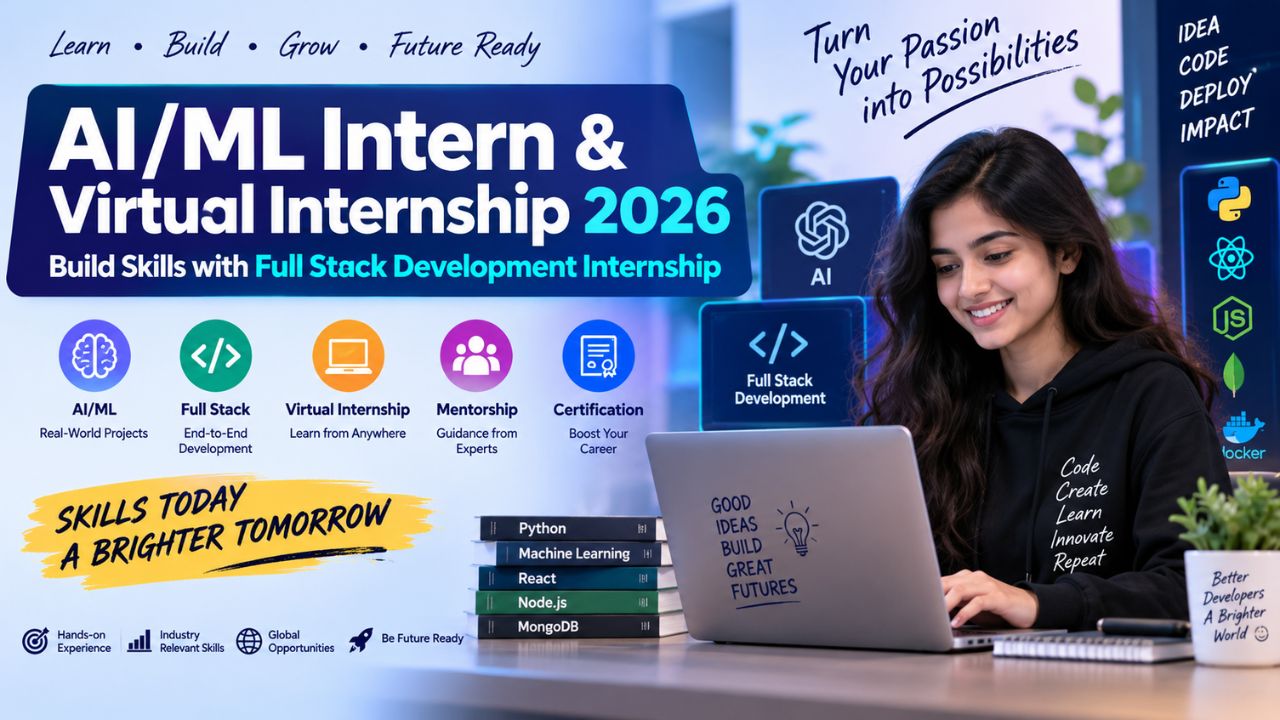
AI/ML Intern & Virtual Internship 2026: Build Skills with Full Stack Development Internship
Finding an AI/ML intern opportunity in 2026 is not just about adding another certificate to your resume. Students and freshers increasingly need practical skills, projects, and a portfolio that show what they can actually build. A structured virtual internship can help learners gain practical exposure without being limited by location, while a full-stack development internship is useful for students who want to learn how complete web applications are developed.
StuIntern provides technology-focused internship programs built around practical learning, projects, mentorship, and career preparation. This guide explains how AI/ML and full-stack internships work, what students can learn, and how to choose the right path.
Table of Contents
- What Is an AI/ML Internship Program?
- Why Do Students Need an AI/ML Internship?
- AI/ML Internship Topics and Skills
- What Is a Virtual Internship?
- Benefits of a Virtual Internship
- Full Stack Development Internship in 2026
- AI/ML vs Full Stack Development Internship
- Step-by-Step Internship Process
- Common Mistakes Students Should Avoid
- Why Choose StuIntern?
- FAQs
- Conclusion
What Is an AI/ML Intern Program?
An AI/ML intern program allows students to apply Artificial Intelligence and Machine Learning concepts to practical tasks and projects.
Instead of learning algorithms only from books or recorded tutorials, students can work with programming, datasets, model development,t and AI applications.
StuIntern’s current AI/ML internship curriculum includes areas such as Python, NumPy, Pandas, machine learning, deep learning, NLP, generative AI, prompt engineering, computer vision, and capstone project work.
A typical learning path can include:
- Python programming
- NumPy and Pandas
- Data processing
- Regression and classification
- Clustering
- Machine learning models
- Neural networks
- TensorFlow or PyTorch
- Natural Language Processing
- Generative AI fundamentals
- Prompt engineering
- Computer vision
- Capstone projects
This practical approach can help a student move from “I have studied machine learning” to “I have built and can explain a machine-learning project.”
Why Do Students Need an AI/ML Internship?
Artificial intelligence is a technical field where theoretical knowledge alone may not be enough to demonstrate practical ability.
Suppose a B.Tech, BCA, MCA, or computer science student understands regression and classification. That is useful academically, but during a technical interview, the student may also need to explain:
- How the dataset was prepared
- Why a particular algorithm was selected
- How the model was trained
- How performance was evaluated
- What problems occurred
- How the final solution could be improved
An AI/ML internship provides a structured environment in which students can practise these skills.
From Theory to Practical Skills
| Academic Learning | Internship-Based Learning |
| Learn Python syntax | Use Python in a project |
| Study ML algorithms | Train and evaluate models |
| Learn neural networks | Experiment with deep-learning models |
| Read about NLP | Develop an NLP-based application |
| Study AI concepts | Build a portfolio-ready project |
The goal should not be collecting certificates. The stronger outcome is having skills and projects that you can confidently explain.
AI/ML Internship Topics and Skills in 2026
Students looking for an AI/ML internship opportunity should evaluate the actual curriculum before enrolling.
1. Python Programming
Python remains an important foundation for AI and machine-learning work. Students should understand programming basics along with commonly used libraries.
2. Data Processing
Real-world data is rarely perfectly clean. Learning how to prepare, transform, and analyse datasets is therefore an important practical skill.
3. Machine Learning
Students can explore concepts such as:
- Regression
- Classification
- Clustering
- Model evaluation
- Feature preparation
4. Deep Learning
A more advanced internship may introduce neural networks and frameworks such as TensorFlow or PyTorch.
5. NLP and Generative AI
With modern AI applications, understanding Natural Language Processing and generative AI can broaden a student’s project possibilities.
6. Capstone Project
The final project is especially valuable because it allows students to combine multiple skills into one demonstrable piece of work.
Suggested internal link: AI/ML Internship
/internship-in-ai-ml
What Is a Virtual Internship?
A virtual internship is an internship experience that students can participate in remotely using online tools, sessions, assignments,s and project collaboration.
For college students, this format can be useful because they may not have to relocate or regularly travel to an office.
A good virtual program should still provide structure. Students should check for:
- Mentor-led sessions
- Practical assignments
- Projects
- Feedback
- Clear curriculum
- Flexible learning
- Internship certification
- Career preparation
StuIntern currently presents its internship programs as flexible, project-oriented learning options across fields such as AI, Data Science & Analytics, Full-Stack Development, and Digital Marketing.
Benefits of a Virtual Internship for Students
Flexible Learning
Students can often manage their internship alongside college classes, exams, or other academic responsibilities.
Location Independence
A student does not necessarily need to move to another city simply to access a relevant learning opportunity.
Practical Project Experience
A well-designed virtual internship should involve more than watching videos. Projects and practical assignments help students apply their knowledge.
Portfolio Development
Technical projects can be documented on a resume, portfolio, or GitHub profile where appropriate.
Mentor Support
Guidance from experienced mentors can help students understand difficult concepts and identify mistakes faster.
Career Preparation
Resume preparation and mock interviews can complement technical learning and help students explain their projects more effectively.
Full Stack Development Internship in 2026
A full stack development internship is designed for students who want to understand both the frontend and backend sides of application development.
For example, StuIntern currently lists a MERN Stack internship covering MongoDB, Express.js, React, and Node.js, along with areas such as APIs, authentication, database integration, deployment, and capstone development.
Frontend Development
Students may work with technologies such as:
- HTML
- CSS
- JavaScript
- React
- Next.js
Frontend development focuses on what users see and interact with.
Backend Development
Backend learning can involve:
- Node.js
- Express.js
- APIs
- Authentication
- Server-side logic
Database Development
A full-stack application also needs to store and retrieve data.
Students may therefore learn database concepts using technologies such as MongoDB.
Deployment
Building an application locally is only one stage. Understanding how an application can be prepared and deployed gives students a broader view of the development lifecycle.
Suggested internal link: MERN Full Stack Development Internship
/internship-in-full-stack-development-mern
AI/ML Intern vs Full Stack Development Internship
Students sometimes get confused about which technology path to choose. The decision should depend on the type of problems they enjoy solving.
| Factor | AI/ML Internship | Full Stack Development Internship |
| Main Focus | AI models & intelligent systems | Web applications |
| Core Language | Python | JavaScript / Python / Java |
| Data Work | High | Moderate |
| Frontend | Usually limited | Major component |
| Machine Learning | Core skill | Usually optional |
| Database | Useful | Core skill |
| Typical Project | Prediction/NLP model | Full web application |
| Best For | AI & ML aspirants | Software/web developers |
Choose an AI/ML intern path if you enjoy data, algorithms, intelligent systems, and model building.
Choose a full-stack development internship if you enjoy websites, software applications, frontend interfaces, APIs, and databases.
Students interested in both can eventually combine them—for example, by creating a full-stack web application that integrates an AI model through an API.
Step-by-Step Process to Start Your Internship
Step 1: Decide Your Career Direction
Do not select an internship simply because a technology is trending.
Ask yourself what you actually want to build.
For example:
AI/ML: prediction systems, NLP applications, or AI tools.
Full Stack: websites, dashboards, e-commerce platforms,s or web applications.
Step 2: Check Your Fundamentals
Before starting an advanced internship, understand the basics of your chosen field.
For AI/ML, start with Python and basic data concepts.
For full-stack development, programming and web-development fundamentals are helpful.
Step 3: Review the Curriculum
Check what the internship actually teaches.
Look for practical technologies rather than an overly generic syllabus.
Step 4: Check the Project Component
Projects should be one of your biggest selection criteria.
StuIntern’s project section currently includes examples such as an AI-powered blog platform, an e-learning management system, em and other application-development projects.
Suggested internal link: Internship Projects
/projects
Step 5: Participate Actively
Do not treat your internship like another recorded course.
Attend sessions, complete assignments, ask questions, and work through errors yourself.
Step 6: Complete Your Project
Document:
- Project objective
- Technology stack
- Your role
- Problems encountered
- Solution implemented
- Outcome
Step 7: Build Your Portfolio
Present your strongest projects clearly.
For software projects, GitHub can be useful when the project can appropriately be shared publicly.
Step 8: Prepare for Interviews
Practise explaining your project without memorising answers.
Interviewers may ask why you selected a particular technology or approach, not just whether you completed an internship.
Common Mistakes Students Make When Choosing an Internship
Choosing Only for the Certificate
An internship with a certificate can add evidence of completion, but the certificate should not be the only reason for joining.
Focus on:
Skills + Projects + Mentorship + Portfolio + Certificate
Joining Without Checking the Curriculum
Always review what technologies and concepts are actually included.
Copying Projects
Copying a ready-made project reduces its learning value.
Build enough of the project yourself that you can explain every major component.
Learning Too Many Technologies at Once
You do not need to master AI, data science, cloud, cybersecurity, and full-stack development simultaneously.
Pick one direction and develop depth.
Ignoring Your Portfolio
Completing an internship without documenting your projects wastes part of its potential value.
Depending Entirely on AI Tools
AI coding tools can help with learning and debugging, but students should understand the code and verify generated outputs rather than blindly copying them.
Why Choose StuIntern for Virtual Internships?
StuIntern currently offers virtual internship programs across technology and career-focused areas.
Its current website highlights features including:
- Mentor-led learning
- Practical and industry-oriented projects
- Flexible internship formats
- Internship certificates
- AI resume-building support
- Mock interviews
- Technology-focused internship programs
Students can currently explore programs including Artificial Intelligence, Data Science & Analytics, Full-Stack Development, Digital Marketing, HR & People Analytics, and cloud-related learning.
For an AI/ML intern, StuIntern’s dedicated AI/ML program includes machine learning, deep learning, NLP, generative AI, and capstone work.
For aspiring developers, StuIntern offers full-stack options including MERN, Python, and Java-focused development paths.
The most important point is to choose the internship that matches your own career direction rather than selecting a program only because it is popular.
Recommended Internal Links
AI/ML Internship:
/internship-in-ai-ml
MERN Full Stack Internship:
/internship-in-full-stack-development-mern
Python Full Stack Internship:
/internship-in-full-stack-development-python
Internship Projects:
/projects
Homepage:
/
Frequently Asked Questions
1. What does an AI/ML intern do?
An AI/ML intern typically learns how to work with data, Python, machine-learning algorithms, and AI applications. Depending on the program, students may also work on deep learning, NLP, generative AI, and practical projects.
2. Is a virtual internship useful for college students?
Yes, a structured virtual internship can be useful when it provides practical assignments, projects, mentorship,p and feedback. Students should evaluate the quality of the experience rather than judging it only by whether it is online or offline.
3. Who can apply for an AI/ML internship?
Students and freshers interested in artificial intelligence, machine learning, Python, and data-driven technologies can consider AI/ML internships. Individual program eligibility should always be checked before applying.
4. What skills can I learn in a full stack development internship?
A full stack development internship can cover frontend development, backend programming, APIs, databases, authentication, and application deployment. The exact technologies depend on whether you choose MERN, Python, Java, or another stack.
5. Which is better: AI/ML or Full Stack Development?
Neither is universally better. AI/ML is more suitable for students interested in data, algorithms, and intelligent systems, while full-stack development suits students interested in building complete web applications.
6. Can I add virtual internship projects to my resume?
Yes. Relevant internship projects can be included on a resume. Mention the project objective, your contribution, technologies used, and meaningful outcomes accurately rather than simply listing the project name.
Conclusion
Choosing the right AI/ML intern opportunity in 2026 should be based on what you will learn, build, and be able to demonstrate afterwards. A structured virtual internship can provide flexibility for students, while a full-stack development internship can help aspiring developers gain end-to-end application-building experience.
Instead of chasing certificates alone, focus on developing practical skills, completing meaningful projects, and building a portfolio that reflects your actual abilities.
If your goal is to gain practical technology experience, explore the current internship programs on StuIntern and select the learning path that best matches your career direction.
CTA: Explore StuIntern’s AI/ML, Full Stack Development, and other virtual internship programs to start building practical skills and project experience in 2026.