

1. Introduction
Completed three courses, but your resume still has little practical work to show? This is a common challenge students face when moving from college to the job market.
A student may understand mathematics, complete assignments, attend lectures, and earn certificates. But during interviews, employers may also want to know whether the candidate can apply knowledge to practical problems.
In 2026, career preparation increasingly involves more than academic qualifications. Students can benefit from developing a combination of problem-solving, analytical thinking, communication, digital skills, practical project experience, and the ability to work with modern tools.
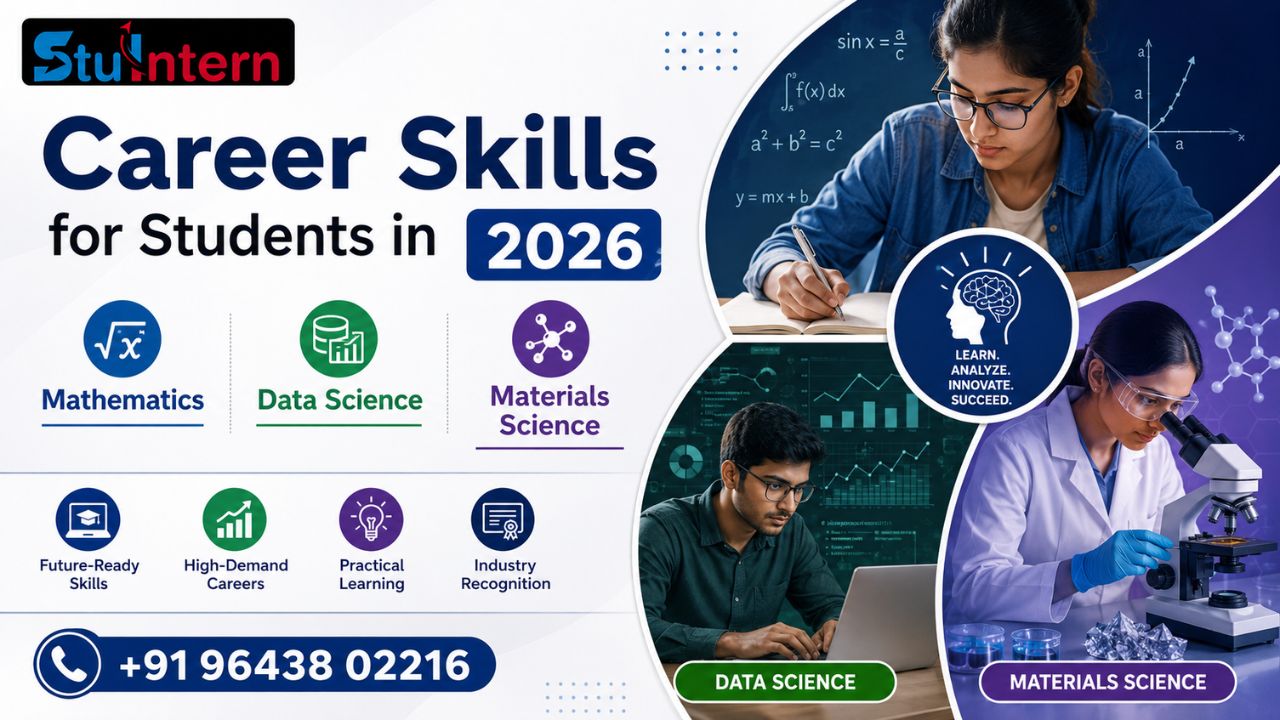
For a mathematics student, this can mean applying mathematical concepts to statistics, analytics, finance, optimization, or machine learning. For students interested in technology and analytics, a Data Science Masterclass can provide structured learning in areas such as Python, data analysis, visualization, statistics, and machine learning. For engineering and science students, Materials Science can lead toward areas such as research, manufacturing, energy, electronics, aerospace, and advanced materials.
The goal is not to collect as many certificates as possible. Instead, students should focus on building a career-ready skill set supported by practical projects, relevant tools, mentorship, and demonstrable experience.
This guide explains how students can choose practical learning programs, develop relevant career skills, evaluate projects and certificates, and prepare for career opportunities in 2026.
Quick Answer: What Should Students Focus on in 2026?
Students should focus on a combination of academic fundamentals, practical projects, mentorship, industry-relevant tools, communication skills, and career experience rather than relying on certificates alone.
The right combination will depend on a student's academic background and career goal. A mathematics student may combine mathematics with statistics and data science, while a Materials Science student may benefit from research projects, technical analysis, data skills, and industry exposure.
2. Biggest Career Challenges Students Face in 2026
Moving from college to employment is not always straightforward. Students may have academic knowledge and certificates but still lack the practical experience needed to demonstrate their abilities to employers.
Some of the most common challenges include:
2.1 Strong Theory but Limited Practical Experience
College education provides important theoretical foundations, but classroom assignments do not always replicate the types of problems students encounter in professional environments.
For example, a student may understand statistical formulas but have never worked with an incomplete or unstructured dataset. Similarly, an engineering student may understand material properties but have limited experience applying that knowledge to a practical material-selection or research problem.
Practical learning helps students connect what they know with how they can use it.
2.2 An Empty or Weak Portfolio
A resume becomes more convincing when students can demonstrate what they have actually worked on.
A useful student portfolio may include:
- Practical projects
- Case studies
- Data analysis work
- Research assignments
- Technical documentation
- Presentations
- Project results and outcomes
These examples give students concrete work to discuss during interviews and can help demonstrate their technical and problem-solving abilities.
2.3 Too Many Certificates and Too Few Projects
Certificates can show that a student completed a course or training program. However, a certificate by itself may not demonstrate how effectively the student can apply the knowledge.
A stronger approach is to combine certificates with practical projects, technical skills, and measurable project outcomes.
For example, instead of simply listing a Data Science certificate, a student could also show a project involving data cleaning, visualization, analysis, or predictive modelling.
2.4 Difficulty Choosing the Right Career Direction
Students often encounter a large number of courses and career options and may find it difficult to decide which skills are relevant to their goals.
Depending on their academic background and interests, they may consider areas such as:
- Data Science
- Artificial Intelligence and Machine Learning
- Mathematics and Statistics
- Programming
- Digital Marketing
- Materials Science
- Business Analytics
- Research Methods
- Full-Stack Development
The right choice depends on factors such as the student's academic background, career objective, existing skills, interest, and the type of work they want to pursue.
Rather than trying to learn everything at once, students should build a focused skill combination that connects their academic knowledge with practical career opportunities.
3. What Should a Good Student Career Platform Offer?
A useful student career platform should offer more than recorded lectures and downloadable certificates. Students should look for programs that help them learn, practise, build projects, receive guidance, and prepare for real career opportunities.
Before enrolling, consider whether the program provides:
| Feature | Why It Matters |
|---|---|
| Practical projects | Helps students apply concepts to real or realistic problems |
| Mentor guidance | Provides feedback and support when students face difficulties |
| Industry-relevant curriculum | Keeps learning connected to practical skills and tools |
| Internship experience | Gives students exposure to professional work environments |
| Certificate | Documents completion of the learning or internship program |
| Career guidance | Helps students understand possible career paths |
| Interview preparation | Helps students explain their skills and project experience |
| Portfolio support | Turns completed work into evidence of practical ability |
| Flexible learning | Makes it easier to balance training with college |
The most useful platform is not necessarily the one with the largest number of courses or certificates. Students should focus on whether the platform provides a clear learning path, practical experience, feedback, and useful evidence of what they can do.
StuIntern currently describes its internship and training programs as including practical projects, mentorship, certification and career-oriented support, with online and offline learning options available across its programs.
4. Why Is Practical Learning Important for Students?
Practical learning helps students move from understanding a concept to applying it.
Instead of only memorising theories and completing academic assignments, students can learn how concepts are used to solve problems, analyse information, create solutions, and communicate results.
For example, mathematics becomes more career-oriented when students apply it to areas such as:
- Statistics
- Probability
- Data interpretation
- Optimization
- Financial modelling
- Machine learning
- Quantitative analysis
Similarly, a Data Science Masterclass can become more valuable when students work with datasets and complete practical exercises instead of only watching lectures.
A typical data project may involve:
- Obtaining or collecting a dataset.
- Cleaning missing or inconsistent information.
- Exploring patterns and relationships.
- Creating useful visualisations.
- Building an appropriate analytical or predictive model.
- Evaluating the results.
- Explaining the findings to a non-technical audience.
This type of project develops both technical skills and problem-solving ability.
For Materials Science students, practical learning can include areas such as material properties, characterization techniques, manufacturing applications, sustainability, composites, polymers, metals, ceramics, and advanced materials.
The key benefit is that students finish with more than theoretical knowledge—they have experience explaining what they worked on, how they approached a problem, and what they learned from the results.
5. How Should Students Compare Different Learning Programs?
Students should not choose a program only because it is inexpensive, popular, or offers an attractive certificate.
Instead, compare programs using the following criteria.
Curriculum
Does the syllabus cover the knowledge and tools relevant to your career goal?
Practical Work
How many meaningful projects, assignments, case studies, or hands-on activities are included?
Mentorship
Can you ask questions, receive feedback, and get guidance when you face technical or academic difficulties?
Industry Relevance
Are the tools, methods, examples, and projects connected to current professional applications?
Portfolio Value
Will you finish the program with work that you can explain during an interview or include in your portfolio?
Career Support
Does the provider offer services such as interview preparation, resume guidance, career counselling, or placement-related support? Check exactly what is included rather than assuming that every program provides the same level of assistance.
Flexibility
Can you complete the program alongside your college schedule, exams, assignments, or other commitments?
Value Beyond the Certificate
Finally, ask one practical question:
“What will I be able to demonstrate after completing this program that I could not demonstrate before?”
A strong program should ideally leave students with a combination of knowledge, practical work, feedback, and career evidence, rather than a certificate alone.
StuIntern currently highlights features such as mentor-led learning, live projects, internship certificates, mock interviews, resume support and career-oriented assistance across its platform. Students should review the specific program page to confirm which features are included in the program they are considering.
6. Which Skills Should College Students Learn in 2026?
There is no single skill that every college student needs to learn in 2026. A better approach is to build a career skill stack that combines academic knowledge, technical ability, analytical thinking, communication, and practical experience.
The right combination depends on a student's degree, interests, and career objective.
Technical Skills
Students should choose technical skills that are relevant to their intended field. Depending on the career path, these may include:
- Python
- SQL
- Data analysis
- Statistics
- Machine learning
- Data visualization
- Cloud fundamentals
- Research methods
- Programming
- Technical writing
For example, students interested in data-related careers can combine Python + SQL + statistics + data visualization + machine learning rather than trying to learn every technology at once.
Analytical Skills
Analytical thinking is useful across many career paths. Mathematics provides a foundation for structured reasoning and quantitative problem-solving.
Students can develop skills in areas such as:
- Probability
- Statistics
- Algebra
- Calculus
- Optimization
- Logical reasoning
- Quantitative analysis
- Data interpretation
These skills can be particularly useful for careers involving data science, analytics, finance, research, engineering, and quantitative decision-making.
Communication Skills
Technical knowledge becomes more valuable when students can clearly explain their work.
Students should be able to communicate:
- What problem they solved
- Why they selected a particular approach
- What the results mean
- What limitations they encountered
- What they would improve or do next
This applies to interviews, project presentations, research work, team meetings, reports, and professional communication.
Professional Skills
Students should also develop transferable skills that remain useful across different industries:
- Teamwork
- Time management
- Presentation
- Research
- Problem-solving
- Adaptability
- Professional communication
- Collaboration
- Critical thinking
The goal is not to master every skill. It is to build a focused combination of skills that supports a specific career direction.
7. How to Choose the Right Program Based on Your Career Goal
The best learning program depends on what you want to do after graduation. Students should first identify a target career direction and then select the skills, tools, and projects that support it.
| Career Goal | Recommended Learning Direction | Practical Project Example |
|---|---|---|
| Data Analyst | Statistics, SQL, Excel, Power BI, Python | Sales or customer analytics dashboard |
| Data Scientist | Python, mathematics, statistics, machine learning | Predictive modelling project |
| AI/ML Professional | Python, mathematics, machine learning, deep learning | Classification or NLP project |
| Mathematics Graduate | Statistics, analytics, modelling, programming | Forecasting or optimization project |
| Materials Science Student | Materials characterization, research, simulation, manufacturing | Material comparison or sustainability study |
| Research Career | Research methodology, statistics, literature review | Research-based study |
| Engineering Graduate | Technical specialization, software/tools, project work | Industry-oriented engineering project |
| Business Career | Analytics, communication, Excel, presentation | Business performance analysis |
Build a Skill Combination, Not Just a Course List
Students should think about how individual skills work together.
For example:
Mathematics → Statistics → Python → Data Analysis → Practical Project
can create a useful foundation for a student interested in data-related careers.
Similarly:
Materials Science → Research Methods → Data Analysis → Technical Project → Industry Exposure
can help a Materials Science student connect academic knowledge with practical applications.
The important question is not simply “Which course should I take?” but:
“Which combination of skills and practical experience will help me move toward my intended career?”
This approach can help students avoid collecting unrelated courses and instead build a focused, career-oriented learning path.
The important point is alignment. A mathematics student does not need to move away from mathematics to build a strong career profile. Mathematical knowledge can be combined with analytics, programming, statistics, or data science to create a broader skill set.
Similarly, a Materials Science student can combine domain knowledge with data analysis, simulation, research methodology, technical software, or manufacturing technologies.
The best learning path is therefore the one that connects a student's academic background, practical skills, projects, and intended career direction.
8. Online vs Offline Learning: Which Is Better for Students?
Neither online nor offline learning is automatically better. The right format depends on the student's schedule, learning preferences, location, access to mentors, and the structure of the program.
| Factor | Online Learning | Offline Learning |
|---|---|---|
| Flexibility | Usually high | Usually moderate |
| Location freedom | High | Limited |
| Self-discipline required | Often higher | Can be easier with a fixed schedule |
| Mentor interaction | Depends on the program | Depends on the program |
| Recorded sessions | Often available | May vary |
| Travel | Usually not required | Usually required |
| Remote collaboration | Can provide strong exposure | Depends on the program |
| Suitable for college students | Often highly flexible | Depends on timetable |
When Online Learning May Work Well
Online learning can be useful for students who need flexibility around college classes, assignments, examinations, or other commitments.
However, a good online program should offer more than recorded videos. Students should look for:
- Live or interactive sessions
- Mentor access
- Practical assignments
- Project-based learning
- Feedback on submitted work
- Opportunities to ask questions
- Clear learning outcomes
When Offline Learning May Work Well
Offline programs can be useful for students who prefer face-to-face interaction, structured schedules, physical collaboration, or direct access to facilities and instructors.
For technical and research-oriented subjects, the availability of laboratories, equipment, workshops, or other practical resources can also influence the choice.
Therefore, students should compare the actual learning experience rather than choosing a format simply because it is online or offline.
StuIntern currently provides online and offline options across its internship and training offerings. Students should check the specific program page for the available mode and included features.
9. Projects vs Certificates: What Actually Helps Your Career More?
Projects and certificates serve different purposes, so students should not necessarily treat them as alternatives.
A certificate can document that a student completed a course, training program, or internship. A project provides an opportunity to demonstrate how the student applied knowledge to a specific problem.
| Factor | Projects | Certificates |
|---|---|---|
| Demonstrates practical ability | Strong | Limited |
| Shows problem-solving | Strong | Limited |
| Helps interview discussions | Strong | Moderate |
| Supports portfolio building | Strong | Limited |
| Documents program completion | Moderate | Strong |
| Shows specific learning | Strong | Strong |
| Demonstrates initiative | Strong | Limited |
| Helps explain technical skills | Strong | Moderate |
The strongest student profile usually combines:
Relevant Skills + Practical Projects + Appropriate Certificates + Internship Experience
For example, instead of writing only:
Completed Data Science certification.
a stronger resume entry could explain:
Developed a predictive analytics project using Python and a real-world dataset, performed data cleaning and visualization, and evaluated model performance.
The second example gives an interviewer something specific to discuss. The student can explain the dataset, methods used, challenges encountered, results achieved, and what they would improve.
This is why students should view certificates as supporting evidence of learning, while using projects and practical experience to demonstrate how they can apply that learning.
10. Why Mathematics Still Matters in 2026
The growing use of artificial intelligence, data analytics, and automation has not made mathematics less relevant. In many technical and analytical careers, mathematical thinking provides a foundation for understanding problems, evaluating evidence, and making quantitative decisions.
Students do not necessarily need advanced mathematics for every career. However, a strong understanding of relevant mathematical concepts can become a valuable advantage when combined with practical skills.
Mathematics and Data Science
Statistics and probability help students understand uncertainty, distributions, correlation, sampling, hypothesis testing, and model evaluation.
These concepts are useful when analysing datasets because they help students distinguish meaningful patterns from random variation.
Mathematics and Artificial Intelligence
Concepts from linear algebra, calculus, probability, statistics, and optimization are connected to many machine learning techniques.
Students interested in AI and machine learning can therefore benefit from understanding the mathematical ideas behind the tools they use rather than treating software libraries as black boxes.
Mathematics and Business
Quantitative reasoning can support areas such as:
- Forecasting
- Financial analysis
- Risk assessment
- Market analysis
- Optimization
- Business analytics
Mathematical thinking can help students evaluate numbers, identify patterns, compare alternatives, and make evidence-based decisions.
Mathematics and Research
Mathematical modelling and statistical analysis can help researchers describe relationships, test assumptions, analyse observations, and interpret experimental results.
This makes mathematics relevant not only to technology careers but also to scientific research, engineering, economics, finance, and other analytical fields.
Therefore, students should not view mathematics only as an examination subject. When combined with programming, statistics, analytics, or domain knowledge, it can become part of a broader career skill stack.
11. What Is the Role of a Data Science Masterclass?
A Data Science Masterclass can be useful when it provides a structured path from fundamental concepts to practical application.
However, students should evaluate the actual curriculum, project work, mentor support, and learning outcomes rather than choosing a program based on the word “Masterclass” alone.
A well-designed Data Science Masterclass may cover the following areas:
Data Fundamentals
Students learn how data is structured, collected, organised, and interpreted. Understanding data quality and context is an important starting point for reliable analysis.
Python and Data Analysis
Python is widely used for data-related tasks. Students can learn how to work with datasets, perform calculations, automate repetitive analysis, and prepare data for further investigation.
Statistics
Statistics helps students understand variation, relationships, uncertainty, sampling, and the reliability of analytical results.
Data Visualization
Charts, dashboards, and other visual tools help students communicate patterns and findings clearly to technical and non-technical audiences.
Machine Learning
Students can learn how machine learning models are selected, trained, evaluated, and applied to suitable problems.
Capstone Projects
A capstone project can bring multiple skills together. Ideally, students should finish with a project that demonstrates the problem, dataset, methodology, analysis, results, and conclusions.
What Should Students Look for in a Data Science Masterclass?
Before enrolling, check whether the program includes:
- Hands-on datasets
- Python or another relevant programming language
- Statistics and data analysis
- Data visualization
- Machine learning fundamentals
- Practical assignments
- Mentor feedback
- A portfolio-ready project
- Clear learning outcomes
The most useful Data Science Masterclass is therefore not simply the one with the longest syllabus. It is the one that helps students understand concepts, practise with data, complete meaningful projects, and explain their work confidently.
12. Why Materials Science Can Be a Strong Career Direction
Materials Science sits at the intersection of science, engineering, chemistry, physics, and manufacturing. It focuses on understanding how the structure, properties, processing, and performance of materials affect their practical applications.
Students interested in this field can explore areas such as:
- Metals and alloys
- Polymers
- Ceramics
- Composites
- Nanomaterials
- Semiconductor materials
- Energy materials
- Sustainable materials
- Biomedical materials
- Advanced manufacturing
Materials Science can also connect with several interdisciplinary areas. Depending on their interests, students may explore research, manufacturing, electronics, energy, aerospace, biomedical applications, or sustainable technologies.
Students should consider combining academic knowledge with laboratory exposure, research projects, technical software, data interpretation, and practical problem-solving.
A strong Materials Science project should allow a student to explain:
- What research or engineering problem was being investigated.
- Why the problem was important.
- Which materials or methods were selected.
- How observations or data were collected.
- How the results were analysed.
- What conclusions were reached.
- What limitations or future improvements were identified.
This type of project can help students demonstrate that they understand not only the theory of Materials Science but also how to apply it in a research or professional context.
13. Common Mistakes Students Make When Choosing a Career Program
Choosing a career program is an important decision, but students sometimes focus more on marketing claims than on the actual learning experience.
Mistake 1: Choosing Only by Certificate
A certificate can document course or internship completion, but it should not be treated as a substitute for practical skills.
Before enrolling, ask what you will actually learn and what work you will complete.
Mistake 2: Selecting a Program Only Because It Is Trending
AI, data science, and other technologies are popular, but a trending field is not automatically the right choice for every student.
Consider your academic background, interests, existing skills, and intended career direction.
Mistake 3: Ignoring Projects
A program without meaningful practical work may provide limited opportunities to demonstrate what you have learned.
Check whether the program includes assignments, case studies, projects, or other hands-on activities.
Mistake 4: Not Checking the Curriculum
Read the syllabus before enrolling.
Check whether it covers the specific concepts, tools, and skills relevant to your career goal rather than relying only on the course title.
Mistake 5: Ignoring Mentorship
Beginners may need feedback when they encounter technical or academic problems.
Check how mentorship works, how often students can interact with mentors, and whether feedback is included in the program.
Mistake 6: Trying to Learn Everything
Learning ten unrelated subjects superficially may be less useful than developing a focused skill stack.
For example, a student interested in data science could start with:
Statistics + Python + SQL + Data Analysis + Projects
and build additional skills gradually.
Mistake 7: Waiting Until Final Year
Career preparation does not need to begin immediately with job applications.
Students can start by completing small projects, developing technical skills, participating in internships, improving communication, and building a portfolio during their college years.
A project completed in the second or third year can become useful evidence of experience when the student begins applying for internships or jobs.
14. Why Consider StuIntern?
StuIntern positions its platform around connecting academic learning with practical career preparation through internships, projects, mentorship, training, and career-oriented support.
Its current platform highlights features such as:
- Industry-oriented internship programs
- Practical and live project opportunities
- Mentor guidance
- Career guidance
- Internship certificates
- Interview preparation
- Resume support
- Online and offline learning options
The exact features and services can vary by program, so students should review the relevant program page before enrolling.
For example, StuIntern's Data Science and AI/ML internship offerings describe practical learning components such as programming, projects, capstone work, certification, and interview-oriented preparation.
Students should compare the curriculum, duration, project structure, mentor support, learning format, certificate details, and current program terms before making a decision.
The goal should not be to choose a platform simply because it offers more features. The better question is whether the program provides the skills, practical experience, guidance, and career evidence that match the student's specific objective.
15. Who Can Benefit From StuIntern?
StuIntern may be relevant for students and graduates who want to combine academic learning with internships, practical projects, mentorship, and career preparation.
The usefulness of a program will depend on the student's academic background, career objective, and the specific internship or training program selected.
Engineering Students
Engineering students can use internships and practical projects to gain exposure beyond their regular curriculum and strengthen their technical portfolios.
BCA, MCA and Computer Science Students
Students from computer-related backgrounds can explore areas such as full-stack development, AI/ML, data science, analytics, and other technology-focused fields.
Mathematics Students
Mathematics students can combine their academic foundation with statistics, programming, analytics, or machine learning to develop a broader career skill set.
Science Students
Science students interested in research, analytics, technology, or technical careers can combine subject knowledge with practical projects and research-oriented learning.
Materials Science Students
Materials Science students can complement their specialization with research projects, technical analysis, data interpretation, simulation, and interdisciplinary skills.
Final-Year Students
Students approaching graduation can use internships, projects, interview preparation, and portfolio development to strengthen their transition from college to employment.
Fresh Graduates
Graduates with limited professional experience can use relevant projects and internships to demonstrate practical skills and give employers concrete examples to discuss during interviews.
Students should still evaluate each program individually and confirm its curriculum, duration, project structure, learning format, mentorship, and other included services before enrolling.
16. How to Prepare for Future Career Opportunities
Effective career preparation is not simply about predicting which job or technology will be popular several years from now.
A more sustainable approach is to develop skills that remain useful as technologies and job requirements change.
These include:
- Learning how to learn
- Mathematical and analytical reasoning
- Problem-solving
- Data literacy
- Communication
- Project execution
- Research ability
- Collaboration
- Adaptability
- Digital skills
For example, a student who understands mathematics, can analyse data, communicate findings, and complete practical projects has a broader foundation than someone who has only memorised course material.
Similarly, a Materials Science student can increase their versatility by combining domain knowledge with data analysis, research methods, technical communication, simulation, or computational tools.
A student taking a Data Science Masterclass should also focus beyond learning software. Knowing Python, SQL, visualization tools, or machine learning libraries is useful, but the greater career value comes from knowing when and how to use those tools to solve problems.
A Simple Career-Readiness Framework
Students can think about career preparation as:
Academic Knowledge → Technical Skills → Practical Project → Internship Experience → Portfolio → Interview Preparation
This creates a progression from learning concepts to demonstrating what can actually be done with them.
17. How Students Can Evaluate an Education or Internship Platform
Before enrolling in an education or internship program, students should evaluate the provider using several practical criteria.
Experience
Look for evidence of real internship programs, practical projects, learning activities, and student experiences.
Expertise
Review the curriculum, trainer or mentor profiles, subject coverage, and the relevance of the learning material.
Authoritativeness
Consider the organisation's professional presence, published resources, program information, industry connections, and other verifiable information.
Trustworthiness
Check whether the provider clearly explains:
- Program duration
- Fees and payment terms
- Learning format
- Project structure
- Certificate details
- Mentorship
- Cancellation or refund policies
- Contact information
- What career or placement support actually includes
Students should avoid making decisions based only on promotional claims. Compare information across the provider's website, individual program pages, independent reviews, and other reliable sources where available.
The most important question is:
“Can I clearly understand what I will learn, what I will work on, and what I will receive after completing the program?”
18. Frequently Asked Questions
What skills should students learn in 2026?
Students should develop a combination of technical and professional skills, including data literacy, mathematics, programming where relevant, communication, problem-solving, project execution, and practical experience.
Is mathematics useful for a career in data science?
Yes. Mathematics, statistics, probability, and logical reasoning provide useful foundations for data analysis, machine learning, optimization, and quantitative modelling.
What is a Data Science Masterclass?
A Data Science Masterclass is generally a structured learning program covering areas such as data analysis, statistics, programming, visualization, and machine learning. Its value depends on the curriculum, practical work, mentorship, and learning outcomes provided.
Is Materials Science a good field for students?
Materials Science can be a suitable field for students interested in materials, engineering, manufacturing, research, energy, electronics, biomedical applications, and advanced technologies. Career opportunities depend on specialization, qualifications, practical experience, and the chosen career path.
Are projects more important than certificates?
Projects and certificates serve different purposes. Projects provide evidence of practical application, while certificates document completion of a course or program. A strong student profile can combine relevant projects, skills, internships, and appropriate certifications.
Should college students choose online internships?
Online internships can be useful because they offer flexibility and allow students to gain experience alongside college. Students should evaluate the quality of mentorship, project work, training, supervision, and the actual responsibilities involved.
Does StuIntern provide practical projects?
StuIntern promotes practical and live project opportunities across its internship offerings. Students should review the specific internship page to confirm the project structure and features included in their chosen program.
Does StuIntern offer Data Science internships?
StuIntern currently lists Data Science internship opportunities. Students should review the current program page for the latest information about curriculum, tools, projects, duration, and other included features.
19. Conclusion
The challenge for many students in 2026 is not simply finding information or completing courses. It is turning academic knowledge into demonstrable skills and practical experience.
Mathematics can provide a foundation for analytical thinking. A Data Science Masterclass can help students develop practical data skills when it includes relevant tools, projects, and application. Materials Science can lead toward research, engineering, manufacturing, energy, and advanced technology applications.
Across these fields, the strongest career preparation combines:
Knowledge + Skills + Projects + Mentorship + Internship Experience + Communication
Instead of asking only, “How many certificates should I collect?”, students should ask:
“What can I build, analyse, explain, or solve after completing this program?”
That question can help students choose more relevant learning opportunities and build a stronger career profile.
20. Start Building Your Career Skills in 2026
Don't wait until graduation to discover that your resume needs practical evidence of your skills.
Explore internship and training opportunities that combine skills, projects, mentorship, and career preparation. Compare programs based on your academic background, career objective, curriculum, project structure, and the practical experience they provide.
Ready to move from classroom knowledge to career-ready skills? Explore StuIntern's internship and training programs and start building your practical portfolio in 2026.
Website: www.stuintern.com
Call/WhatsApp: +91 96438 02216