

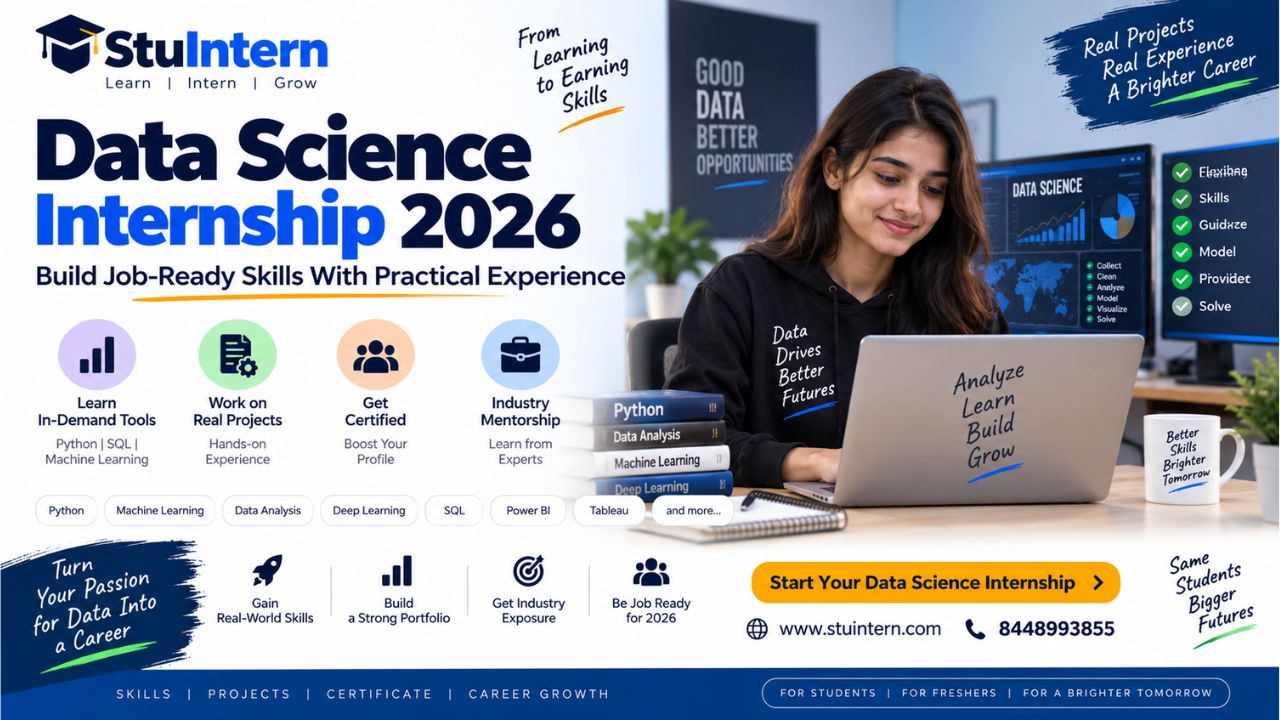
Data Science Internship 2026: Build Job-Ready Skills With Practical Experience
Starting a career can be challenging when you have academic knowledge but limited practical experience. Employers increasingly look for candidates who can apply their knowledge to real problems, use industry tools, and demonstrate completed projects. A Data Science Internship can help students and freshers bridge this gap by combining structured learning with practical exposure.
For students interested in technology, data, and business, internships can provide an opportunity to develop relevant skills while understanding how professional teams work. Depending on your career goal, options such as a Data Analytics Internship or Digital Marketing Internship can also help you build specialized expertise.
In this guide, you will learn how internships work in 2026, what skills you can develop, what projects to expect, and how to select a program that supports your career goals.
Quick Answer Box
A Data Science Internship gives students and freshers practical exposure to data analysis, programming, visualization, and problem-solving. A good internship combines mentorship, hands-on projects, and industry-relevant tools. In 2026, choosing a program based on practical learning, portfolio projects, and career relevance can help you become more job-ready.
Table of Contents
- What Is a Data Science Internship?
- Why Is a Data Science Internship Important in 2026?
- Who Should Choose a Data Science Internship?
- Types of Internship Opportunities
- Best Fields and Options in 2026
- Skills and Tools You Can Learn
- Practical Projects and Learning Outcomes
- Key Benefits of an Internship
- How to Choose the Right Program
- Step-by-Step Internship Process
- Common Mistakes to Avoid
- Internship Comparison
- Why Choose StuIntern?
- Frequently Asked Questions
- Conclusion
Quick Highlights Table
| Best For | Students, graduates, and freshers |
| Mode | Online, hybri,d or program-dependent |
| Skills | Technical and professional skills |
| Practical Learning | Hands-on assignments and activities |
| Projects | Portfolio-focused real-world projects |
| Mentorship | Guidance from experienced professionals |
| Certificate | Program completion certificate, where applicable |
| Career Focus | Industry exposure and job preparation |
What Is a Data Science Internship?
A Data Science Internship is a practical learning opportunity where students or fresh graduates develop skills related to data, technology, and business problem-solving.
Instead of focusing only on theory, an internship allows learners to work on practical assignments and projects. Depending on the program, students may explore areas such as data cleaning, exploratory data analysis, visualization, statistics, programming, and introductory machine learning.
A strong internship should help you answer an important question:
“Can I apply what I have learned to solve a real-world problem?”
For beginners, this practical experience can become an important addition to a resume and portfolio.
Why Is a Data Science Internship Important in 2026?
The technology and business landscape continues to change rapidly. Organizations use data to understand customers, improve operations, measure performance, and support decision-making.
This creates a growing need for professionals who understand how to work with data.
However, simply listing Python, Excel, or analytics on a resume may not demonstrate practical ability. Projects and hands-on experience provide evidence of what you can actually do.
A Data Science Internship in 2026 can help students:
- Apply classroom concepts to practical scenarios.
- Develop problem-solving skills
- Build portfolio projects
- Become familiar with industry tools.
- Improve their resume
- Understand professional workflows
- Gain confidence before applying for jobs.
The goal should not simply be to collect an internship certificate. The real value comes from skills + projects + experience + mentorship.
Who Should Choose a Data Science Internship?
A data-focused internship can be suitable for a variety of learners.
Students
College students can use internships to gain experience before graduation and explore whether data-related careers match their interests.
Fresh Graduates
Graduates without professional experience can use projects and internship work to demonstrate practical capabilities to potential employers.
Beginners Switching Careers
Learners from business, commerce, engineering, mathematics, or other backgrounds may use structured programs to explore data-related career paths.
Aspiring Data Professionals
Students already familiar with programming or statistics can use internships to strengthen their portfolios and work on more practical problems.
Types of Internship Opportunities
Not every student wants to follow the same career path. Different internship areas develop different skill sets.
Data Science Internship
Best suited for learners interested in programming, statistics, data analysis, and machine learning.
Typical learning areas include:
- Python
- Data preparation
- Statistics
- Data visualization
- Exploratory analysis
- Machine learning fundamentals
Data Analytics Internship
A Data Analytics Internship focuses more strongly on analyzing information and converting data into useful business insights.
Students may work with:
- Excel
- SQL
- Power BI
- Tableau
- Data visualization
- Business reporting
This can be an excellent starting point for learners who enjoy numbers, reporting, and business problem-solving.
Digital Marketing Internship
A Digital Marketing Internship is designed for students interested in online marketing, content, search engines, social media, and performance measurement.
Students may explore:
- SEO
- Social media marketing
- Content strategy
- Keyword research
- Web analytics
- Campaign performance
- Digital advertising fundamentals
Best Fields and Options in 2026
Choosing the right field depends on your interests and long-term career direction.
| Data Science | Students interested in data and technology | Python, statistics, ML | Predictive analysis |
| Data Analytics | Business and numbers-oriented learners | SQL, Excel, BI | Business dashboard |
| Digital Marketing | Creative and marketing-focused students | SEO, content, analytics | Marketing campaign |
| Business Analytics | Students interested in business decisions | Excel, SQL, visualization | Business insights report |
| AI/ML | Advanced technical learners | Python, ML concepts | Classification model |
The best choice is not necessarily the most popular field. It is the one that matches your interests, existing skills, and career goals.
Skills and Tools You Will Learn
The exact curriculum depends on the program, but a practical data internship may introduce students to several important technologies.
Technical Skills
- Python fundamentals
- Data manipulation
- SQL basics
- Statistics
- Data visualization
- Exploratory data analysis
- Machine learning fundamentals
Professional Skills
Technical knowledge alone is not enough. Students can also develop:
- Communication
- Presentation
- Problem-solving
- Time management
- Team collaboration
- Analytical thinking
Tools
Depending on the program, learners may work with tools such as:
- Python
- Jupyter Notebook
- Excel
- SQL
- Power BI
- Tableau
- Git/GitHub
The objective should be to understand how and when to use a tool, rather than simply learning tool names.
Practical Projects and Learning Outcomes
Projects are one of the most valuable parts of an internship because they allow students to demonstrate practical ability.
For example, a beginner-level data project could involve analyzing customer information to identify purchasing patterns.
An analytics project might involve creating a dashboard showing sales performance, revenue trends, and key business metrics.
A marketing project could involve researching keywords, analyzing competitors, and developing a content strategy.
Possible Project Ideas
Data Science
- Customer churn prediction
- Sales forecasting
- Customer segmentation
- Exploratory data analysis
Data Analytics
- Sales dashboard
- Business performance report
- Customer behavior analysis
- Marketing performance analysis
Digital Marketing
- SEO audit
- Keyword research project
- Content strategy
- Social media campaign analysis
The strongest projects demonstrate a clear problem → analysis → solution → result structure.
Key Benefits of a Data Science Internship
1. Practical Experience
Internships allow students to move beyond textbooks and practice solving realistic problems.
2. Stronger Portfolio
Completed projects can become portfolio pieces that demonstrate your capabilities.
3. Better Career Understanding
Working through practical tasks helps you understand what a particular career actually involves.
4. Professional Mentorship
Guidance can help beginners avoid common mistakes and understand industry expectations.
5. Resume Development
A well-structured internship can add relevant practical experience to your resume.
6. Confidence Building
Completing projects and presenting your work can improve confidence when applying for opportunities.
7. Job Readiness
The combination of technical skills, project experience, and professional skills can make students better prepared for entry-level roles.
How to Choose the Right Program
Before joining an internship, evaluate the program carefully.
Look for Practical Projects
Avoid programs that focus exclusively on lectures. Check whether students actually complete assignments or projects.
Check the Curriculum
The syllabus should include skills relevant to your target career.
Evaluate Mentorship
Beginners benefit significantly from feedback and guidance during project work.
Understand the Certificate
A certificate can document participation, but it should not be the primary reason for joining. Prioritize the actual learning experience.
Review Career Relevance
Ask whether the skills you will learn are relevant to the roles you eventually want to apply for.
Check Flexibility
Students should consider program duration, schedule, and learning format before committing.
Step-by-Step Process
A structured internship journey can look like this:
Step 1: Select Your Career Track
Choose between data science, analytics, digital marketing, or another relevant field.
Step 2: Understand the Fundamentals
Learn the basic concepts and tools required for the program.
Step 3: Practice Through Assignments
Apply concepts through structured exercises.
Step 4: Complete Practical Projects
Work on projects that simulate real-world problems.
Step 5: Receive Feedback
Use mentor feedback to improve your technical and professional work.
Step 6: Build Your Portfolio
Document your strongest projects and explain your contribution clearly.
Step 7: Prepare for Opportunities
Update your resume, LinkedIn profile, and interview preparation based on your new skills.
Common Mistakes to Avoid
Choosing a Program Only for the Certificate
A certificate has limited value if you cannot explain what you learned or demonstrate your work.
Ignoring Projects
Projects provide tangible evidence of your abilities. Take them seriously.
Learning Too Many Tools at Once
Beginners often try to learn everything simultaneously. Build strong fundamentals first.
Copying Projects
A copied project may look good temporarily but makes it difficult to answer interview questions. Understand every part of your work.
Neglecting Communication Skills
Data professionals need to explain findings clearly to technical and non-technical audiences.
Not Building a Portfolio
Keep your best projects organized so recruiters or interviewers can understand your capabilities.
Data Science vs Data Analytics vs Digital Marketing Internship
| Main Focus | Data, programming & predictive analysis | Business data & insights | Online marketing |
| Core Tools | Python, SQL, notebooks | Excel, SQL, Power BI | SEO, analytics, marketing tools |
| Best For | Technical/data-oriented students | Analytical/business students | Creative/marketing-oriented students |
| Projects | Models and data analysis | Dashboards and reports | SEO/content/campaign projects |
| Key Strength | Technical problem-solving | Business decision support | Audience and growth strategy |
Why Choose StuIntern?
StuIntern can be positioned as a practical learning platform for students and freshers who want to move from academic knowledge toward career-ready skills.
The focus should be on helping learners develop skills through structured learning, practical projects, and industry-relevant exposure.
Whether your goal is a Data Science Internship, Data Analytics Internship, or Digital Marketing Internship, choosing a program that emphasizes hands-on experience can help you get more value from your internship journey.
Why Practical Learning Matters
Students learn more effectively when they can immediately apply concepts. Instead of simply watching lessons, project-based learning allows learners to experiment, make mistakes, receive feedback, and improve.
For students preparing for their first job, this experience can make the transition from education to employment more manageable.
Ready to build practical skills and strengthen your career profile? Explore StuIntern's internship opportunities and choose a learning path aligned with your goals.
Frequently Asked Questions
1. What is a Data Science Internship?
A Data Science Internship is a practical learning experience designed to help students and freshers develop skills in data analysis, programming, statistics, visualization, and related technologies. Depending on the program, students may work on real-world datasets, assignments, and projects while receiving guidance and feedback.
2. Is a Data Science Internship good for freshers?
Yes. A Data Science Internship can be particularly useful for freshers because it provides practical experience that may be difficult to gain through academic coursework alone. Completing meaningful projects can also help freshers demonstrate their skills when preparing resumes, portfolios, and entry-level job applications.
3. What skills are needed for a Data Science Internship?
Beginners can benefit from basic programming, mathematics, statistics, and analytical thinking. Python, SQL, Excel, and data visualization are useful skills to develop. You do not necessarily need to master every technology before starting; a structured internship can help you build skills progressively.
4. What is the difference between Data Science and Data Analytics internships?
A Data Science Internship generally covers programming, statistics, data analysis, and machine learning concepts, while a Data Analytics Internship focuses more heavily on extracting insights from data and communicating business findings. Both paths can involve tools such as SQL, Excel, and visualization platforms.
5. Is a Digital Marketing Internship suitable for beginners?
Yes. A Digital Marketing Internship can be suitable for beginners interested in SEO, content, social media, analytics, and online business growth. Practical assignments such as keyword research, SEO audits, and campaign analysis can help students understand how digital marketing works in real-world situations.
6. How can I choose the right internship program?
Start by identifying your career goal and current skill level. Then compare the curriculum, practical projects, mentorship, duration, learning format, and career relevance. Prioritize programs where you can produce meaningful work rather than choosing solely based on the certificate.
7. Can an internship help with job preparation?
A good internship can support job preparation by giving students practical experience, portfolio projects, and exposure to professional workflows. However, an internship does not guarantee employment. Students should combine their internship experience with strong fundamentals, resume preparation, and interview practice.
8. Should I choose Data Science, Data Analytics, or Digital Marketing?
Choose based on your interests. Data Science is suitable for learners interested in programming and advanced data problems. Data Analytics is a good fit for people who enjoy business insights and numbers. Digital Marketing suits students interested in online audiences, content, SEO, and marketing strategy.
Conclusion
A Data Science Internship in 2026can be a valuable stepping stone for students and freshers who want to turn theoretical knowledge into practical experience. The right program should go beyond a certificate by providing relevant skills, hands-on projects, mentorship, and opportunities to build a portfolio.
If data is not your preferred career path, a Data Analytics Internship or Digital Marketing Internship may provide a better fit depending on your interests and goals.
The most important takeaway is simple: choose an internship for the experience and skills you will gain—not just the certificate you will receive.
Start building practical, career-relevant skills with StuIntern and take a confident step toward your professional future.