

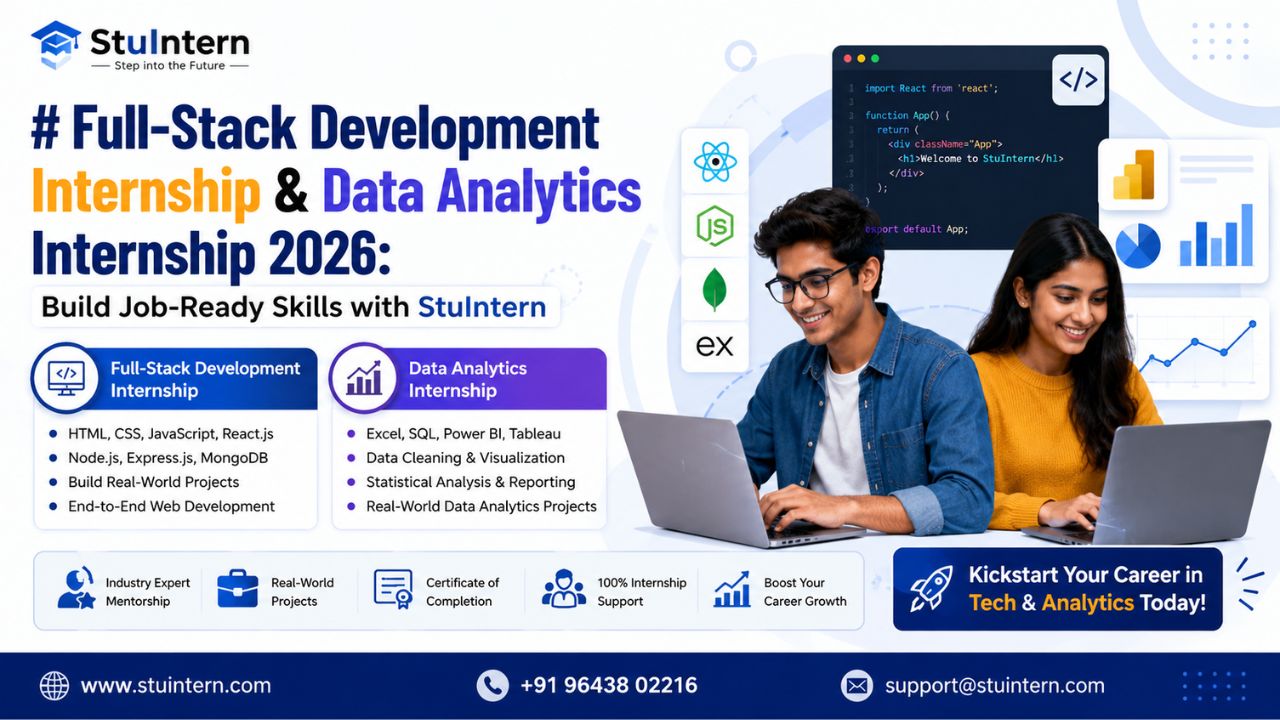
Full-Stack Development Internship & Data Analytics Internship 2026: Build Job-Ready Skills with StuIntern
Choosing the right internship in 2026 is about more than adding a certificate to your resume. Students and freshers increasingly need practical skills, portfolio projects, and experience explaining how they solved real problems. A Full-Stack Development Internship can help aspiring developers understand frontend, backend, databases,s and application deployment. In contrast, a Data Analytics Internship can help students learn how to clean, analyse, visualise, and interpret data.
StuIntern provides technology-focused internship opportunities designed around practical learning and project experience. Whether your career goal is to become a full-stack developer or data analyst, selecting an internship aligned with your target role can help turn classroom knowledge into demonstrable skills.
Quick Highlights
| Feature | Full-Stack Development Internship | Data Analytics Internship |
| Best For | Aspiring web/software developers | Aspiring data analysts |
| Core Focus | Building complete web applications | Analysing and visualizing data |
| Key Technologies | React, Node.js, Express, MongoDB | Python, SQL, Power BI, Tableau |
| Practical Output | Web applications & APIs | Dashboards & data analysis projects |
| Portfolio Value | Development projects | Analytics projects |
| Suitable For | B.Tech, BCA, MCA, CS/IT students | B.Tech, BCA, MCA, BBA, MBA, statistics & related students |
| Learning Style | Project-oriented | Dataset and project-oriented |
Table of Contents
- What is a Full-Stack Development Internship?
- What is a Data Analytics Internship?
- Why Do Students Need These Internships?
- Types of Skills and Projects
- Benefits of Full-Stack and Data Analytics Internships
- Step-by-Step Internship Learning Process
- Full-Stack vs Data Analytics Internship
- Common Mistakes Students Should Avoid
- How to Choose Between the Two
- Why Choose StuIntern?
- Frequently Asked Questions
- Conclusion
What is a Full-Stack Development Internship?
A Full-Stack Development Internship is a practical learning opportunity where students develop skills across different layers of a web application.
Instead of focusing only on website design or backend programming, full-stack learning combines multiple areas of application development.
Students may develop knowledge of:
- HTML, CSS, and JavaScript
- React or other frontend frameworks.
- Node.js
- Express.js
- MongoDB and database concepts
- REST APIs
- Authentication and authorization
- Git and version control
- Application deployment
- Debugging and testing
StuIntern’s full-stack offerings include MERN-focused development using MongoDB, Express.js, React,t and Node.js, with project-oriented learning and application development.
Example Full-Stack Project
A student could develop an online learning management system.
The project might contain:
- Student registration and login
- Admin dashboard
- Course management
- User authentication
- Database integration
- REST APIs
- Progress tracking
- Responsive frontend
- Application deployment
Completing a project like this gives students something concrete to discuss during interviews, rather than relying solely on theoretical knowledge.
What is a Data Analytics Internship?
A Data Analytics Internship teaches students how raw information can be converted into useful business insights.
Organisations generate large amounts of information through customers, sales, marketing, operations, websites, and other activities. Data analysts organise this information and identify patterns that can support better decisions.
A practical internship may introduce students to:
- Microsoft Excel
- SQL
- Python
- Pandas
- NumPy
- Data cleaning
- Exploratory Data Analysis
- Data visualization
- Power BI
- Tableau
- Dashboard development
- Basic statistics
- Reporting and presentation
StuIntern’s data-focused internship offering includes technologies and skills such as Python, SQL, Power BI, Tableau, data visualisation, and dashboard creation.
Example Data Analytics Project
Suppose an e-commerce company provides a dataset containing:
- Orders
- Customers
- Products
- Revenue
- Locations
- Dates
- Discounts
An intern could clean the dataset, analyse monthly sales, identify top-performing products,s and create an interactive Power BI dashboard.
This type of project can demonstrate both technical ability and business understanding.
Why Do Students Need a Full-Stack Development Internship or Data Analytics Internship?
Knowing concepts and applying them are two different things.
A student may understand JavaScript but struggle to build a complete application. Similarly, someone may know basic Excel formulas but not know how to analyse thousands of rows of business data.
Internships can help bridge this gap.
1. Apply Classroom Knowledge
Students get an opportunity to apply programming, database, statistics, cs and other concepts to practical tasks.
2. Develop a Portfolio
Recruiters can understand your abilities more easily when you can demonstrate projects rather than simply list technologies on a resume.
3. Understand Real Workflows
Projects introduce students to practical processes such as planning, development, testing, analysis, reporting, and documentation.
4. Discover Your Career Direction
An internship can help students determine whether they actually enjoy a particular career path before making a long-term commitment.
5. Prepare for Interviews
Working on projects gives candidates meaningful experiences to discuss when interviewers ask questions such as:
“Tell me about a project you have worked on.”
Types of Skills and Projects You Can Explore
Full-Stack Development Skills
A Full Stack Developer Internship may cover three major areas.
Frontend Development
The frontend is what users see and interact with.
Important skills can include:
- HTML5
- CSS3
- JavaScript
- React
- Responsive web design
- Component-based development
- API integration
Backend Development
The backend manages application logic and communication between the frontend and database.
Common technologies include:
- Node.js
- Express.js
- REST APIs
- Authentication
- Server-side programming
Database Development
Students also need to understand how application data is stored and retrieved.
Common database skills include:
- MongoDB
- MySQL
- Database design
- CRUD operations
- Queries
- Data validation
Data Analytics Skills
A Data Analyst Internship can focus on a different technical toolkit.
Excel
Useful for:
- Cleaning data
- Formulas
- Pivot tables
- Charts
- Basic reporting
SQL
SQL helps analysts retrieve and manipulate information stored in relational databases.
Students should practise:
- SELECT
- WHERE
- GROUP BY
- JOIN
- Subqueries
- Aggregate functions
Python
Python can help automate and perform more advanced data analysis.
Popular libraries include:
- Pandas
- NumPy
- Matplotlib
Power BI and Tableau
Visualisation platforms help convert complex datasets into understandable dashboards and reports.
Students can learn to create:
- KPI dashboards
- Sales reports
- Customer analysis
- Trend charts
- Performance reports
Benefits of Full-Stack Development Internship & Data Analytics Internship
Practical Skill Development
Internships encourage students to use tools rather than simply read about them.
Stronger Resume
Relevant project experience can make a fresher’s resume more informative.
Instead of writing:
“Knowledge of React.”
You may be able to explain:
“Built a MERN-based web application with authentication, API integration and database functionality.”
The second statement provides clearer evidence of what you have practised.
Portfolio Development
Full-stack students can showcase deployed applications, Git repositories and technical documentation.
Data analytics students can showcase dashboards, notebooks, SQL queries and analysis reports.
Problem-Solving Skills
Real datasets and applications rarely behave perfectly.
Students learn to:
- Identify errors
- Debug code
- Clean inconsistent data
- Research solutions
- Test different approaches
- Document their work
These problem-solving habits can be as valuable as learning an individual tool.
Step-by-Step Internship Learning Process
Step 1: Define Your Career Goal
First, decide what role you are targeting.
Choose Full-Stack Development if you are interested in building applications and software.
Choose Data Analytics if you enjoy working with numbers, patterns, dashboards, and business insights.
Step 2: Learn the Fundamentals
Before tackling large projects, understand the basics.
For full-stack development:
HTML → CSS → JavaScript → React → Node.js → Express → Database
For data analytics:
Excel → SQL → Python → Data Cleaning → Visualization → Power BI/Tableau
Step 3: Complete Small Practical Tasks
Start with smaller exercises.
For example:
Full Stack: Build a login page connected to a database.
Data Analytics: Analyse a sales dataset and create a dashboard.
Step 4: Work on a Complete Project
Your next goal should be combining individual skills into one meaningful project.
Step 5: Document Your Work
Explain:
- Problem statement
- Tools used
- Approach
- Challenges
- Solution
- Results
Good documentation makes your project easier for recruiters and interviewers to understand.
Step 6: Build Your Portfolio
Full-stack students can create a portfolio containing deployed applications and GitHub projects.
Data analytics students can showcase dashboards, analysis reports,s and notebooks.
Step 7: Prepare for Interviews
Practise explaining your projects without simply memorising definitions.
Be ready to answer:
- Why did you choose this technology?
- What problem did your project solve?
- What was the biggest challenge?
- How did you test your solution?
- What would you improve next?
Full-Stack Development Internship vs Data Analytics Internship
| Factor | Full-Stack Development | Data Analytics |
| Main Goal | Build applications | Generate insights from data |
| Coding Requirement | High | Moderate |
| Main Languages | JavaScript, Python/Java depending on stack | Python, SQL |
| Visualization | UI development | Charts and dashboards |
| Database Knowledge | Important | Important |
| Mathematics | Basic to moderate | Moderate |
| Popular Tools | React, Node, Express, MongoDB | Excel, SQL, Python, Power BI, Tableau |
| Typical Portfolio | Websites/web applications | Dashboards/analysis projects |
| Career Direction | Full Stack Developer, Web Developer, Software Developer | Data Analyst, BI Analyst, Junior Data Professional |
Which Internship Should You Choose in 2026?
Choose a Full-Stack Development Internship if you enjoy:
- Programming
- Building websites
- Creating applications
- Solving coding problems
- Designing application functionality
- Working with frontend and backend technologies
Choose a Data Analytics Internship if you enjoy:
- Working with datasets
- Finding patterns
- Creating dashboards
- SQL queries
- Business problem-solving
- Statistics and visualization
Neither field is automatically better.
The better internship is the one that matches your skills, interests, ts and career goals.
Common Mistakes Students Should Avoid
Choosing an Internship Only for a Certificate
A certificate can document completion, but students should also focus on what they can actually demonstrate afterwards.
Prioritize:
Skills + Projects + Portfolio + Understanding + Certificate
rather than the certificate alone.
Learning Too Many Technologies at Once
Beginners sometimes try React, Angular, Vue, Python, Java, AI, and cloud computing simultaneously.
This can create shallow knowledge.
Start with one clear learning path.
Copying Projects Without Understanding Them
Downloading source code and changing the project title provides little learning value.
Understand every major component of your project.
Ignoring Git and Documentation
Technical students should learn how to document and organise their work professionally.
Building Dashboards Without Understanding the Data
For analytics students, attractive charts are not enough.
You should be able to explain:
- What the metric means
- Why it matters
- What changed
- Why it changed
- What action could be taken?
Why Choose StuIntern for Your Internship?
StuIntern provides internship and project-oriented learning opportunities across technology fields, including Full-Stack Development and Data Science & Analytics.
Students looking for practical exposure can explore programs that combine technical learning with project work.
Practical Project Exposure
StuIntern emphasises hands-on projects designed to help learners apply technical concepts.
Multiple Technology Paths
Students can explore different career areas rather than following the same internship path.
Available areas include Full-Stack Development, Data Science & Analytics, Artificial Intelligence, Digital Marketing, HR & People Analytics,s and other skill-focused programs.
Portfolio-Oriented Learning
Projects can give students demonstrable work they can discuss in interviews and showcase in their portfolios.
Career-Focused Skill Development
The objective should be to move from:
“I have studied this technology.”
to:
“I have used this technology to build or analyse something.”
That transition is particularly important for students and fresh graduates entering competitive technology careers.
Recommended StuIntern Resources
Students interested in software development can explore the Full-Stack Development Internship options available on StuIntern, including MERN-focused development.
Students interested in analytics can explore StuIntern’s Data Science & Analytics Internship opportunities covering Python, SQL, visualisation, and dashboard-related skills.
You can also explore StuIntern’s Internship Projects section to understand the kinds of practical projects that can strengthen a student portfolio.
For broader career and internship opportunities, visit the StuIntern homepage.
Frequently Asked Questions
1. Is a Full-Stack Development Internship suitable for beginners?
Yes. Beginners can start with HTML, CSS, and JavaScript fundamentals before progressing toward frontend frameworks, backend development, databases, and APIs. Students should choose a program appropriate to their existing skill level.
2. What skills should I learn for a Data Analytics Internship?
Useful foundational skills include Excel, SQL, Python, data cleaning, basic statistics, data visualisation, and tools such as Power BI or Tableau.
3. Which is better: Full-Stack Development or Data Analytics?
It depends on your career goals. Full-stack development is more suitable for students who want to build software and web applications. Data analytics is better suited to students interested in datasets, dashboards,s and business insights.
4. Can B.Tech, BCA and MCA students apply for these internships?
These fields are highly relevant to computer science, IT, and related students. Eligibility can differ between individual internship programs, so students should always review the current program requirements before enrolling.
5. Do internship projects help during job interviews?
Yes. A well-understood project can provide concrete examples when answering technical and behavioural interview questions. Students should be able to explain their contribution, technologies, challenges,s and results.
6. Where can I find Full-Stack and Data Analytics internships?
Students can explore technology-focused internship opportunities through StuIntern, including full-stack development and data-focused programs.
Conclusion
A Full-Stack Development Internship and Data Analytics Internship can both be valuable career-building options in 2026, but they prepare students for different professional paths.
If you want to build websites, APIs, Is and complete applications, full-stack development may be the right direction. If you prefer working with datasets, SQL, Python, visualisation, and dashboards, data analytics may be a stronger match.
The most important factor is not simply completing an internship—it is finishing with skills and projects you understand and can confidently demonstrate.
Ready to build practical skills in 2026?
Explore internship programs, practical projects, and career-focused learning opportunities with StuIntern and choose a path aligned with your future career.