

Introduction
Starting a PhD research project often begins with one simple activity: reading. But as you start searching for journal articles, books, conference papers, and previous studies, the amount of information can quickly become overwhelming.
This is why learning how to conduct a proper literature review for PhD research is so important.
A literature review helps a researcher understand what has already been studied, what researchers currently know, where studies disagree, and which areas still need further investigation. It also helps connect your research topic with a clear research problem and research gap.
A good literature review is not simply a long list of references. It is a thoughtful discussion of previous research and its connection to your own study.
What Is a Literature Review in PhD Research?
A literature review is an organized study of existing academic research related to your topic.
For a PhD thesis, the review may include research articles, books, conference papers, reports, theoretical studies, and other reliable academic sources.
The main purpose of a PhD literature review is to understand the current state of knowledge in your research area.
For example, imagine your research is about artificial intelligence in higher education. You may find hundreds of studies discussing AI tools, student learning, teaching methods, academic performance, and technology acceptance.
Your job is not to describe every paper individually.
Instead, you need to understand the larger picture:
- What has already been studied?
- What methods have researchers used?
- What findings are common?
- Where do researchers disagree?
- What limitations exist?
- What areas have received less attention?
- What questions remain unanswered?
These questions can help you build a meaningful research direction.
Why Is a Literature Review Important?
A strong literature review for thesis provides the academic foundation for your research.
It can help you understand your subject before collecting new data or developing your methodology.
A good review can help you:
- Understand existing research
- Learn important theories and concepts
- Identify important researchers and studies
- Compare previous findings
- Understand research methods
- Find limitations in previous studies
- Identify a research gap
- Develop research questions
- Improve your research objectives
- Select suitable research methods
It can also prevent you from repeating research that has already been completed.
Start With a Clear Research Topic
Before searching for hundreds of papers, make your research topic as clear as possible.
A broad topic can make your search difficult.
For example:
Broad topic:
Artificial Intelligence in Education
More focused topic:
Impact of AI-Based Personalized Learning on Undergraduate Student Engagement
The second topic gives you more specific areas to search.
You can create keyword combinations based on:
- Main topic
- Research variables
- Target population
- Location
- Industry
- Technology
- Research method
This approach makes the literature search more manageable.
Create a Literature Search Strategy
A common problem among research scholars is searching without a plan.
Instead of using the same keyword again and again, create several keyword combinations.
For example, if your research is about digital learning, your search terms might include:
- digital learning
- online learning
- student engagement
- digital education
- virtual learning environment
- online student performance
- technology acceptance in education
You can combine keywords using different search terms and phrases.
The objective is to find research that is closely connected to your research problem.
Choose Relevant Academic Sources
Finding research is only the first step. You also need to decide which sources are relevant.
When evaluating a paper, consider:
Relevance
Does the study directly relate to your research topic?
Research Quality
Does the study explain its methodology clearly?
Recency
Is the study recent enough for your research area?
Findings
Does the paper provide useful evidence?
Limitations
Does the study identify limitations that may be relevant to your research?
Academic Value
Does the source contribute something useful to your understanding of the subject?
Not every paper that appears in a search result needs to be included in your thesis.
Read Research Papers With Questions in Mind
Reading research papers passively can take a lot of time.
Instead, read with specific questions.
For every important paper, ask:
What was the purpose of the study?
What research problem was investigated?
What methodology was used?
Who or what was studied?
What were the major findings?
What limitations were identified?
What did the researchers recommend for future research?
How is this study connected to my research?
These questions can help you turn reading into analysis.
Keep Your Research Notes Organized
A PhD literature review can involve a large number of sources. Without proper organization, it can become difficult to remember where particular findings came from.
Create a simple research table containing information such as:
| Researcher | Year | Topic | Method | Main Finding | Limitation |
|---|
You can add other columns depending on your subject.
This makes it easier to compare studies later.
Reference management tools can also help organize citations and references. StuIntern currently lists literature review and citation management among its research support services, including tools such as Zotero, Mendeley, and EndNote.
Do Not Write a Literature Review as a List of Summaries
This is one of the most important points for PhD scholars.
A weak review may look like this:
“Researcher A studied X. Researcher B studied Y. Researcher C studied Z.”
Although this provides information, it does not show enough critical thinking.
A stronger review connects the studies.
For example:
“Several studies have found a positive relationship between X and Y. However, these studies mainly focused on urban populations. Research involving rural populations remains limited, creating an opportunity for further investigation.”
This style shows comparison and analysis.
That is what makes a research literature review useful.
How to Identify a Research Gap
One of the most important purposes of a literature review is finding a research gap.
A research gap is an area where existing knowledge is incomplete, limited, inconsistent, or not sufficiently explored.
You may identify a gap by looking at:
Different Research Findings
Two studies may produce different results.
This difference can lead to an interesting research question.
Limited Research Population
Previous studies may focus on one group while another relevant group receives little attention.
Geographic Limitations
Research may be concentrated in certain countries or regions.
Methodological Limitations
Previous research may rely heavily on one method.
Limited Variables
Researchers may have studied some factors while leaving other important variables unexplored.
Changing Technology or Conditions
A study may have been conducted several years ago, while technology, policies, markets, or social conditions have changed.
However, you should not assume that something is a research gap simply because you cannot find a paper about it.
Always conduct a broader and more recent literature search before making that claim.
How Literature Review and Research Gap Are Connected
The connection between literature review and research gap is very important.
The literature review provides the evidence.
The research gap explains what is still missing.
Your research then attempts to address that gap.
A simple flow is:
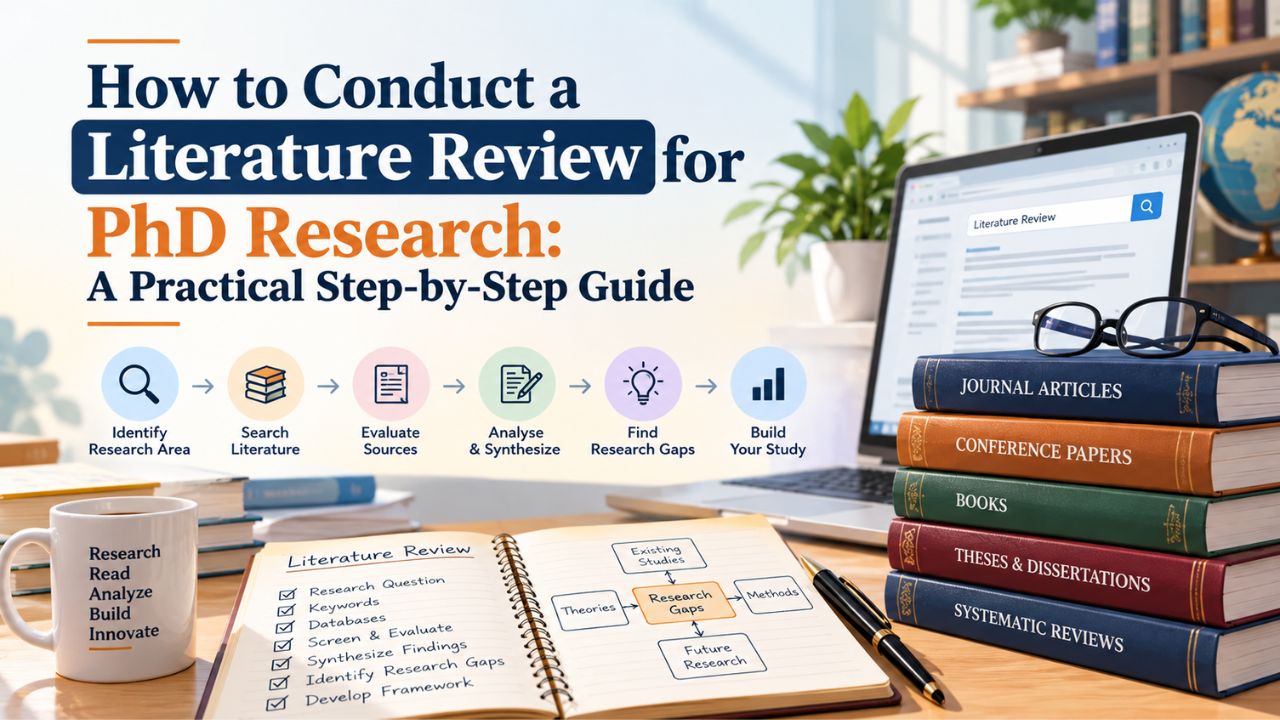
Existing Research → Critical Analysis → Research Gap → Research Question → Research Objectives → Methodology
If these parts are connected logically, your research proposal and thesis can become much clearer.
StuIntern's academic services currently include university-approved synopsis and research-gap support as well as comprehensive literature review analysis.
Develop Themes Instead of Reviewing Papers One by One
One useful way to organize a literature review is by themes.
Suppose your research is about employee adoption of artificial intelligence.
You might organize the review around:
Theme 1: AI Adoption
Discuss studies examining why organizations adopt AI.
Theme 2: Employee Acceptance
Review research about employee attitudes toward new technologies.
Theme 3: Skills and Training
Discuss studies about employee skills and training requirements.
Theme 4: Organizational Factors
Examine leadership, organizational culture, resources, and other relevant factors.
Theme 5: Research Gaps
Bring the themes together and identify what existing research has not adequately addressed.
This structure can make a long literature review easier to understand.
Understand the Difference Between Narrative and Systematic Literature Review
Not every research project requires the same type of review.
A narrative or traditional literature review generally discusses and synthesizes relevant research around a topic.
A systematic literature review follows a more clearly defined process for searching, selecting, evaluating, and synthesizing studies.
Depending on the research question, a systematic review may involve:
- Search strategies
- Databases
- Inclusion criteria
- Exclusion criteria
- Screening
- Quality assessment
- Data extraction
- Evidence synthesis
The appropriate approach depends on your research objectives and academic field.
StuIntern also lists systematic review and meta-analysis support among its research services.
Connect the Literature Review With Your Methodology
Your literature review should not exist separately from the methodology chapter.
Previous research can help you understand which methods have been used to study similar problems.
For example, previous researchers may have used:
- Surveys
- Interviews
- Case studies
- Experiments
- Secondary data
- Statistical analysis
- Qualitative analysis
- Mixed-method research
You can evaluate these approaches and decide which methods are appropriate for your own research.
The final methodology should be based on your research questions and objectives rather than simply copying another study.
Common Problems in Literature Review Writing
PhD scholars often face a few common problems while preparing their reviews.
Too Many References
Adding more papers does not automatically make a literature review stronger.
Relevant and useful research is more important than the total number of citations.
Lack of Critical Analysis
Simply describing papers is not enough. Compare their findings, methods, limitations, and conclusions.
Poor Structure
A review should have a clear flow. Readers should understand why one topic leads to the next.
Unsupported Research Gap
Do not claim that “no research exists” without conducting a sufficiently broad search.
Outdated Sources
Older studies can be valuable, especially foundational research, but recent research should also be considered where relevant.
Citation Errors
Incorrect references or inconsistent citation styles can create unnecessary academic problems.
How to Improve Your Literature Review
After writing the first draft, read it again from the perspective of someone who does not know your research.
Ask yourself:
- Is the topic clearly introduced?
- Are the major studies included?
- Are studies compared rather than simply summarized?
- Is the research gap supported?
- Does the review connect with my research questions?
- Does the methodology follow logically?
- Are the references accurate?
- Is the writing clear?
- Have I included recent and relevant studies?
If the answer to these questions is yes, your review will have a stronger foundation.
When Should You Start Writing the Literature Review?
Do not wait until your entire research project is finished.
Start reviewing literature during the early stages of your research.
Early reading can help you:
- Refine your research topic
- Develop a problem statement
- Understand existing theories
- Identify variables
- Find potential research gaps
- Develop research questions
- Choose a research methodology
At the same time, literature searching should continue throughout your research because new studies may become available.
How StuIntern Supports PhD Research
Preparing a detailed literature review requires time, organization, and careful academic reading.
StuIntern currently provides research support covering literature review services, research-gap analysis, thesis writing and structuring, research methodology, data analysis, and publication-related assistance.
The platform also describes literature review and citation management as part of its research support, alongside thesis structuring, research paper publication, methodology consultation, and systematic review services.
For scholars who need literature review support, the goal should be to understand the research clearly, organize existing evidence, and develop their own academic contribution.
Frequently Asked Questions
What is the purpose of a literature review in PhD research?
The main purpose is to understand existing research, compare previous findings, identify limitations, establish academic context, and find a research gap that connects with the proposed study.
How many papers should I read for my PhD literature review?
There is no fixed number. The required amount depends on your research topic, discipline, university guidelines, thesis scope, and availability of relevant literature.
How do I identify a research gap?
Compare recent and relevant studies, examine conflicting findings, limitations, research populations, methodologies, geographical areas, and future research recommendations.
What is the difference between a literature review and a systematic literature review?
A systematic literature review follows a predefined and structured process for searching, selecting, evaluating, and synthesizing research. A traditional review can be more flexible in how literature is selected and discussed.
Should I use recent papers in my literature review?
Yes, recent research is important for understanding the current state of your field. However, older studies may still be necessary when they provide foundational theories, models, or important discoveries.
Can a literature review help develop research questions?
Yes. Understanding what has already been studied and what remains unclear can help you develop focused and meaningful research questions.
Does StuIntern provide literature review support?
StuIntern's current academic research services include comprehensive literature review analysis, citation management, research-gap support, methodology guidance, and related thesis and publication services.
Final Thoughts
A good literature review takes time, but it can make the rest of your PhD research much easier.
The goal is not to collect as many papers as possible. The real goal is to understand the existing research, compare important findings, identify limitations, and explain where your research can contribute.
When you approach the process step by step, a large collection of research papers becomes easier to manage.
Start with a focused topic. Search carefully. Read critically. Organize your sources. Compare studies. Identify the research gap. Then connect that gap with your research questions and methodology.
For scholars looking for PhD literature review services, literature review writing services, or literature review support for PhD research, StuIntern provides academic research services designed around literature review, research methodology, thesis development, data analysis, and publication support.
Website: https://www.stuintern.com/
Call / WhatsApp: +91 81308 34430