

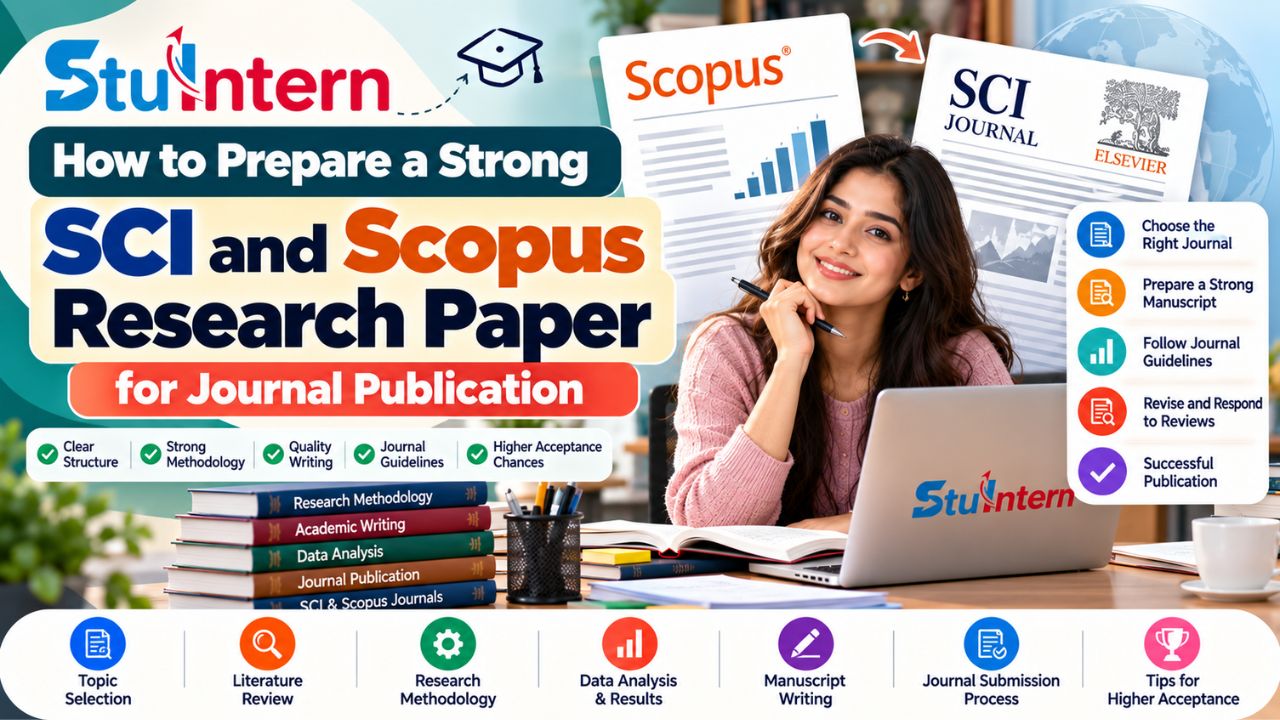
Introduction
Publishing a research paper in a reputed journal is an important goal for many PhD scholars, researchers, and postgraduate students. But having a good research idea is only the beginning. A paper also needs clear writing, a suitable research method, proper analysis, relevant references, and a structure that matches the requirements of the selected journal.
Many researchers find the publication process confusing, especially when they are preparing their first paper for an SCI or Scopus-indexed journal. They may know their research topic well but still have questions about manuscript structure, journal selection, formatting, citations, and reviewer comments.
This is where proper academic guidance can make the process easier.
StuIntern provides research paper support for SCI and Scopus publication, including manuscript preparation, formatting, citation alignment, and submission-related guidance. Its academic services also cover literature reviews, research methodology, data analysis, and publication-ready paper preparation.
Why Publishing in SCI and Scopus Journals Matters
Research becomes more useful when it is shared with the academic community. Journal publication gives researchers an opportunity to communicate their findings, receive feedback, and contribute to existing knowledge.
For PhD scholars, research publications can also form an important part of their academic profile. However, publication should not be treated simply as a numbers game. The quality of the research, the suitability of the journal, and responsible academic practices are all important.
Researchers should therefore focus on producing a paper that clearly explains:
- What problem was studied?
- Why is the problem important?
- What has previous research found?
- What is missing from existing research?
- What method was used?
- What were the findings?
- What do the findings mean?
- How does the study contribute to the field?
Answering these questions clearly can make a research paper easier to understand and evaluate.
What Makes a Good SCI or Scopus Research Paper?
A strong manuscript is not necessarily the one with the most complicated language. Academic writing should be clear, precise, and supported by evidence.
A good research paper normally has:
- A focused research problem
- A clear research objective
- A meaningful research gap
- Relevant literature
- Appropriate methodology
- Reliable data
- Logical analysis
- Clear results
- A balanced discussion
- Accurate references
- A well-written conclusion
The paper should also follow the specific instructions of the journal selected by the researcher.
Start With a Clear Research Problem
Before writing the manuscript, researchers should understand exactly what they are trying to investigate.
A broad topic such as “Artificial Intelligence in Education” may be difficult to develop into a focused research paper. A more specific question can provide a clearer direction.
For example, a researcher could examine how a particular AI-based learning system affects student engagement in a defined educational setting.
The exact research question will depend on the field, available data, and research objectives.
A clear problem helps determine the research methodology, data requirements, analysis, and overall structure of the paper.
Identify the Research Gap
A research gap explains what is missing, limited, unclear, or insufficiently explored in previous research.
Finding a gap requires reading existing studies carefully rather than simply searching for a topic online.
While reviewing previous literature, researchers can look for:
- Conflicting findings
- Limited sample sizes
- Unexplored populations
- Different geographical settings
- Methodological limitations
- Areas that have received little attention
- New developments that previous studies have not covered
The research gap should connect directly with the purpose of the new study.
A paper becomes stronger when the researcher can clearly explain why another study is needed.
Build a Useful Literature Review
A literature review should provide the background needed to understand the research problem.
Simply collecting dozens of papers is not enough. Researchers need to read, compare, and connect previous studies.
A useful literature review can answer questions such as:
- What do researchers already know?
- Which theories are commonly used?
- What methods have previous researchers applied?
- Where do previous findings agree?
- Where do they differ?
- What limitations have researchers identified?
- What area needs further investigation?
References should be selected carefully and cited correctly.
StuIntern's research services include comprehensive literature-review support and citation management as part of its academic research offerings.
Choose the Right Research Method
The methodology is one of the most important parts of a research paper.
The selected method should match the research question and objectives. Depending on the project, researchers may use quantitative, qualitative, or mixed-method approaches.
For quantitative research, the study may involve surveys, experiments, statistical testing, regression, or other numerical techniques.
Qualitative research may involve interviews, observations, case studies, document analysis, or thematic analysis.
Some studies combine both approaches.
The important point is that the methodology should be explained clearly enough for readers to understand how the research was conducted.
Organize the Research Paper Properly
Most research papers follow a logical sequence, although the exact structure depends on the journal and discipline.
A common structure includes:
Title
The title should describe the main subject of the research clearly.
Abstract
The abstract gives readers a short overview of the study, including the objective, methodology, major findings, and conclusion.
Introduction
The introduction presents the background, research problem, gap, and objectives.
Literature Review
This section discusses relevant previous research and establishes the academic context of the study.
Methodology
The methodology explains the research design, participants or samples, data collection, tools, and analysis methods.
Results
The results present the findings obtained from the research.
Discussion
The discussion explains the meaning of the findings and compares them with previous research.
Conclusion
The conclusion summarizes the main findings and explains the contribution of the study.
References
All sources used in the paper should be properly cited and listed according to the journal's requirements.
Pay Attention to Data Analysis
Good research depends not only on collecting data but also on analyzing it appropriately.
Researchers may use tools such as SPSS, R, Python, MATLAB, or other statistical and analytical software depending on the subject and research design.
Data analysis can include:
- Descriptive statistics
- Correlation
- Regression
- Hypothesis testing
- Predictive analysis
- Classification
- Data visualization
- Qualitative coding
- Statistical modeling
The selected technique should be justified by the research question and methodology.
StuIntern currently lists support for statistical analysis using SPSS, R, Python, MATLAB, and advanced data visualization, along with statistical modeling and machine-learning research support.
Select a Journal Carefully
Journal selection is an important part of the publication process.
Before submitting a paper, researchers should check:
- Journal subject area
- Scope of the journal
- Article types accepted
- Author guidelines
- Current indexing status
- Formatting requirements
- Reference style
- Submission process
- Publication policies
- Peer-review process
Researchers should verify indexing information using reliable and current sources rather than depending only on third-party websites.
The journal should also be relevant to the research topic. A well-written manuscript can still be unsuitable if it does not match the journal's scope.
Follow the Journal Guidelines
Every journal has its own requirements.
One journal may require a specific reference style, while another may have different rules for figures, tables, headings, or supplementary information.
Before submission, researchers should compare the manuscript against the journal's latest author guidelines.
Check:
- Word count
- Abstract format
- Keywords
- Heading structure
- Tables
- Figures
- References
- Citation format
- Author information
- Ethical statements
- Supplementary files
Following these instructions can prevent avoidable technical problems during submission.
What Are SCI Scopus Paper Writing Services?
SCI Scopus paper writing services generally provide academic assistance for researchers preparing manuscripts for SCI or Scopus-indexed journals.
Depending on the provider, support may include:
- Research paper structure
- Literature review guidance
- Methodology presentation
- Manuscript editing
- Reference formatting
- Citation management
- Journal formatting
- Submission preparation
- Reviewer-response guidance
Researchers should remain involved in their work and ensure that the final manuscript accurately represents their own research, data, methods, and findings.
StuIntern's current service information describes its SCI/Scopus support as covering publication-ready manuscripts, formatting, citations, originality, and journal-specific preparation across multiple subject areas.
SCI and Scopus Paper Support Across Different Subjects
Research publication requirements can vary significantly by discipline.
StuIntern's SCI/Scopus research services cover areas including Science, Engineering, Pharmacy, Management, Commerce and Accounting, Arts and Humanities, and Medical Sciences.
For example, pharmaceutical research may involve drug delivery, pharmaceutical chemistry, pharmacokinetics, pharmaceutical analysis, or regulatory research.
Medical and public-health research may involve areas such as epidemiology, healthcare systems, biostatistics, disease prevention, health policy, and related topics.
This makes subject knowledge particularly important when preparing a technical research manuscript.
Common Problems That Can Delay Publication
Researchers often spend a lot of time developing their study but give less attention to the final manuscript.
Some common problems include:
Weak Introduction
The introduction does not clearly explain the research problem or purpose.
Unclear Research Gap
The manuscript does not explain what is missing from previous studies.
Poor Methodology Description
Readers cannot understand how the research was conducted.
Weak Discussion
The results are presented but their meaning is not properly explained.
Inconsistent References
Citations and reference lists do not follow the journal's requirements.
Journal Mismatch
The paper is submitted to a journal whose scope does not fit the research.
Formatting Problems
The manuscript does not follow the journal's technical instructions.
Checking these areas before submission can improve the overall quality of the manuscript.
How to Prepare Before Submission
Before clicking the submit button, take some time to review the complete paper.
Ask yourself:
Is the research question clear?
Does the literature review support the research problem?
Is the research gap properly explained?
Does the methodology match the objectives?
Are the results presented clearly?
Does the discussion explain the findings?
Are all references accurate?
Does the manuscript follow the journal's guidelines?
Is the journal currently suitable for the paper?
A final review can help identify issues that may not be obvious while writing individual sections.
How StuIntern Can Help With SCI and Scopus Research Papers
StuIntern presents its research services as support for scholars working through different stages of academic research. Its services include publication-ready paper writing, literature review, research methodology, data analysis, and global-standard SCI/Scopus paper support.
The dedicated SCI/Scopus service also covers different academic domains and describes support around manuscript preparation, citations, originality, formatting, and publication readiness.
For researchers, this type of structured support can be useful when they need help understanding the technical and editorial side of journal publication while remaining responsible for their research and academic decisions.
Frequently Asked Questions
What are SCI Scopus paper writing services?
SCI Scopus paper writing services provide academic assistance with preparing, editing, formatting, and organizing research manuscripts intended for relevant SCI or Scopus-indexed journals.
How can I prepare my paper for a Scopus journal?
Start with a clear research problem, conduct a strong literature review, explain the research gap, use an appropriate methodology, present your findings clearly, and follow the target journal's current author guidelines.
Can PhD scholars get SCI and Scopus research support?
Yes. PhD scholars may seek support with literature review, methodology, manuscript structure, data analysis, editing, formatting, and publication preparation.
Is journal selection important?
Yes. The journal should match the subject and scope of the research. Researchers should also verify its current indexing status and read the latest submission requirements.
What is the role of a research gap?
A research gap explains what previous studies have not adequately addressed. It helps establish the reason for conducting the new research.
Does StuIntern provide research paper support?
StuIntern's current services include publication-ready paper writing and SCI/Scopus paper support, along with literature review, methodology, and data-analysis services.
Final Thoughts
A successful research paper starts long before journal submission. It begins with a useful research question, a clear gap, suitable methodology, reliable evidence, and careful analysis.
Once the research is completed, the findings need to be presented in a way that is clear and appropriate for the target journal. This includes manuscript structure, references, formatting, and careful checking of journal requirements.
For researchers searching for SCI Scopus Paper Writing Services, the most useful support is guidance that helps them understand and improve their own research while maintaining academic integrity.
StuIntern offers research and publication support for different academic fields, including SCI/Scopus manuscript preparation and related research services.
Website: Stuintern.com
Contact: +91 81308 34430