

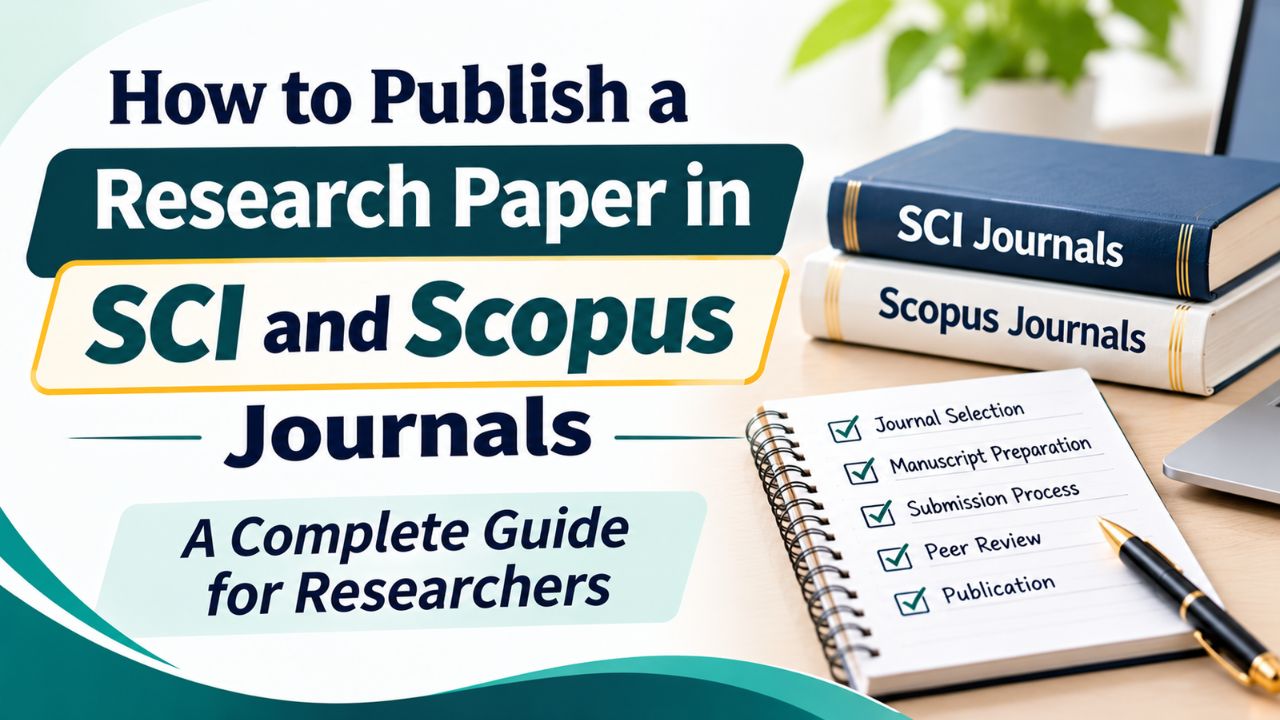
Introduction
Publishing a research paper in a recognised academic journal is an important achievement for students, researchers and PhD scholars. It helps researchers share their findings, contribute to existing knowledge and build their academic profiles.
However, preparing a research manuscript for journal publication requires careful planning. Researchers must select a relevant topic, conduct a detailed literature review, follow an appropriate methodology, analyse findings and present their work according to journal guidelines.
Many researchers face difficulties during this process. Some struggle with manuscript preparation, while others find it difficult to select a suitable journal or respond to reviewer comments.
Understanding the publication process can help researchers avoid common mistakes and improve the quality of their manuscripts.
SCI Scopus Paper Writing Services can provide academic guidance throughout manuscript preparation, editing, journal selection and submission. In this guide, we explain the important stages of research paper publication and how researchers can prepare their work for academic journals.
What Are SCI and Scopus Journals?
SCI and Scopus are associated with major academic indexing systems used to discover and evaluate scholarly publications.
Researchers often aim to publish in these journals because indexed publications can improve research visibility and support academic career development.
However, SCI and Scopus are not the same indexing system.
SCI (Science Citation Index) is a citation index within Clarivate's Web of Science platform. Researchers also commonly encounter SCIE (Science Citation Index Expanded), which covers a broader collection of scientific journals.
Scopus is an abstract and citation database maintained by Elsevier. It covers academic journals, conference proceedings, book series and other scholarly sources across different disciplines.
Both systems help researchers discover published studies and examine citation information.
Difference Between SCI and Scopus Journals
| Basis | SCI/SCIE | Scopus |
|---|---|---|
| Platform | Web of Science | Elsevier |
| Main purpose | Citation indexing | Abstracting and citation indexing |
| Coverage | Selected scholarly journals | Journals, conferences and other sources |
| Subject areas | Mainly scientific and related disciplines | Multiple academic disciplines |
| Evaluation | Journal selection and coverage criteria | Source selection and evaluation criteria |
| Verification | Clarivate Master Journal List | Scopus Sources |
Researchers should verify the current indexing status of a journal before submitting their manuscripts.
A journal's previous indexing status does not automatically confirm its current coverage.
Why Is SCI and Scopus Research Paper Publication Important?
Academic publication allows researchers to communicate their findings with the wider research community.
It also creates opportunities for academic collaboration, further investigation and professional development.
There are several reasons why researchers aim for SCI and Scopus journal publication.
1. Builds Academic Recognition
Publishing in a recognised academic journal can strengthen a researcher's academic profile.
It demonstrates the ability to conduct research, analyse information and communicate findings in a structured academic format.
For PhD scholars, journal publications may also support academic milestones, depending on their university requirements.
2. Improves Research Visibility
Research publication makes academic findings accessible to other researchers, students and professionals.
Indexed publications can be discovered through academic databases, helping interested readers find relevant research.
Greater visibility may create opportunities for citations and academic collaboration.
3. Supports Research Development
Preparing a research paper encourages researchers to examine existing studies, identify research gaps and develop meaningful questions.
The peer-review process can also provide feedback that helps authors improve their work.
4. Strengthens Academic Career Opportunities
Research publications can be useful when applying for academic positions, research opportunities, fellowships and higher education programmes.
However, the importance of a publication depends on the institution, subject area and applicable evaluation criteria.
How to Prepare a Research Paper for SCI and Scopus Journals
A strong research manuscript requires more than good academic writing. It must present a clear research problem, reliable evidence and meaningful findings.
The following steps can help researchers prepare their manuscripts.
Step 1: Select a Relevant Research Topic
Topic selection is the starting point of a successful research paper.
Researchers should select a subject that is relevant to their academic field and offers an opportunity to contribute something meaningful.
Before finalising a topic, consider:
- Relevance to your research area.
- Availability of academic literature.
- Research originality.
- Practical importance.
- Availability of reliable data.
- Scope for further investigation.
For example, a computer science researcher may investigate machine learning applications in healthcare, while a management scholar may study digital transformation and employee productivity.
A focused research topic makes it easier to develop research questions and select appropriate methods.
Step 2: Identify a Research Gap
A research gap is an unanswered question, limitation or underexplored area in existing academic studies.
Identifying a research gap helps researchers explain why their study is necessary.
To identify a suitable research gap:
- Read relevant research papers.
- Examine the objectives and findings of previous studies.
- Compare different research approaches.
- Identify limitations in existing literature.
- Examine areas requiring further investigation.
- Develop a clear research question.
A research paper should offer a meaningful contribution rather than simply repeat previously published findings.
Step 3: Conduct a Detailed Literature Review
A literature review examines existing academic publications related to the selected research topic.
It helps researchers understand current knowledge, compare previous findings and establish the academic background of their study.
Useful sources include:
- Peer-reviewed journal articles.
- Academic books.
- Conference proceedings.
- Research databases.
- University repositories.
- Relevant government publications.
Researchers should evaluate the credibility, relevance and publication details of each source.
A strong literature review connects previous research with the current study and explains how the proposed research adds value.
Step 4: Select an Appropriate Research Methodology
Research methodology explains how the study is designed and conducted.
The methodology should match the research objectives and the type of information being investigated.
Common research approaches include:
Qualitative Research: Focuses on experiences, opinions, observations and interviews.
Quantitative Research: Uses numerical information, surveys, experiments and statistical analysis.
Mixed-Method Research: Combines qualitative and quantitative techniques.
Researchers should clearly explain their sampling methods, data collection process and analytical techniques.
The methodology must also address research ethics, data accuracy and relevant limitations.
Step 5: Collect and Analyse Research Data
Data collection and analysis are important parts of research paper preparation.
Researchers should use suitable methods to collect reliable information and analyse it according to their research objectives.
Some commonly used tools include:
| Software | Research application |
|---|---|
| SPSS | Statistical analysis |
| Python | Data processing and machine learning |
| R | Statistical computing |
| MATLAB | Mathematical modelling |
| Microsoft Excel | Data organisation and visualisation |
| NVivo | Qualitative data analysis |
The results should be presented accurately through tables, graphs, figures and explanations.
Researchers should never manipulate or fabricate data to achieve a preferred outcome.
Step 6: Prepare the Research Manuscript
After completing the research and analysis, the next step is manuscript preparation.
A standard research paper generally contains the following sections:
- Title: Clearly describes the research topic.
- Abstract: Summarises the purpose, methodology and main findings.
- Keywords: Identifies the central concepts of the paper.
- Introduction: Explains the research background and problem.
- Literature Review: Discusses relevant previous studies.
- Methodology: Describes the research design and methods.
- Results: Presents the findings.
- Discussion: Explains the meaning and importance of the results.
- Conclusion: Summarises the research contribution and limitations.
- References: Lists the sources used in the manuscript.
The exact structure depends on the selected journal and research discipline.
How to Select the Right SCI or Scopus Indexed Journal
Journal selection is one of the most important stages of academic publication.
Submitting a manuscript to an unsuitable journal can lead to rejection, unnecessary delays or avoidable publication expenses.
Researchers should evaluate journals carefully before submission.
Important Factors to Check Before Journal Selection
1. Subject Relevance
Choose a journal that regularly publishes research related to your subject.
Read its aims, scope and recently published articles.
2. Indexing Status
Verify whether the journal is currently covered by the indexing database you require.
For Scopus, check the official Scopus Sources database.
For SCI and SCIE, check Clarivate's Master Journal List.
3. Publication Guidelines
Read the journal's author instructions.
Check manuscript length, reference style, formatting, figures, tables and submission requirements.
4. Peer-Review Process
Understand the journal's review procedure and editorial policies.
5. Publication Charges
Check whether the journal charges submission fees, article processing charges or other publication-related costs.
6. Publication Ethics
Review the journal's policies on plagiarism, authorship, conflicts of interest, data availability and research ethics.
Researchers should avoid journals that promise guaranteed acceptance or publication without genuine editorial assessment.
Common Reasons Why Research Papers Get Rejected
Research paper rejection is a normal part of academic publishing. Even well-prepared manuscripts may receive negative decisions.
However, understanding common rejection reasons can help authors improve future submissions.
| Rejection reason | How to improve |
|---|---|
| Weak research contribution | Explain the originality and importance of the study |
| Poor methodology | Select and justify suitable research methods |
| Limited literature review | Include relevant and reliable studies |
| Incorrect journal selection | Match the manuscript with the journal scope |
| Poor academic writing | Improve clarity and sentence structure |
| Inaccurate references | Verify every citation and reference |
| Weak data analysis | Use suitable analytical methods |
| Formatting problems | Follow the journal's submission guidelines |
Researchers should carefully review editorial and reviewer feedback.
If the journal allows resubmission or revision, prepare a detailed response explaining how each concern has been addressed.
How SCI Scopus Paper Writing Services Support Researchers
Preparing a research manuscript can be challenging, particularly for PhD scholars and researchers managing multiple academic responsibilities.
SCI Scopus Paper Writing Services can provide structured academic guidance at different stages of manuscript preparation.
The scope of assistance may include:
Research Topic and Journal Selection
Researchers may need help identifying suitable topics and matching their manuscripts with relevant journals.
Journal selection should consider subject relevance, indexing status, publication policies and author requirements.
Research Paper Writing and Editing
Academic editing can improve sentence clarity, logical flow, grammar and consistency.
Researchers should ensure that the final manuscript accurately represents their own research and contributions.
Literature Review and Referencing
Guidance with literature reviews can help authors organise previous studies and establish the academic foundation of their research.
Proper citation practices also help maintain research integrity.
Statistical Analysis and Data Presentation
Researchers working with quantitative data may require support with statistical testing, interpretation and visual presentation.
Suitable tools should be selected according to the research design.
Journal Formatting and Submission Guidance
Every journal follows its own manuscript preparation requirements.
Support may include:
- Manuscript formatting.
- Abstract and keyword review.
- Reference style correction.
- Figure and table formatting.
- Cover letter preparation.
- Submission checklist review.
- Guidance on reviewer comments.
These services should support the researcher's work rather than replace independent research or authorship responsibilities.
Why Choose StuIntern for SCI and Scopus Publication Support?
StuIntern provides academic research and publication support for researchers, PhD scholars and postgraduate students.
Its SCI Scopus Paper Writing Services focus on important stages of research manuscript preparation, including research validation, technical editing, journal formatting and submission guidance.
The service areas include:
- Research paper preparation and editing.
- SCI and Scopus journal formatting.
- Literature review guidance.
- Research methodology support.
- Data analysis and result interpretation.
- Citation and reference alignment.
- Pre-submission manuscript review.
- Journal selection and submission guidance.
StuIntern also highlights manuscript validation, technical checks and publication workflow support through its research services.
Researchers can discuss their requirements and understand the available support before beginning the process.
Visit the official service page:
SCI and Scopus Paper Writing Services – StuIntern
The objective is to help researchers prepare clear, accurate and well-organised manuscripts while maintaining academic integrity.
Frequently Asked Questions About SCI and Scopus Publications
1. What is the difference between SCI and Scopus journals?
SCI/SCIE journals are covered by Clarivate's Web of Science indexing system, while Scopus journals are covered by Elsevier's Scopus database. Both are academic indexing systems, but their coverage and selection processes differ.
2. How can I publish a research paper in a Scopus indexed journal?
Prepare an original research manuscript, select a suitable journal, follow its author guidelines and submit the paper through its official submission system. The manuscript must pass the journal's editorial and peer-review process.
3. How do I check whether a journal is Scopus indexed?
Search for the journal by title or ISSN using the official Scopus Sources database. Verify its current coverage years and publication status before submitting your manuscript.
4. What is the importance of a research gap?
A research gap identifies an unanswered question or limitation in existing studies. It helps researchers develop meaningful research questions and explain the contribution of their work.
5. Can a research paper be published without a literature review?
A literature review is an important part of most research manuscripts. It establishes the background of the study, explains existing knowledge and helps demonstrate the originality of the research.
6. What is peer review in academic publishing?
Peer review is an evaluation process in which independent subject specialists assess a submitted manuscript. They may examine its originality, methodology, research contribution, accuracy and presentation.
7. How long does SCI or Scopus publication take?
Publication time varies by journal, subject, editorial workload and review requirements. There is no universal publication timeline or guaranteed acceptance period.
8. What are the common reasons for research paper rejection?
Common reasons include weak originality, unsuitable methodology, poor journal selection, incomplete literature reviews, inaccurate data presentation and failure to follow author guidelines.
9. Do SCI and Scopus journals charge publication fees?
Some journals charge article processing or publication fees, while others do not. Researchers should check the official journal website for transparent information about applicable charges.
10. How can StuIntern help with SCI and Scopus paper publication?
StuIntern provides research publication support covering manuscript preparation, editing, formatting, research methodology, data analysis and journal submission guidance. Researchers can contact the team to discuss their requirements.
Conclusion
Publishing a research paper in an SCI or Scopus indexed journal requires careful research, proper manuscript preparation and a suitable publication strategy.
From identifying a research gap to selecting a journal and responding to reviewer comments, every stage contributes to the quality of the final manuscript.
Researchers should focus on originality, accurate data, appropriate methodology and ethical publication practices.
Choosing the right journal is equally important. Always verify indexing information and read the journal's official publication guidelines before submitting your work.
StuIntern provides academic research and publication support to help researchers understand the manuscript preparation and submission process.
Website: www.stuintern.com
Call/WhatsApp: +91 96438 02216