

Introduction
Writing a PhD thesis is a major part of a doctoral research journey. It takes time, patience, careful planning and a clear understanding of the research topic. Many scholars spend months collecting information, reading academic papers and conducting research. However, when it is time to put everything into a complete thesis, they often face one common question: How should the thesis be structured?
A well-organised thesis helps readers understand the research from beginning to end. It presents the research problem, explains the objectives, describes the methodology, discusses the findings and shows what the study contributes to the subject.
A clear PhD thesis structure also makes the writing process easier. Instead of trying to write the entire document at once, scholars can work on individual chapters and improve them step by step.
In this guide, we will explain the common chapters of a PhD thesis, what to include in each section, how to organise your research and which mistakes to avoid.
What Is a PhD Thesis Structure?
A PhD thesis structure is the organised arrangement of chapters and sections used to present doctoral research. It provides a logical order for explaining the research journey, from introducing the topic to presenting the conclusions.
The exact format may differ between universities, departments and research disciplines. For example, a thesis in engineering may include technical design, experiments and simulation results, while a thesis in management may focus on business concepts, surveys, statistical analysis and interpretation.
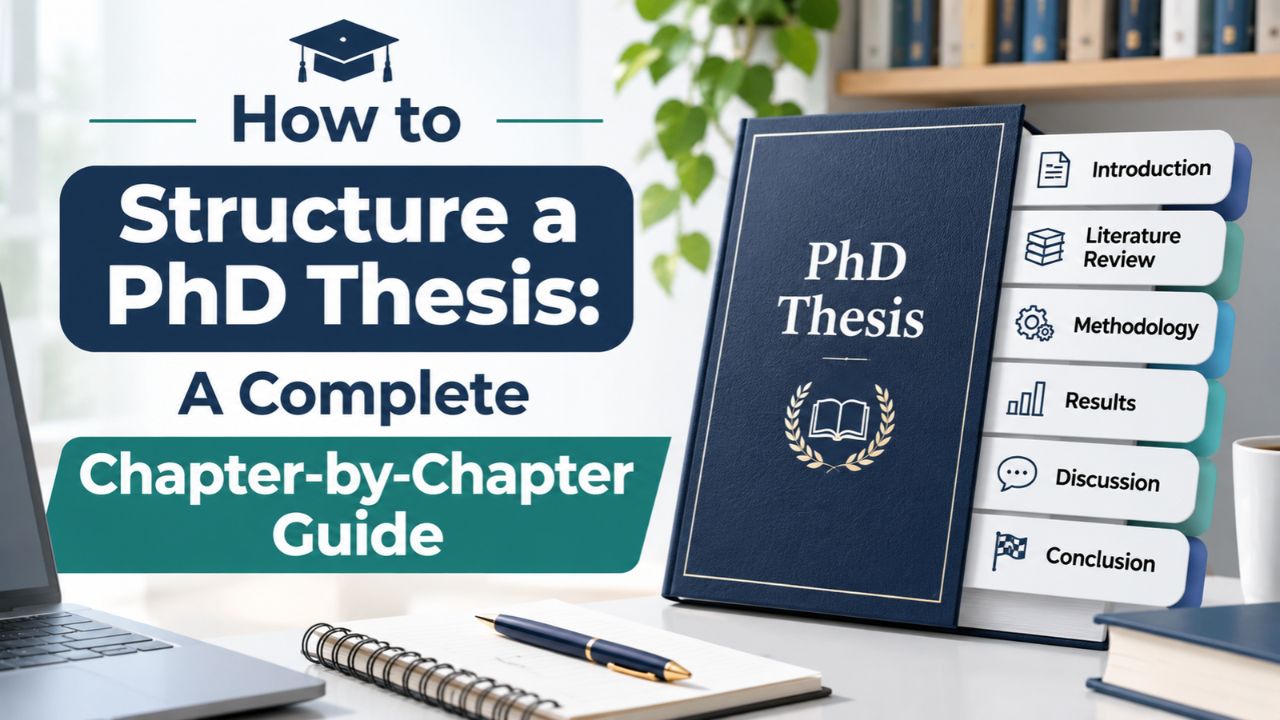
However, most traditional PhD theses include these major parts:
- Preliminary pages
- Introduction
- Literature review
- Research methodology
- Results or findings
- Discussion
- Conclusion and recommendations
- References and appendices
Before starting, always check your university’s official thesis guidelines. The required chapter order, formatting rules and word limits may be different.
Common Chapters of a PhD Thesis
A traditional doctoral thesis usually follows a chapter-based format. Each chapter has a separate purpose, but all chapters work together to explain the research.
1. Preliminary Pages
The preliminary pages appear before the main chapters. They provide basic information about the research and help readers navigate the document.
These pages commonly include:
- Title Page: Contains the thesis title, scholar’s name, university and department details.
- Declaration: A statement of originality, where required by the university.
- Certificate or Approval Page: Included according to institutional requirements.
- Acknowledgement: Thanks supervisors, institutions and individuals who provided appropriate support.
- Abstract: A summary of the research problem, objectives, methodology, main findings and conclusion.
- Table of Contents: Lists chapters and their page numbers.
- List of Tables and Figures: Helps readers locate visual information.
- List of Abbreviations: Explains abbreviations and technical terms used in the thesis.
These sections should be arranged according to the university’s prescribed format.
2. Chapter One: Introduction
The introduction is the starting point of your thesis. It introduces the research topic and explains what the study intends to investigate.
A good introduction should give readers enough background to understand the research problem and its importance.
Common sections include:
Background of the Study: Explain the topic, its context and the relevant developments that led to the research.
Research Problem: Describe the specific issue or question that the study addresses.
Research Aim and Objectives: State the overall purpose of the study and the smaller objectives that will help achieve it.
Research Questions or Hypotheses: Present the questions the study intends to answer or hypotheses it will test, where applicable.
Significance of the Study: Explain the potential academic or practical value of the research.
Scope of the Study: Clarify what the research covers and its boundaries.
Thesis Organisation: Briefly explain what readers can expect in the remaining chapters.
The introduction should be focused and consistent with the rest of the thesis. Avoid including every detail of the literature or methodology at this stage.
3. Chapter Two: Literature Review
The literature review examines existing academic research related to your topic. It helps establish what is already known, what researchers have discussed and which areas need further investigation.
A strong PhD literature review is more than a collection of summaries. It should compare, evaluate and connect previous studies.
You can organise this chapter around:
- Important concepts and definitions
- Relevant theories and academic models
- Previous research findings
- Similarities and differences between studies
- Limitations in existing research
- Unanswered questions and research gaps
For example, if your research focuses on employee job satisfaction, you may review previous studies about workplace culture, leadership, salary, employee motivation and organisational performance.
Use reliable academic sources and follow the citation style required by your university. Make sure every borrowed idea, quotation or finding is properly acknowledged.
4. Chapter Three: Research Methodology
The methodology chapter explains how you conducted or plan to conduct your research. It gives readers a clear understanding of the methods used to collect and analyse information.
The selected methodology should match your research objectives and questions.
Common sections include:
Research Design: Explain whether your study follows a qualitative, quantitative or mixed-methods approach.
Research Approach: Describe the overall approach used to investigate the research problem.
Population and Sample: Identify the target population and explain how the sample was selected.
Sampling Technique: Describe the sampling method, such as random sampling, stratified sampling, purposive sampling or convenience sampling, where appropriate.
Data Collection Methods: Explain how information is collected, such as through surveys, interviews, observations, experiments or secondary sources.
Research Instruments: Describe questionnaires, interview guides, measurement tools or other instruments used in the study.
Data Analysis Techniques: Explain how the collected information is analysed. Depending on the research, this may involve statistical tests, thematic analysis, coding or computational methods.
Ethical Considerations: Explain how consent, confidentiality, privacy and responsible data handling are addressed.
The methodology should be detailed enough for readers to understand how the study was conducted and assess whether the methods are appropriate.
5. Chapter Four: Results or Research Findings
The results chapter presents the information obtained through the research process. It should report findings clearly and organise them according to the research questions, objectives or hypotheses.
The presentation depends on the subject and methodology.
For quantitative research, this chapter may include:
- Descriptive statistics
- Frequency distributions
- Tables and graphs
- Correlation analysis
- Regression analysis
- Hypothesis testing
For qualitative research, it may include:
- Major themes
- Interview findings
- Participant responses
- Patterns in observations
- Supporting quotations, where appropriate
For experimental or technical research, it may include experimental measurements, model outputs, performance comparisons or simulation results.
Use tables and figures when they make the findings easier to understand. Give each one a clear title and explain its relevance in the text.
Most importantly, present the findings accurately. Do not change, invent or selectively report data to support a preferred conclusion.
6. Chapter Five: Discussion of Findings
The discussion chapter explains what your research findings mean. It connects the results with the research objectives, questions and existing academic literature.
For example, suppose your study finds that employee training is associated with higher job satisfaction. The discussion should explain this result, compare it with previous studies and consider possible reasons for the finding.
A good discussion usually covers:
- Interpretation of the main findings
- Relationship between findings and research objectives
- Comparison with previous studies
- Possible explanations for unexpected results
- Theoretical or practical implications
- Limitations affecting interpretation
Do not simply repeat the results chapter. The purpose of discussion is to explain and interpret the evidence.
If your findings differ from earlier research, discuss possible reasons instead of ignoring the difference.
7. Chapter Six: Conclusion and Recommendations
The conclusion brings the research together. It reminds readers of the research purpose and summarises the most important findings.
Common sections include:
Summary of the Research: Briefly revisit the problem, objectives and methodology.
Major Findings: Highlight the main outcomes of the research.
Research Contribution: Explain what the study adds to academic knowledge or practical understanding.
Recommendations: Suggest realistic actions based on the findings, where appropriate.
Limitations: Acknowledge the important limitations of the study.
Future Research Directions: Identify questions that future researchers could investigate.
The conclusion should be based on the research actually conducted. Avoid introducing major new arguments or unsupported claims.
Example of a PhD Thesis Chapter Structure
The following table shows a common chapter arrangement. It is an illustrative structure, not a compulsory format for every university.
| Thesis Section | Main Purpose |
| Preliminary Pages | Present the title, abstract and document information |
| Chapter 1: Introduction | Introduce the topic and research problem |
| Chapter 2: Literature Review | Examine previous studies and identify research gaps |
| Chapter 3: Methodology | Explain the research design and methods |
| Chapter 4: Results | Present the collected data and findings |
| Chapter 5: Discussion | Interpret and compare the findings |
| Chapter 6: Conclusion | Summarise contributions and recommendations |
| References | List cited academic sources |
| Appendices | Include supporting research materials |
Some universities combine results and discussion into one chapter. Others require separate chapters for theoretical frameworks, research models or domain-specific analysis.
Difference Between Results and Discussion Chapters
Many PhD scholars find it difficult to understand the difference between results and discussion. Although these chapters are connected, they serve different purposes.
| Results Chapter | Discussion Chapter |
| Presents the research findings | Explains the meaning of the findings |
| Focuses on collected data | Connects findings with research questions and literature |
| Uses tables, graphs and themes | Uses interpretation and critical analysis |
| Reports what was observed | Explores why the findings may have occurred |
| Avoids unsupported interpretation | Discusses implications and possible explanations |
Keeping these chapters distinct can make your thesis easier to follow, unless your university recommends a combined format.
How to Organise Your PhD Thesis Writing Process
Writing a thesis becomes more manageable when you follow a planned process.
1. Read Your University Guidelines: Understand the required format, chapter sequence, citation style, word limit and submission rules before drafting.
2. Prepare a Chapter Outline: List the main chapters and their subheadings. This gives you a clear writing direction.
3. Organise Your Research Material: Keep your academic papers, notes, data, tables and references properly arranged.
4. Set Realistic Writing Targets: Divide large chapters into smaller sections and set achievable weekly goals.
5. Maintain Consistent Referencing: Use a reference manager or an organised citation system to track your sources.
6. Review Each Chapter: Check whether the content is relevant, logically arranged and connected to your research objectives.
7. Ask for Academic Feedback: Discuss your draft with your supervisor and make revisions based on their feedback.
8. Proofread the Complete Thesis: Check grammar, formatting, citations, figure numbering, tables and consistency before submission.
You do not always need to write the thesis in chapter order. Some researchers prepare the methodology or literature review first. The best sequence depends on your research progress and supervisor’s guidance.
Common Mistakes to Avoid in PhD Thesis Writing
A thesis can contain useful research but still become difficult to understand if its structure is weak. Avoid these common mistakes:
1. Unclear Chapter Organisation: Make sure every chapter has a clear purpose and follows a logical order.
2. Repeating the Same Information: Avoid copying the same explanations into multiple chapters. Refer back to earlier sections where necessary.
3. Weak Connection Between Objectives and Findings: Your results and discussion should address the research objectives and questions.
4. Poor Referencing: Give proper credit to the original authors and follow the required citation style consistently.
5. Unsupported Conclusions: Base your conclusions on the evidence collected and analysed during the study.
6. Ignoring Formatting Guidelines: Inconsistent headings, margins, page numbers and references can create avoidable submission problems.
7. Leaving Editing Until the Last Minute: Review the thesis chapter by chapter instead of waiting until the entire document is complete.
Final Tips for Preparing a Strong PhD Thesis
Before submitting your thesis, use this practical checklist:
- Confirm that the thesis follows your university’s format.
- Check that the research title matches the actual study.
- Ensure that the objectives and research questions are clear.
- Review whether the literature review is relevant and critical.
- Confirm that the methodology is explained properly.
- Check that the results accurately represent your data.
- Ensure that the discussion interprets the findings.
- Verify every citation and reference.
- Review tables, figures and appendices.
- Proofread the document for grammar and consistency.
- Discuss final revisions with your supervisor.
A thesis is not judged only by the number of pages. Clear research questions, suitable methods, reliable evidence and logical presentation are essential parts of a strong academic document.
Frequently Asked Questions (FAQs)
1. What is the correct structure of a PhD thesis?
A common PhD thesis structure includes preliminary pages, introduction, literature review, research methodology, results, discussion, conclusion, references and appendices. However, the exact structure depends on university guidelines and research discipline.
2. How many chapters are there in a PhD thesis?
Many traditional theses contain five to seven main chapters. Some universities use a different structure or combine results and discussion into one chapter.
3. What should be included in the introduction chapter?
The introduction commonly includes the research background, problem statement, aim, objectives, research questions, significance, scope and an overview of the thesis chapters.
4. What is the purpose of a literature review?
A literature review examines existing research, compares academic findings, explains important theories and identifies areas that require further investigation.
5. What is included in a research methodology chapter?
It generally explains the research design, approach, population, sample, sampling technique, data collection methods, research instruments, data analysis and ethical considerations.
6. Are results and discussion the same chapter?
Not necessarily. The results chapter presents what the research found, while the discussion explains what those findings mean. Some universities require them as separate chapters, while others allow a combined chapter.
7. Can I write my PhD thesis chapters in a different order?
Yes. Researchers often draft chapters according to their research progress. However, the final document should follow the structure approved by the university and supervisor.
8. How can I maintain consistency throughout my thesis?
Use consistent terminology, heading styles, formatting, citation rules and chapter organisation. Also check that the research objectives, methodology, results and conclusions remain connected.
9. Why is proofreading important before thesis submission?
Proofreading helps identify grammatical errors, unclear sentences, formatting problems, missing references and inconsistencies that may affect the presentation of your research.
10. Where can PhD scholars get guidance for thesis writing?
Scholars can consult their research supervisors, university writing centres, academic mentors and research support services for guidance on research organisation, methodology, formatting and academic presentation.
Conclusion
A well-structured PhD thesis makes complex research easier to understand and evaluate. Each chapter has an important role, from introducing the research problem and reviewing existing studies to explaining the methodology, presenting findings and discussing the final contribution.
The most effective approach is to plan your chapters carefully, follow your university’s guidelines and maintain a clear connection between your research objectives and conclusions. Regular feedback, accurate referencing and careful proofreading can also improve the quality of your final document.
If you need guidance with PhD thesis writing, research methodology, literature review, thesis structuring or academic formatting, StuIntern provides research support to help scholars organise and present their work more effectively.
Website: www.stuintern.com
Call/WhatsApp: +91 96438 02216