

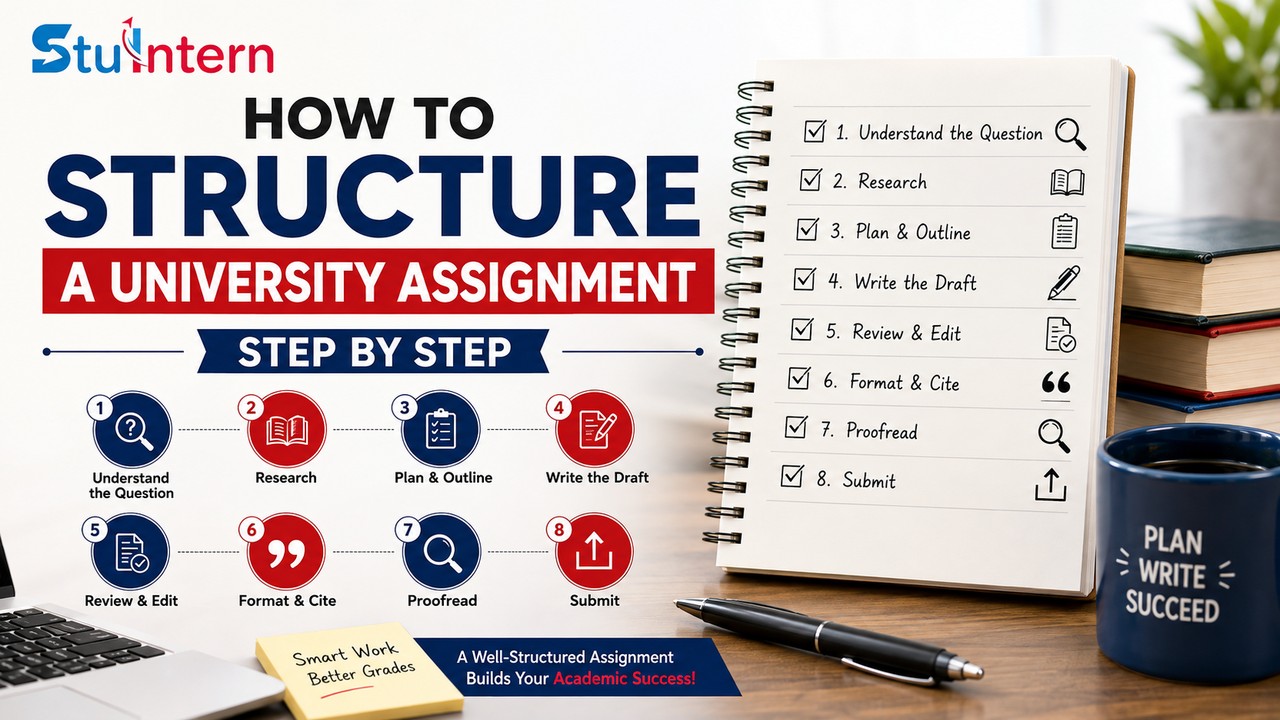
A strong assignment isn't just well-written — it's well-organized. Examiners can usually tell within the first page whether a student understood the brief or just started writing and hoped for the best. The good news is that structure is learnable: it's a repeatable process, not a talent you either have or don't.
This guide walks through structuring a university assignment step by step, from reading the brief to formatting your final draft, so you spend less time staring at a blank page and more time writing something that actually answers the question.
Step 1: Read the Brief Like You're Being Tested on It
Before you write a single sentence, break the assignment brief into its actual components: the core question, the word count, the required format (essay, report, case study), and any specific instructions about sections or referencing style. It sounds obvious, but a surprising number of low grades come from otherwise good writing that simply answered the wrong question.
A useful habit: underline the instructional verbs in the brief — "analyze," "compare," "evaluate," "discuss" — because each one implies a different structure. "Compare" needs a structure built around points of similarity and difference; "evaluate" needs a structure that builds toward a judgment.
Step 2: Build a Skeleton Outline Before You Write Anything
Once you understand the question, sketch an outline — just headings and one-line notes under each, no full sentences yet. A typical academic assignment outline looks like:
- Introduction (context, thesis/argument, what the assignment will cover)
- 3–5 body sections, each built around one main idea
- Conclusion (synthesis, not new information)
- References
For longer assignments — dissertations, extended reports — you'll add sections like literature review, methodology, and discussion, but the same skeleton-first principle applies. Outlining first prevents the most common structural problem: an assignment that wanders because it was written in one continuous pass without a plan.
Step 3: Write an Introduction That Sets Up the Whole Argument
Your introduction should do three things in a short space: give context, state your argument or thesis clearly, and briefly signal how the rest of the assignment will unfold. Avoid restating the assignment question word-for-word — instead, show you've interpreted it.
A good test: if someone read only your introduction, could they accurately guess what your conclusion will say? If not, the introduction isn't doing its job yet.
Step 4: Build Body Paragraphs Around One Idea Each
Each body section should center on a single main point, not several loosely related ones crammed together. A reliable paragraph structure to follow:
- Topic sentence — states the main point of the paragraph
- Evidence or explanation — supports the point with a source, example, or reasoning
- Analysis — explains why this evidence matters to your overall argument
- Transition — links naturally to the next point
This is where students who understand the material often lose marks anyway — not because the content is wrong, but because ideas are scattered across paragraphs instead of grouped logically. If you're finding it hard to organize a longer piece of coursework like a term project rather than a single assignment, StuIntern's project support applies the same section-by-section structuring approach to bigger academic work.
Step 5: Reference as You Write, Not After
One of the most common structural mistakes is treating referencing as a final cleanup step. Instead, add citations the moment you use a source — it's far easier to track which claim came from where while you're still writing than to reconstruct it afterward. Whichever style your university requires (APA, MLA, Chicago, IEEE), consistency matters more than which one you pick, assuming your brief allows a choice.
Step 6: Write the Conclusion Last, and Make It Earn Its Place
A conclusion should synthesize your argument, not just repeat the introduction in different words. Restate your position, briefly summarize how your body sections supported it, and — where relevant — note any limitations or broader implications. Never introduce new evidence in a conclusion; if a point is important enough to mention, it belongs in the body.
Step 7: Review Structure Separately From Reviewing Language
Most students proofread for grammar and spelling but skip a dedicated structural review. Before submission, read through your assignment focusing only on flow: Does each section connect logically to the next? Is there a paragraph that could move to a different section? Does the conclusion actually follow from the body? This kind of structural pass catches problems spell-check never will — and it's exactly where a second set of eyes, like a mentor reviewing your draft, tends to add the most value.
Frequently Asked Questions
Does assignment structure change by subject? The core skeleton (introduction, body, conclusion, references) holds across most subjects, but the body sections vary — a lab report needs methodology and results sections; a literature essay needs thematic or comparative sections instead.
How long should each section be? As a rough guide, introductions and conclusions are typically 10–15% of the total word count each, leaving 70–80% for the body — though always follow specific proportions given in your brief if provided.
Should I write the introduction first or last? Draft it first to guide your writing, but revisit and rewrite it once your body sections are finished — your argument often sharpens as you write, and the introduction should reflect the final version, not the first idea.
What's the biggest structural mistake students make? Writing without an outline. Skipping Step 2 is the single most common reason assignments end up disorganized, even when the research and writing quality are strong.
Conclusion
Structuring a university assignment isn't about following a rigid template — it's about giving your ideas a logical container so the reader can follow your argument without effort. Read the brief carefully, outline before you write, build each paragraph around one idea, reference as you go, and review structure as its own separate step. Do that consistently, and structure stops being the thing that costs you marks.
Need structured guidance for your assignment? Connect with StuIntern for planning, formatting, and referencing support.
Website: www.stuintern.com Call/WhatsApp: +91 96438 02216