

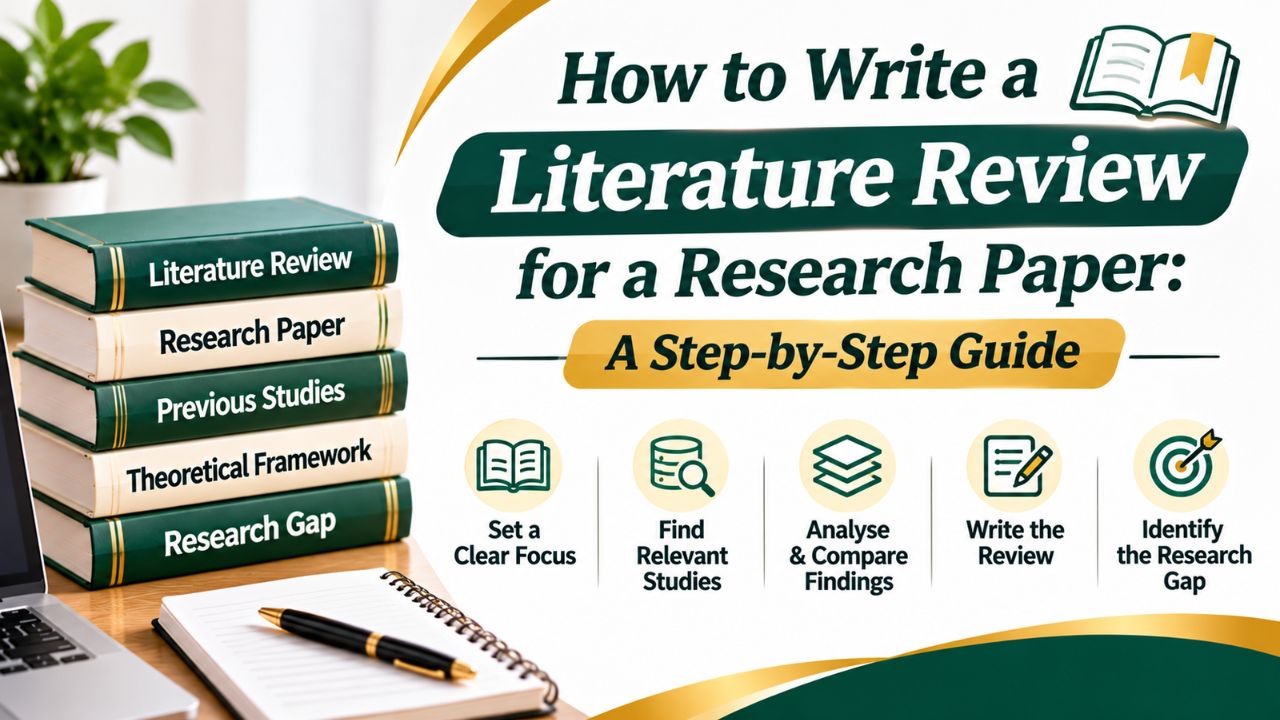
Introduction
A good research paper is built on a clear understanding of existing academic studies. Before presenting new findings, researchers need to understand what other scholars have already discovered, which methods they have used, and what questions still need further investigation. This is where a literature review for a research paper becomes important.
Many students and PhD scholars find literature reviews challenging because they are unsure which research papers to select, how to organize information, and how to connect different studies. Simply collecting summaries of published papers is not enough. A strong literature review compares previous research, identifies common findings, discusses differences, and explains the need for further study.
In this guide, you will learn how to write a literature review for a research paper, how to organize academic sources, common mistakes to avoid, and practical ways to improve the quality of your review.
What Is a Literature Review in Research?
A literature review is a structured discussion of previously published research related to a particular topic. It helps researchers understand the existing knowledge in their field and identify areas that require additional investigation.
A literature review may include:
- Research articles published in academic journals
- Previous PhD theses and dissertations
- Books and academic publications
- Conference papers
- Relevant reports and research documents
For example, if your research topic is artificial intelligence in healthcare, your literature review may examine previous studies on AI-based diagnosis, medical data analysis, patient monitoring, and challenges in healthcare technology.
The purpose is not simply to describe each publication. Researchers should explain how the studies relate to one another and what their findings mean for the current research.
Why Is a Literature Review Important for a Research Paper?
A well-developed literature review in research provides the academic foundation for a study. It shows that the researcher understands the subject and has considered relevant previous findings.
1. Understand existing research: It helps researchers learn what has already been studied and what conclusions have been reached.
2. Identify research gaps: Comparing previous studies can reveal unanswered questions, limitations, or areas that need further investigation.
3. Avoid repeating existing work: A literature review helps researchers understand how their study can offer a meaningful contribution.
4. Select suitable research methods: Previous studies can provide useful information about research designs, data collection techniques, and analysis methods.
5. Build a strong research argument: Relevant academic sources help support the background, importance, and direction of the study.
A literature review is therefore an important part of research planning and academic writing.
Step-by-Step Process to Write a Literature Review
Writing a literature review becomes easier when the work is divided into clear stages.
Step 1: Understand Your Research Topic
Before searching for academic papers, define your research topic and its main areas. A focused topic helps you find relevant publications instead of collecting unrelated information.
For example, if your topic is "Impact of Social Media Marketing on Consumer Buying Behaviour," you may explore:
- Social media advertising
- Consumer decision-making
- Online brand engagement
- Influencer marketing
- Digital purchasing behaviour
These subtopics can help organize your literature search.
Step 2: Search for Relevant Academic Sources
Use reliable academic databases and research platforms to find relevant publications. Examples include Google Scholar, PubMed, IEEE Xplore, ScienceDirect, and publisher websites, depending on your subject.
Try different keyword combinations to discover useful research papers.
For example, for a study on digital marketing, possible search terms include:
- Digital marketing and consumer behaviour
- Social media marketing effectiveness
- Online advertising and purchase intention
- Consumer engagement on social media
Check the publication details, relevance, research methods, and credibility of each source before including it.
Step 3: Read and Evaluate Research Papers
Do not depend only on the title or abstract. Read the relevant sections of each paper to understand its purpose, methodology, findings, and limitations.
While reviewing a publication, note:
- Author and publication year
- Research objective
- Research methodology
- Sample or study population
- Major findings
- Limitations
- Relevance to your research topic
This information makes it easier to compare studies and write a meaningful review.
Step 4: Organize Research According to Themes
One of the most effective ways to write a literature review is to organize sources around common themes.
For example, a literature review on artificial intelligence in education could include:
Theme 1: AI-Based Learning Tools
Discuss studies related to personalized learning platforms, automated feedback, and intelligent tutoring systems.
Theme 2: Student Performance and Engagement
Compare research examining the relationship between AI-supported learning and student participation or academic performance.
Theme 3: Challenges of AI in Education
Review studies discussing data privacy, accessibility, technical limitations, and ethical concerns.
Organizing research thematically helps readers follow the discussion more easily.
Step 5: Compare and Analyze Previous Studies
A strong academic literature review should do more than summarize individual papers. It should explain how different studies connect.
For example, two researchers may investigate the same topic but use different research methods or study different populations. Their findings may be similar or may differ because of their research settings.
Discuss these similarities and differences. Explain which findings are consistent, where disagreements exist, and what limitations remain.
Step 6: Identify the Research Gap
After reviewing relevant studies, identify what has not been adequately explored.
A research gap may relate to:
- A population that has received limited research attention
- A geographical area that needs further investigation
- A limitation in existing research methods
- Conflicting findings between previous studies
- A new technology or development that requires investigation
Make sure the gap is supported by the literature you have reviewed. Avoid making broad claims without sufficient evidence.
Step 7: Write and Edit the Literature Review
Arrange your discussion in a logical order. Start with the broader research background, move towards specific themes, compare previous findings, and explain the research gap.
Use clear academic language and maintain proper citations throughout the chapter or section.
Finally, check the structure, grammar, references, and consistency with your university or journal guidelines.
Common Types of Literature Reviews
Different research projects may require different types of literature reviews. The appropriate approach depends on the research question and academic requirements.
| Type | Main Purpose |
|---|---|
| Narrative Literature Review | Provides an organized discussion of existing research |
| Systematic Literature Review | Uses a planned and transparent process to identify and evaluate studies |
| Scoping Review | Maps the available research on a broad topic |
| Integrative Literature Review | Combines findings from different types of research |
| Critical Literature Review | Evaluates the strengths, weaknesses, and arguments of previous studies |
Researchers should select a review type based on their objectives and the requirements of the project or journal.
Difference Between a Literature Review and an Annotated Bibliography
A literature review and an annotated bibliography both involve academic sources, but they are not the same.
| Literature Review | Annotated Bibliography |
|---|---|
| Discusses and connects multiple studies | Lists individual sources with short descriptions |
| Organizes research around themes or questions | Usually organizes entries by source |
| Compares findings and research methods | Explains the content and relevance of each source |
| Identifies patterns and research gaps | Helps document and evaluate selected publications |
Understanding this difference helps researchers choose the correct format for their academic work.
Common Mistakes to Avoid in a Literature Review
A literature review may become weak if it lacks organization, critical analysis, or reliable references.
Only summarizing research papers: Avoid writing one paragraph for every paper without connecting the findings. Compare studies and explain their relationship.
Using irrelevant sources: Select publications that directly support your research topic and objectives.
Ignoring recent research: Include relevant recent studies alongside important foundational publications. The appropriate publication period depends on your subject.
Missing research gaps: Explain what remains unclear after reviewing the available literature.
Poor citation practices: Give proper credit to the original authors and follow the required citation style, such as APA, IEEE, or Vancouver.
Using unsupported information: Verify every important claim against the original publication. Never invent findings, references, or publication details.
Weak organization: Use meaningful headings and themes to make the discussion easy to understand.
How to Improve the Quality of Your Literature Review
A well-written literature review requires careful reading and consistent academic writing.
Here are some practical suggestions:
- Use research papers that are directly related to your topic.
- Maintain a research summary sheet to record important findings.
- Group studies according to themes, methods, or publication periods.
- Compare results rather than simply repeating them.
- Identify limitations and unanswered questions.
- Use a consistent referencing style.
- Check the originality and accuracy of your writing.
- Follow the journal or university's formatting instructions.
These practices can help make your literature review more organized, relevant, and academically useful.
Literature Review Support for Research Scholars at StuIntern
Preparing a literature review can take considerable time, especially when a research topic includes several theories, methods, and published studies. Scholars may need help with organizing references, developing research themes, comparing findings, and connecting previous research with their own objectives.
StuIntern provides academic research support for students and scholars working on research papers, dissertations, literature reviews, and research proposals.
The support process can include research planning, literature organization, academic editing, formatting, and guidance on manuscript preparation. Researchers should always verify their sources and ensure that the final work reflects their own research and follows academic integrity requirements.
Explore StuIntern's SCI and Scopus Paper Support Services for information about research paper preparation and publication support.
Frequently Asked Questions (FAQs)
1. What is a literature review in a research paper?
A literature review is a structured discussion of previously published studies related to a research topic. It explains existing knowledge, compares findings, and identifies areas that require further investigation.
2. How do I start writing a literature review?
Start by defining your research topic and searching for relevant academic publications. Read and evaluate the selected sources, organize them into themes, and prepare a logical outline before writing.
3. How many research papers should be included in a literature review?
There is no fixed number for every research project. The number depends on the topic, research scope, academic level, and university or journal requirements. Relevance and quality are more important than simply including many sources.
4. What is the difference between a literature review and a research gap?
A literature review examines existing research, while a research gap identifies an area that previous studies have not adequately addressed. The literature review helps researchers establish and justify the gap.
5. Can I use Google Scholar for a literature review?
Yes. Google Scholar can help locate academic articles, books, theses, and conference papers. However, researchers should verify publication details, source quality, and the original documents before citing them.
6. Should a literature review include recent research papers?
Yes, relevant recent publications are important for understanding current developments. However, older foundational studies may also be necessary when they provide important theories or concepts.
7. How can I avoid plagiarism in a literature review?
Read the original sources, explain ideas in your own words, cite the original authors, and use quotation marks for direct quotations. Rewriting sentences without proper citation does not remove the need to acknowledge the source.
Conclusion
Writing a strong literature review for a research paper requires more than collecting academic publications. Researchers need to evaluate previous studies, compare their findings, identify limitations, and explain how their work connects with existing knowledge.
By following a structured process, selecting reliable sources, organizing research into meaningful themes, and maintaining accurate citations, students and PhD scholars can develop a clear and useful literature review.
A well-organized literature review also provides a stronger foundation for identifying research gaps and developing the next stages of a research project. For research planning, academic writing guidance, and publication-related support, visit StuIntern.
Website: www.stuintern.com
Call/WhatsApp: +91 96438 02216