

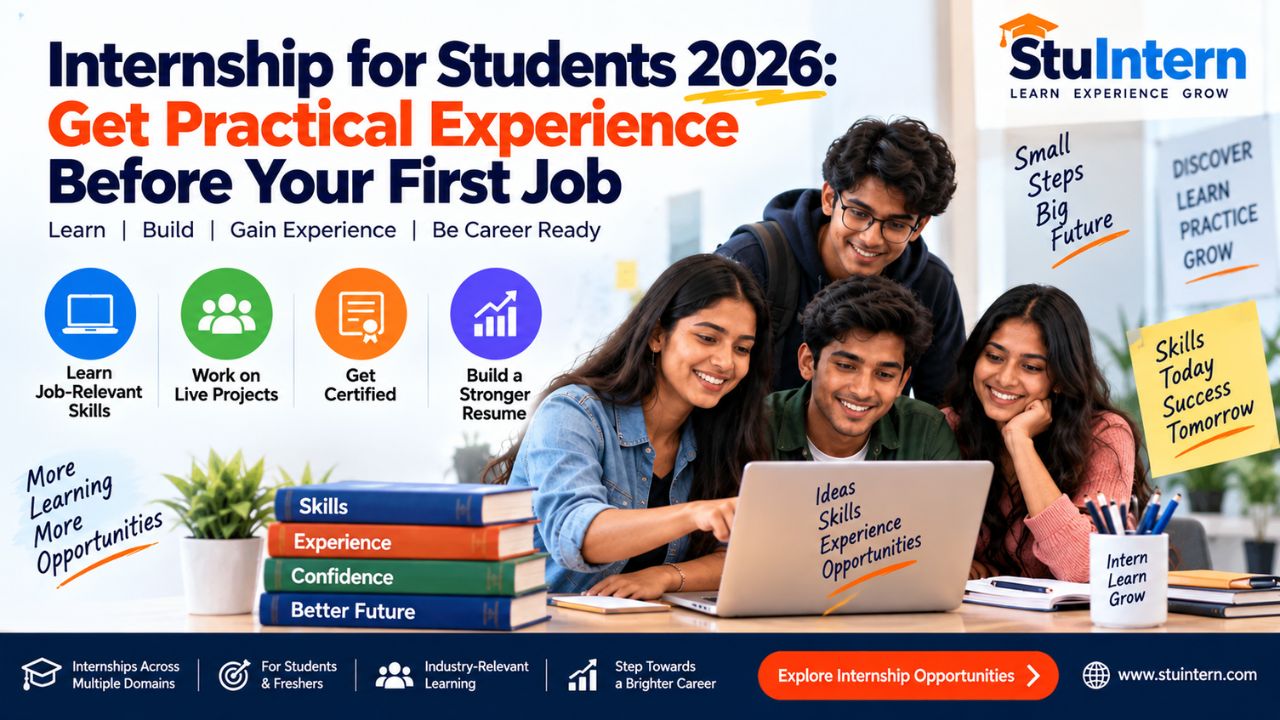
Internship for Students 2026: Get Practical Experience Before Your First Job
Getting a degree is important, but many students face the same challenge after college: “I have studied the subject, but how do I prove that I can actually work on it?”
An Internship for Students can help solve this gap by giving learners opportunities to apply their knowledge through practical tasks, projects and industry-relevant tools. Instead of waiting until graduation to gain experience, students can start developing practical abilities while they are still studying.
An Internship for Freshers can be equally useful for graduates who have academic knowledge but little professional exposure.
In this guide, you will learn how internships can help build experience, which fields you can explore in 2026, what skills matter and how to choose an internship that supports your career goals.
Quick Answer
An Internship for Students provides practical exposure before entering full-time employment. Students can learn relevant tools, complete projects, understand professional workflows and build a stronger portfolio. The right internship should focus on meaningful learning and practical application rather than only offering a certificate.
Table of Contents
- What Does an Internship for Students Actually Offer?
- Why Practical Experience Matters in 2026
- Who Can Start an Internship?
- Types of Internships Students Can Explore
- Popular Internship Fields in 2026
- Skills Students Can Develop
- Practical Projects and Learning Outcomes
- Benefits for Students and Freshers
- How to Find the Right Internship
- Step-by-Step Plan for Your First Internship
- Mistakes Students Should Avoid
- Online vs Traditional Internship
- Why Explore StuIntern?
- FAQs
- Conclusion
Quick Highlights
| Factor | Details |
| Best For | College students, graduates & freshers |
| Mode | Online / Virtual |
| Skills | Technical + professional |
| Practical Learning | Application-based |
| Projects | Portfolio-focused projects |
| Mentorship | Guidance during learning |
| Certificate | Available with applicable programs |
What Does an Internship for Students Actually Offer?
An internship should be more than a certificate you add to LinkedIn.
A useful Internship for Students creates an environment where learners can take concepts they have studied and apply them to practical situations.
Consider a student learning digital marketing. Reading about SEO explains what keyword research means, but performing keyword research for a website teaches the student how search intent, competition and content planning work together.
Similarly, learning Python syntax is different from using Python to analyse an actual dataset.
That practical difference is where internships become valuable.
Students can use internships to understand:
- How professional tasks are completed
- Which tools are commonly used
- How projects are planned
- How problems are approached
- How feedback improves work
- What employers may expect from beginners?
The objective is to move from “I know this topic” to “I have applied this skill.”
Why Practical Experience Matters for Students in 2026
The entry-level career market is changing quickly.
Students now have access to AI tools, online courses and thousands of tutorials. As a result, simply knowing basic concepts may not differentiate one candidate from another.
Practical application matters.
For example, instead of only writing “Data Analytics” under skills, a student who has completed an analytics project can explain:
- Which dataset was used
- How the data was cleaned
- Which metrics were analysed
- Which tool was used
- What insights were discovered
- How the final dashboard was created
That creates a much stronger conversation during an interview.
An Internship for Freshers can provide opportunities to build these examples before applying for entry-level roles.
Who Should Choose an Internship in 2026?
You do not have to wait until the final semester of college.
Internships can be suitable for:
- First- and second-year students exploring career options
- Final-year students preparing for graduation
- B.Tech and engineering students
- BCA and MCA students
- BBA and MBA students
- Commerce and management students
- Recent graduates
- Freshers without previous work experience
- Students switching to a new skill or domain.
Your reason for joining may differ depending on your stage.
A first-year student may want career exposure, while a final-year student may want portfolio projects and practical skills before beginning job applications.
Types of Internships Students Can Explore
Skill-Based Internship
These internships concentrate on a specific skill or career field.
Students can choose areas such as data science, digital marketing, AI or web development and develop relevant technical abilities.
They are useful when you already have a general idea of the career you want to explore.
Project-Based Internship
Here, practical projects become a major part of the learning experience.
Instead of only studying concepts, students work toward a specific output such as:
- Website
- Dashboard
- Marketing plan
- Data analysis report
- AI/ML project
- Business case study
Projects can later become useful additions to a portfolio.
Virtual Internship
A Virtual Internship allows students to learn and participate remotely.
This format can be particularly convenient for college students because they can gain experience without relocating or travelling daily.
However, students should still check whether the virtual program includes practical work, mentor support and clear learning outcomes.
Popular Internship Fields for Students & Freshers in 2026
Different career goals require different internship choices.
| Field | Skills to Explore | Example Practical Outcome |
| Data Science | Python, Pandas, visualization | Data analysis project |
| Data Analytics | Excel, SQL, Power BI | Interactive dashboard |
| Digital Marketing | SEO, Ads, analytics | Digital campaign plan |
| Artificial Intelligence | Python, ML, AI tools | AI/ML project |
| Full-Stack Development | Front-end + back-end tools | Web application |
| HR Analytics | Excel, HR metrics, Power BI | Employee analytics dashboard |
Do not select a field only because it is trending.
Ask yourself: Would I actually enjoy solving problems in this area every day?
An internship can help you discover that answer.
Skills Students Can Develop Through Internships
A practical internship can help develop two major skill groups.
Technical Skills
Depending on the program, these could include:
- Python
- SQL
- Excel
- Power BI
- SEO
- Google Ads
- Meta Ads
- Analytics
- React
- Node.js
- Databases
- AI/ML tools
Professional Skills
Technical knowledge alone is not enough.
Students should also work on:
- Communication
- Research
- Problem-solving
- Time management
- Presentation
- Critical thinking
- Team collaboration
- Project documentation
These transferable skills remain useful even if you later change your career direction.
Practical Projects & Learning Outcomes
Imagine two students applying for the same entry-level role.
Student A says:
“I completed a data analytics course.”
Student B says:
“I cleaned a dataset, analysed key metrics and created a Power BI dashboard to present the results.”
Student B has something specific to discuss.
That is why practical projects matter.
A useful internship project should ideally help you answer four questions:
What problem did you work on?
Which tools did you use?
What did you personally do?
What was the outcome?
If you can confidently answer these questions, you have more than a certificate—you have a practical experience story.
Key Benefits of an Internship for Students
1. Turn Theory Into Practice
Internships give students a reason to apply what they have learned instead of simply memorising concepts.
2. Build Your First Portfolio
Projects can demonstrate your capabilities even when you have limited formal work experience.
3. Understand Career Options
You may discover that the field you planned to enter is different from what you expected.
That discovery itself is valuable.
4. Develop Confidence
Completing tasks independently can make technical and interview discussions easier.
5. Learn Industry-Relevant Tools
Students gain opportunities to practice the tools associated with their target roles.
6. Improve Your Resume
Instead of having only education and certifications, you can mention relevant skills, projects and internship experience.
7. Prepare for Interviews
Practical work gives you real examples when interviewers ask what you have built, analysed, or solved.
How to Choose the Right Internship Program
Before selecting an internship, check these factors carefully.
Career relevance: Does the internship align with the field you want to explore?
Practical work: Will you actually complete assignments or projects?
Tools: Are the tools relevant to current industry workflows?
Mentorship: Is guidance available when you encounter problems?
Project outcomes: Will you have meaningful work to demonstrate afterwards?
Flexibility: Can you realistically manage it alongside college?
Certificate: Is certification provided where relevant?
Program details: Are the curriculum, duration and expectations clearly explained?
Do not make your decision based solely on advertisements or certificate promises.
Step-by-Step Plan for Your First Internship
Step 1: Pick One Career Area
Do not try to learn five unrelated fields simultaneously. Start with one area that matches your interests.
Step 2: Learn the Fundamentals
Understand the basic terminology and concepts before beginning practical work.
Step 3: Compare Internship Programs
Check curriculum, projects, tools, mentorship and learning format.
Step 4: Apply for a Relevant Opportunity
Focus on relevance rather than applying randomly to hundreds of internships.
Step 5: Complete Every Practical Task
Small assignments often build the skills needed for larger projects.
Step 6: Ask for Feedback
Feedback can reveal mistakes you may not notice yourself.
Step 7: Create a Project Portfolio
Document your best work clearly.
Step 8: Update Your Resume
Mention specific tools and outcomes rather than vague statements.
For example:
Weak: “Worked on digital marketing.”
Better: “Performed keyword research and prepared an SEO content plan for a website project.”
Specific information makes experience easier to understand.
Common Internship Mistakes to Avoid
Students sometimes focus so much on “getting an internship” that they forget why they wanted one.
Avoid:
- Joining only for a certificate
- Choosing an unrelated field
- Skipping practical assignments
- Copying someone else’s project
- Trying to learn too many tools simultaneously
- Ignoring mentor feedback
- Failing to document your work
- Adding skills to your resume that you cannot explain
- Expecting guaranteed employment after completion
Your goal should be measurable skill development.
Online Internship vs Traditional Internship
| Factor | Online/Virtual Internship | Traditional Internship |
| Location | Can participate remotely | Usually location-dependent |
| Travel | Generally not required | Often required |
| Flexibility | Usually higher | Usually fixed |
| College Compatibility | Easier to manage | Can be challenging |
| Practical Projects | Depends on program | Depends on organization |
| Interaction | Online | Face-to-face |
| Best Choice | Depends on learning goals | Depends on learning goals |
Neither format is automatically better.
A structured online internship with meaningful projects can be more useful than an offline internship where a student has little meaningful work—and vice versa.
Evaluate the experience.
Why Explore StuIntern?
StuIntern is designed for students and freshers looking to develop practical skills through internship-based learning.
The platform provides opportunities across career-focused fields such as:
- Artificial Intelligence
- Data Science & Analytics
- Digital Marketing
- Full-Stack Development
- HR & People Analytics
The focus on practical learning makes it relevant for students who want to move beyond theoretical knowledge.
Students can explore programs according to their academic background and career interests, while features such as projects, mentorship and skill-focused learning can help them build practical exposure.
Instead of asking only “Which certificate will I receive?”, students should ask:
“What will I be able to do after completing this internship?”
Explore current opportunities at StuIntern: https://www.stuintern.com/
Frequently Asked Questions
1. Which Internship for Students is best in 2026?
There is no single best internship for every student. Choose according to your career goals, current skills and interests. Look for practical projects, relevant tools, mentorship and clearly defined learning outcomes. Data analytics, AI, digital marketing and development are among the fields students can explore depending on their background.
2. Can freshers apply for internships without experience?
Yes. An Internship for Freshers is often intended to help beginners gain practical exposure. Having basic knowledge of the chosen field can improve your learning experience, but students should always check the specific eligibility requirements of the program before applying.
3. Is an online internship useful for college students?
Yes, provided it offers structured learning and practical work. An Online Internship for Students can offer flexibility around college schedules while allowing learners to develop skills and complete projects remotely. Evaluate the curriculum and outcomes rather than choosing solely based on convenience.
4. What should I learn during my first internship?
Focus on the core tools used in your chosen field and develop problem-solving, communication and project skills. Most importantly, try to complete at least one project you can explain confidently. Your ability to demonstrate practical learning is more meaningful than simply listing multiple tools.
5. Does an internship certificate help freshers?
A certificate can verify participation or completion, but its value is stronger when supported by practical skills and projects. During interviews, employers may ask what you actually did. Students should therefore focus on the learning experience first and treat certification as supporting evidence.
6. How can I prepare before starting an internship?
Learn the fundamentals of your chosen domain, research commonly used tools and understand what the internship expects from you. You do not need to know everything beforehand. Basic preparation helps you spend more internship time applying skills instead of struggling with introductory concepts.
7. Should I do multiple internships during college?
Multiple internships can be useful when each provides meaningful and different experience. However, completing five superficial internships is not necessarily better than completing one or two strong programs with practical projects. Prioritise depth, relevance and demonstrable learning.
8. Can an internship help me get my first job?
An internship can improve your practical skills, portfolio, resume and interview confidence, but it does not guarantee employment. Students still need to build relevant skills, apply strategically and perform well during selection processes. Think of an internship as preparation for opportunities rather than a job guarantee.
Conclusion
The right Internship for Students can turn college knowledge into practical experience before the pressure of finding a first full-time role begins. Instead of collecting certificates, focus on developing skills you can demonstrate, projects you can explain and tools you can confidently use.
For graduates, an Internship for Freshers can provide the same opportunity to strengthen practical exposure before entering the professional environment.
If you want to explore skill-focused internship opportunities in areas such as Data Science, AI, Digital Marketing and Full-Stack Development, visit StuIntern and choose a program that matches your career direction.
Start building practical experience with StuIntern: https://www.stuintern.com/