

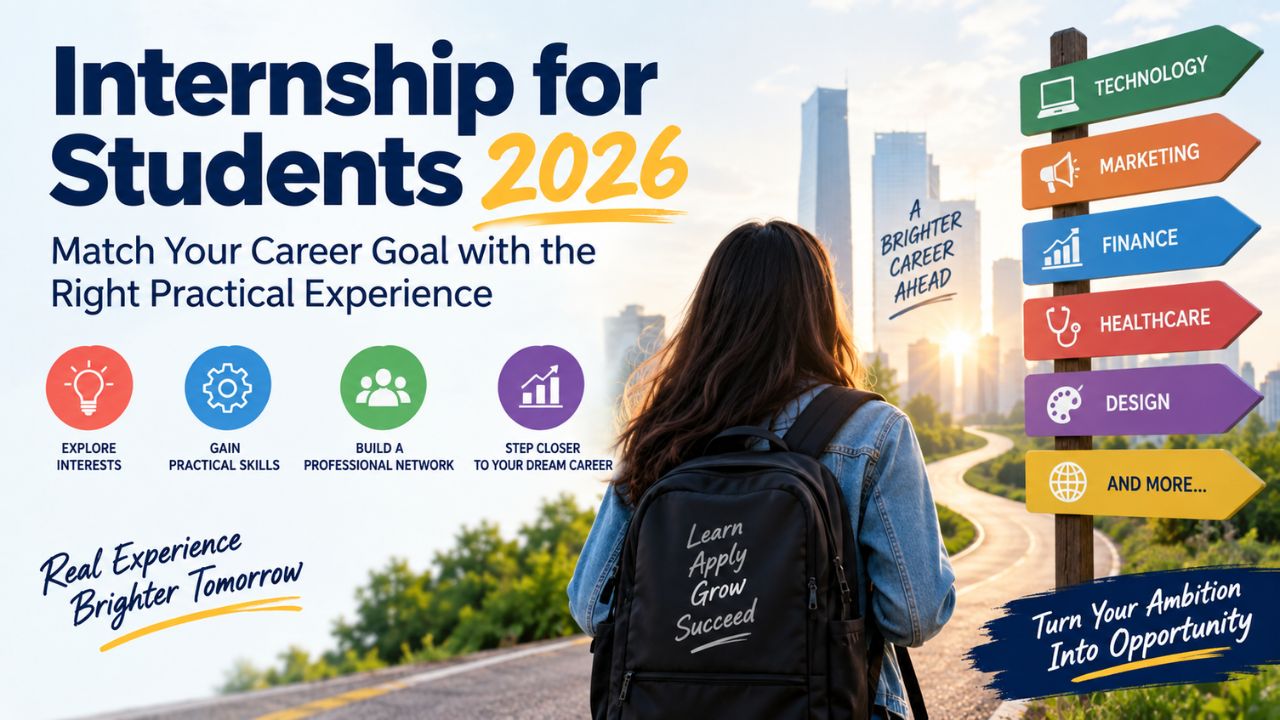
Internship for Students 2026: Match Your Career Goal with the Right Practical Experience
Choosing an internship for students should start with one important question: What do you want to be able to do after completing it? In 2026, simply collecting certificates is not enough. Students need opportunities that help them practise relevant tools, solve problems, complete projects, and explain their experience confidently.
The challenge is that internship programs can differ significantly in learning structure, project quality, mentorship, duration, and career relevance. A program suitable for a data science student may not provide the right experience for someone interested in digital marketing or software development.
This guide helps students connect their career goal with the right internship experience, compare opportunities, and understand what practical outcomes they should expect before choosing a program.
Quick Answer
An internship for students should provide practical experience that matches the learner’s career direction. Instead of selecting a program only for its certificate, students should check the skills, tools, projects, mentorshi,p and expected outcomes. The right internship helps turn academic knowledge into experience that can be demonstrated through projects, portfolios, and interviews.
Table of Contents
- What Is an Internship for Students?
- Why Are Student Internships Important in 2026?
- Who Should Choose an Internship?
- Types of Internship Opportunities
- Best Internship Fields in 2026
- Match Your Career Goal With the Right Internship
- Skills and Tools You Can Learn
- Practical Projects and Learning Outcomes
- Key Benefits of Internships
- How to Choose the Right Internship Program
- Step-by-Step Internship Roadmap
- Common Mistakes Students Should Avoid
- Online vs Offline Internship
- Why Choose StuIntern?
- FAQs
- Conclusion
Quick Highlights
| Factor | What Students Should Look For |
| Best For | College students, graduate,s and freshers |
| Mode | Online, virtu,al or program-specific |
| Skills | Technical, analytical and professional skills |
| Practical Learning | Tasks based on actual applications |
| Projects | Work that demonstrates learned skills |
| Mentorship | Guidance, feedback and problem-solving support |
| Certificate | Clear completion requirements and verifiable proof |
What Is an Internship for Students?
An internship for students is a structured opportunity to apply academic concepts in practical situations while developing skills relevant to a particular career field.
A useful internship should create a bridge between what you study and what you can actually do.
For example, knowing the concepts of digital marketing is different from performing keyword research, analysing campaign data or preparing content. Similarly, learning Python syntax in class is different from cleaning a dataset, analysing, it and presenting useful conclusions.
Students should therefore evaluate an internship according to its learning outcomes rather than treating participation itself as the final goal.
Why Are Student Internships Important in 2026?
Technology and professional workflows continue to evolve, which makes practical application increasingly important for students preparing for careers.
An internship can expose students to tools, project workflows, deadlines, feedback, and problem-solving situations that may not be fully covered in classroom learning.
The strongest outcome is not simply:
“I completed an internship.”
It is being able to explain:
“This was the problem, these were the tools I used, this was my approach, and this is what I learned.”
That difference can make an internship more meaningful for a student’s portfolio, resume, and interview preparation.
Who Should Choose an Internship?
Internships can be useful at different stages of education.
First- and second-year students can use internships to explore fields before committing to a specialisation.
Final-year students can focus on practical projects and skills closely connected to their intended career.
Postgraduate students may choose specialised programs related to analytics, technology, managemen,t or their academic discipline.
Freshers can use practical internships to strengthen areas where they have academic knowledge but limited applied experience.
The correct program therefore depends on the student’s current skill level and next career objective.
Types of Internship Opportunities for Students
Skill-Building Internships
These are suitable for beginners who need structured practice before handling complex projects. The focus should be on understanding concepts, too,ls and workflows.
Project-Based Internships
Project-based programs are useful for students who already understand basic concepts and want to demonstrate practical application.
A good project should require students to make decisions, solve problems, and produce a clear outcome.
Virtual or Online Internships
An online internship for students can provide flexibility for learners who need to balance college schedules with practical learning.
Students should still verify the training structure, assignments, project requirements, feedback process, and completion criteria rather than assuming every online program offers the same experience.
Best Internship Fields for Students in 2026
Students should select fields based on their interests, academic background, and intended career rather than choosing only what appears popular.
Some practical areas include:
- Artificial Intelligence and Machine Learning
- Data Science and Data Analytics
- Digital Marketing
- Full-Stack Development
- Human Resources and People Analytics
- Cloud Computing
StuIntern currently lists virtual internship programs in AI, digital marketing, data science and analytics, full-stack development, HR and people analytics, and AWS cloud-related learning. Students should review individual program details before choosing one.
Match Your Career Goal With the Right Internship
This is one of the most important steps students often skip.
Start with your career goal, then work backwards to determine the skills and experience you need.
| Career Direction | Skills to Prioritise | Useful Practical Outcome |
| Data Analytics | Excel, Python, data cleaning, visualization | Analytical dashboard/report |
| Data Science | Python, Pandas, ML fundamentals | Dataset-based prediction project |
| Digital Marketing | SEO, advertising, analytics, content | Campaign or SEO project |
| Full-Stack Development | Frontend, backend, databases | Functional web application |
| AI/ML | Python, model development, APIs | Working AI application/model |
| HR Analytics | Excel, HR metrics, dashboards | Workforce analytics project |
This approach prevents students from choosing an internship simply because the title sounds attractive.
Ask yourself:
Career Goal → Required Skills → Relevant Tools → Practical Project → Demonstrable Outcome
If the internship fits this sequence, it is more likely to support your career direction.
Skills and Tools You Can Learn
Different internships develop different technical abilities, but students should also pay attention to transferable skills.
Technical Skills
Depending on the field, these may include Python, Power BI, Excel, React, Node.js, MongoDB, SEO tools, advertising platforms, or cloud technologies.
Problem-Solving
Projects should encourage students to understand a problem before selecting an approach or tool.
Communication
Being able to explain your work clearly is important. Students should practise documenting projects and presenting their decisions and results.
Time Management
Deadlines and structured assignments can help students learn how to divide larger tasks into manageable stages.
Analytical Thinking
Instead of simply following instructions, students should learn to interpret information and make decisions based on evidence.
Practical Projects and Learning Outcomes
Before joining any internship, ask:
“What will I be able to show after completing this program?”
A project creates stronger evidence of learning than a certificate alone.
For example, a data analytics learner might produce a dashboard from a dataset. A full-stack student might build an application. A digital marketing learner could work on keyword research, content planning, or campaign analysis.
The exact project depends on the program, but students should look for work that demonstrates a clear combination of:
Skill + Tool + Problem + Output
A good learning outcome should also be explainable without memorising a scripted answer.
Key Benefits of an Internship for Students
A relevant internship can help students:
- apply classroom concepts practically;
- understand tools used within their chosen field;
- build projects for a portfolio;
- identify skill gaps early;
- improve communication and problem-solving;
- understand professional workflows;
- strengthen resume content with relevant experience;
- prepare better examples for interviews.
However, these benefits depend heavily on active participation. Simply registering for an internship does not automatically produce practical skills.
How to Choose the Right Internship Program
Instead of asking only “Which is the best internship platform in India?”, students should ask whether a particular program matches their own needs.
Check the following before applying:
Learning objective: Is it clear what you should learn?
Skill level: Is the program appropriate for a beginner, intermediate, or advanced learner?
Tools: Are the tools relevant to the field you want to enter?
Projects: Will you create something that demonstrates practical ability?
Guidance: Is mentorship or feedback available?
Duration: Can you realistically manage it alongside college?
Completion criteria: What must you complete to qualify for the certificate?
Career relevance: Can you explain how the experience connects to your next academic or career step?
The best internship platform in India for an individual student is ultimately one that offers a program aligned with these requirements.
Step-by-Step Internship Roadmap for Students
Step 1: Define Your Career Direction
Choose a broad field first. You do not need your entire career planned, but you should know what you want to explore.
Step 2: Identify Your Current Skill Level
Separate the skills you already know from those you need to learn.
Step 3: Compare Internship Programs
Review curriculum, mode, duration, projects, tools, guidanc,e and completion requirements.
Step 4: Set a Practical Outcome
Decide what you want to produce by the end of the internship—a dashboard, application, analysis, campaign project, or another relevant output.
Step 5: Participate Actively
Complete assignments yourself, ask questions, and understand why each step is being performed.
Step 6: Document Your Work
Keep notes about problems, tools, decisions, and results.
Step 7: Convert Learning Into Career Proof
After completion, update your resume and portfolio with the skills and projects you can genuinely explain.
Common Mistakes Students Should Avoid
One common mistake is choosing an internship only because it offers a certificate. A certificate records completion; it does not automatically demonstrate practical ability.
Students should also avoid selecting programs without reading their curriculum, choosing a field only because it is trending, joining too many programs simultaneously or copying project work without understanding it.
Another mistake is finishing an internship without documenting the project. After several months, remembering technical decisions becomes difficult.
Your goal should be to leave the program with knowledge you understand and work you can explain.
Online Internship vs Offline Internship
| Factor | Online Internship | Offline Internship |
| Location | Can often be completed remotely | Requires physical presence |
| Schedule | Often more flexible | Usually fixed |
| Learning | Digital sessions/tasks | Workplace-based exposure |
| Projects | Digital or remote projects | May include on-site work |
| Communication | Online collaboration | Face-to-face interaction |
| Suitable For | Students balancing college and learning | Students seeking workplace exposure |
Neither format is automatically better.
Choose according to the quality of the program, your learning style, schedule, career goal and the type of experience you need.
Why Choose StuIntern for Student Internships?
StuIntern offers virtual internship programs across areas such as Artificial Intelligence, Digital Marketing, Data Science & Analytics, Full-Stack Development and HR & People Analytics.
Its website describes programs built around mentor-led learning, projects, industry-related tools and internship certification. Students can compare the available programs and choose according to their academic background, skill level and career direction.
For example, StuIntern currently describes its Data Science & Analytics program around Python, Pandas, Power BI and scikit-learn, while its Digital Marketing internship includes Google Ads, Meta Ads, Canva and ChatGPT. Its Full-Stack Development program covers technologies including React, Node.js, Express and MongoDB.
The important step is still to review the specific program before enrolling and make sure its learning outcomes match your personal career goal.
Explore StuIntern internship programs and choose the learning path that matches the skills and practical experience you want to build.
Frequently Asked Questions
1. Which internship is best for students in 2026?
The best internship depends on the student’s academic background, existing skills and career goals. Instead of selecting a program only because it is popular, compare its curriculum, tools, practical projects, mentorship and learning outcomes with the skills required for your intended career.
2. How do students choose the right internship?
Start by defining the field you want to explore. Then identify the skills you need and compare internship programs based on their projects, tools, mentorship, duration and expected outcomes. Choose a program that closes a genuine skill or experience gap.
3. Are online internships useful for students?
Yes, an online internship can be useful when it provides structured learning, relevant assignments, practical projects and meaningful guidance. Students should evaluate the actual learning experience rather than judging an internship solely by whether it is online or offline.
4. What skills can students learn during an internship?
Skills depend on the field. Technical internships may develop programming, analytics, marketing or development skills, while most well-structured programs can also help students practise communication, problem-solving, project management, documentation and analytical thinking.
5. How can I find the best internship platform in India?
Compare platforms based on the relevance of their programs, learning structure, practical projects, tools, mentorship, duration and completion requirements. The best platform should help you find an internship that aligns with your academic background and career goals rather than simply offering a certificate.
6. Is an internship certificate useful for students?
An internship certificate can provide evidence that a program was completed, but its value is stronger when supported by genuine skills and project experience. Students should be prepared to explain what they worked on, which tools they used and what they learned.
7. Can college students do internships while studying?
Yes. Students can look for flexible or online programs that fit around their academic schedule. Before joining, check the expected weekly commitment, deadlines and duration to ensure you can complete both college and internship responsibilities properly.
8. What should I add to my resume after an internship?
Mention the internship field, relevant responsibilities, tools used, projects completed and measurable or clearly defined outcomes where appropriate. Avoid vague descriptions. Your resume should reflect work you genuinely completed and can confidently explain during an interview.
Conclusion
The right internship for students in 2026 should help convert academic knowledge into practical, demonstrable ability. Instead of chasing certificates or choosing programs only because they are trending, start with your career goal and identify the skills, tools and project experience you actually need.
A strong internship gives you something valuable to carry forward: practical knowledge, completed work and a clearer understanding of your career direction.
If you are ready to build practical experience, explore StuIntern and compare available internship programs based on your interests, current skill level and future career goals.