

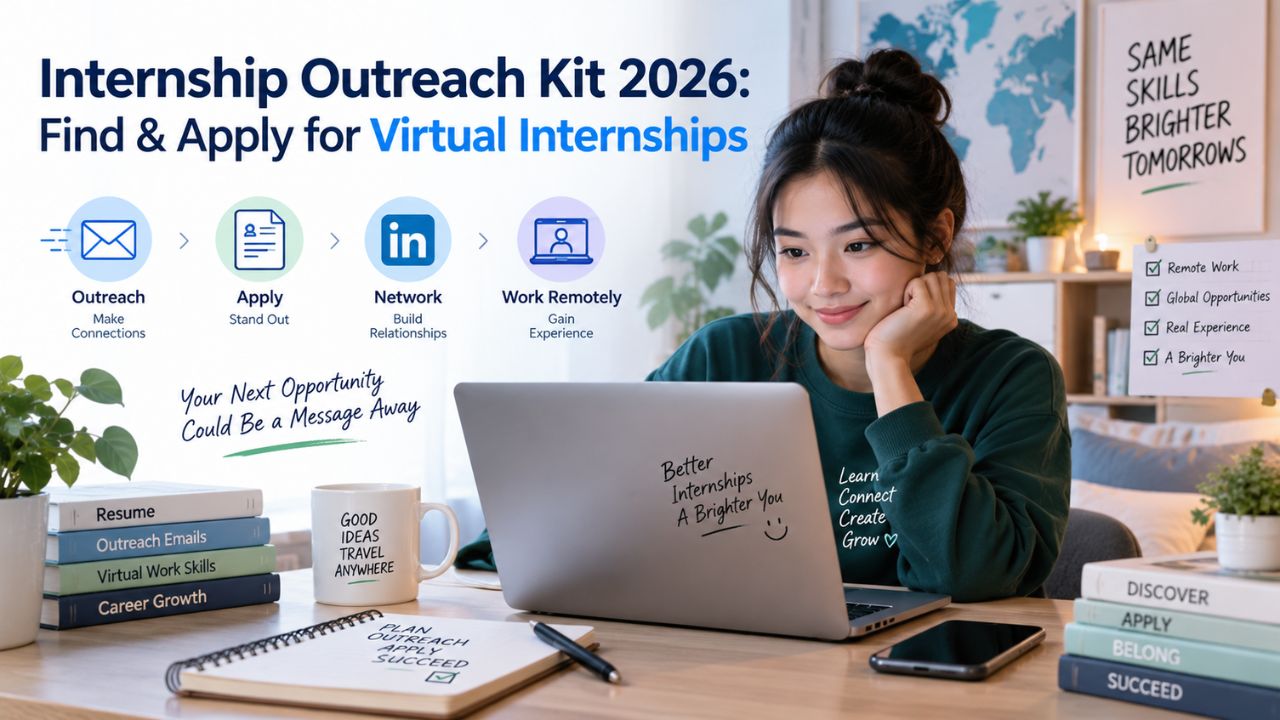
Internship Outreach Kit 2026: Find & Apply for Virtual Internships
Finding an internship is often harder than students expect. You may have the right degree and basic skills, but if your resume is unclear, your outreach email sounds generic, or you do not know how to approach companies, good opportunities can easily pass you by.
An Internship Outreach Kit helps solve this problem by organising the essential resources you need to approach companies professionally. At the same time, Virtual Internships make practical experience more accessible by allowing students and freshers to learn and work remotely.
This guide explains how to build an effective outreach kit, approach internship opportunities, choose a suitable virtual program, develop practical skills, and turn your internship experience into stronger career proof.
Quick Answer
An Internship Outreach Kit is a collection of application resources such as a targeted resume, professional introduction, outreach email, portfolio, and follow-up messages. When combined with Virtual Internships, it can help students approach opportunities professionally while building practical skills and project experience remotely.
Table of Contents
- What Is an Internship Outreach Kit?
- Why Is an Internship Outreach Kit Important in 2026?
- Who Should Create an Internship Outreach Kit?
- Types of Internship Outreach
- Best Virtual Internship Fields in 2026
- Skills and Tools You Can Learn
- Practical Projects and Learning Outcomes
- Key Benefits of an Internship Outreach Kit
- How to Choose the Right Virtual Internship
- Step-by-Step Internship Outreach Process
- Common Mistakes to Avoid
- Internship Outreach vs Random Applications
- Why Choose StuIntern?
- FAQs
Quick Highlights
| Element | Details |
| Best For | College students, graduate,s and freshers |
| Mode | Online / Virtual |
| Skills | Technical, communicatio,n and professional skills |
| Practical Learning | Hands-on, task and project-based learning |
| Projects | Domain-specific practical projects |
| Mentorship | Program-dependent mentor guidance |
| Certificate | Available with eligible internship programs |
What Is an Internship Outreach Kit?
An Internship Outreach Kit is a ready-to-use set of materials that helps a student communicate with companies, recruiters, mento,rs or internship providers professionally.
Instead of sending the same resume and “I need an internship” message everywhere, you prepare resources that can be customised for each opportunity.
A useful outreach kit can include:
- A clean one-page resume
- A short professional introduction
- Customised internship outreach emails
- LinkedIn profile information
- Portfolio or project links
- Skills and tools summary
- Follow-up message templates
- A simple application tracker
Think of it as your internship application toolbox. It does not guarantee selection, but it can make your applications clearer, more relev,ant and easier for the recipient to evaluate.
Why Is an Internship Outreach Kit Important in 2026?
Internship applications are increasingly digital. Students may discover opportunities through internship platforms, company websites, LinkedIn, professional communities, or direct outreach.
That convenience also creates competition.
A recruiter may receive many similar applications. A generic email with an unrelated resume gives them little reason to spend extra time understanding your profile.
A structured Internship Outreach Kit helps you communicate three things quickly:
Who are you?
Your course, specialisation, and current career stage.
What can you do?
Your relevant skills, tools, coursework, and projects.
Why are you contacting this organisation?
A specific reason showing that your message is not mass-sent.
This is particularly useful for freshers who have limited professional experience but can still demonstrate practical skills, academic projects, and genuine interest.
Who Should Choose an Internship Outreach Kit?
An outreach kit can be useful for almost any student searching for practical exposure, but it is especially valuable for:
- Undergraduate students seeking their first internship
- B.Tech, BCA, MCA, BB,A and MBA students
- Final-year students preparing for employment
- Fresh graduates without substantial work experience
- Students looking for Virtual Internships.
- Career switchers building experience in a new field
- Students who have skills but struggle to receive responses
- Learners building a project-based portfolio
You do not need years of experience to create one. In fact, creating an outreach kit before your first internship can help you present the experience you already have more effectively.
Types of Internship Outreach Opportunities
Direct Company Outreach
Identify companies working in your target field and approach them with a concise, personalised message.
Research the company before contacting it. Mention the particular domain, proje,ct or type of work that interests you rather than sending an identical email to dozens of organisations.
Platform-Based Internship Applications
Internship platforms can simplify discovery because students can explore opportunities according to their field and interests.
Your resume, skills, and project portfolio still matter. Treat every platform application as a professional application rather than a simple form submission.
Virtual Internship Programs
Virtual Internships allow students to participate remotely. Depending on the program, learning may include live sessions, mentor interaction, practical assignments, case studies, or projects.
StuIntern currently lists online internship programs with mentor-led learning, live project,s and certificates across several career-focused domains.
Best Fields and Virtual Internship Options in 2026
Students should choose an internship based on the career direction they want to explore rather than selecting a field only because it is popular.
StuIntern currently features virtual internship options including AI, Digital Marketing, Data Science & Analytics, Full-Stack Developme,nt and HR & People Analytics.
| Internship Field | Skills / Tools to Explore | Possible Practical Work |
| AI & Machine Learning | Python, ML, NLP | AI models and ML projects |
| Data Science & Analytics | Python, Pandas, Power BI | Data analysis and dashboards |
| Digital Marketing | SEO, Google Ads, Meta Ads, Canva | Campaigns and marketing analysis |
| Full-Stack Development | React, Node.js, MongoDB | Web applications |
| HR & People Analytics | Excel, Power BI, HR metrics | HR dashboards and workforce analysis |
Choose a field that connects with your existing education, intere,sts or future career plans.
Skills & Tools You Will Learn
A good internship should help you develop both technical and workplace skills.
For example, a digital marketing learner might work with SEO, advertising and content tools, while a data analytics learner may use spreadsheets, Python or visualisation platforms.
Beyond tools, students should also focus on:
Communication: Writing professional messages and explaining work clearly.
Problem-solving: Understanding a task before jumping to a solution.
Research: Finding reliable information and turning it into useful insights.
Time management: Completing assignments and projects within deadlines.
Documentation: Explaining what you built, how you built it, and what you learned.
These transferable abilities remain useful even when the exact software used in an industry changes.
Practical Projects & Learning Outcomes
Watching tutorials can teach concepts. Building something gives you evidence that you can apply those concepts.
That is why practical projects matter in Virtual Internships.
StuIntern’s project catalog emphasizes hands-on projects designed around industry-oriented scenarios, while its internship offerings emphasise practical learning and mentorship.
Depending on your chosen field, your practical output might include:
- A data visualisation dashboard
- A digital marketing campaign plan
- SEO analysis of a website
- A functional web application
- An AI or machine-learning model
- An HR analytics dashboard
- A case study or business analysis
After completing a project, document the problem, tools used, your role, process, and outcome. That turns “I learned this skill” into “Here is how I applied this skill.”
Key Benefits of an Internship Outreach Kit
The biggest benefit is organisation.
Instead of beginning from zero whenever you discover an opportunity, you already have your core materials ready.
An outreach kit can help you:
- Apply more consistently
- Personalize applications faster
- Present your skills clearly.
- Reduce poorly written cold messages.
- Keep track of applications and follow-ups.
- Showcase projects professionally
- Build confidence while communicating with companies.
It also encourages students to think beyond the resume. Your project portfolio, professional profil,e and communication can all contribute to how an organisation evaluates you.
How to Choose the Right Virtual Internship Program
Do not choose a Virtual Internship only because it provides a certificate.
Start with the learning outcome.
Ask yourself:
Does the internship match my career goal?
A student interested in analytics should prioritise programs involving real datasets, analytical tools and projects.
Will I actually practice the skills?
Look for assignments, projects, case studies or practical tasks rather than only passive video content.
Is mentorship available?
Feedback can help beginners understand what they are doing incorrectly and how to improve.
Can I show the work later?
Portfolio-ready output can make the internship more useful after completion.
Is the schedule manageable?
A virtual program should fit alongside college or other commitments without compromising meaningful participation.
Step-by-Step Internship Outreach Process
Step 1: Define your target role.
Choose a specific field such as digital marketing, data analytics, AI/ML or web development.
Step 2: Improve your resume.
Keep it concise and highlight skills, relevant coursework, projects and measurable achievements where available.
Step 3: Build project proof.
Add links to appropriate portfolios, GitHub projects, dashboards, case studies or other relevant work.
Step 4: Create your outreach message.
Introduce yourself briefly, explain why you are interested and state what you can contribute or want to learn.
Step 5: Research each organisation.
Personalise your message based on the company, role or domain.
Step 6: Apply through relevant channels.
Use internship platforms, company career pages and appropriate professional networking channels.
Step 7: Track every application.
Record the company, role, application date, contact person and status.
Step 8: Follow up professionally.
If appropriate, send a short follow-up instead of repeatedly messaging the recipient.
Step 9: Keep improving your skills.
Do not stop learning while waiting for replies. Continue building practical work that can strengthen future applications.
Common Mistakes to Avoid
One of the biggest mistakes is sending the same generic message everywhere.
Avoid:
- Sending identical outreach emails to every company
- Writing very long introductory messages
- Applying without understanding the role
- Adding skills to your resume that you cannot demonstrate
- Using an unprofessional email address
- Sending resumes with formatting or spelling errors
- Focusing only on certificates
- Ignoring practical projects
- Contacting recruiters repeatedly
- Applying randomly without tracking results
Quality outreach is usually more useful than mass outreach with no personalisation.
Internship Outreach Kit vs Random Internship Applications
| Internship Outreach Kit | Random Applications |
| Targeted resume | Same resume everywhere |
| Personalized communication | Generic copy-paste messages |
| Organized portfolio | Projects may be difficult to find |
| Applications tracked | No clear application record |
| Planned follow-ups | Follow-ups easily forgotten |
| Career-focused targeting | Applying to unrelated roles |
| Skills demonstrated through projects | Skills mainly listed as claims |
The purpose of an outreach kit is not to make the application complicated. It is to make your internship search more intentional.
Why Choose StuIntern for Virtual Internships?
StuIntern provides internship programs aimed at students and freshers who want practical learning rather than relying only on classroom concepts.
Its current website highlights 100% online, mentor-led learning, verified internship certificates, live projects and case studies, industry-recognised tools, flexible batches, mock interviews and resume-building support.
Students can currently explore fields such as Artificial Intelligence, Digital Marketing, Data Science & Analytics, Full-Stack Development and HR & People Analytics.
For students building an Internship Outreach Kit, practical internship experience can also provide useful material for a stronger resume and portfolio. Instead of simply mentioning a skill, you can explain the project or task through which you applied it.
Frequently Asked Questions
1. What is an Internship Outreach Kit?
An Internship Outreach Kit is a collection of resources used when approaching internship opportunities. It can contain your resume, short professional introduction, personalised outreach email, portfolio, project links and follow-up messages. Its purpose is to make internship applications more organised, relevant and professional.
2. What are Virtual Internships?
Virtual Internships are internship experiences that can be completed remotely. Depending on the provider and program, students may participate in online training, practical assignments, projects, mentor sessions and assessments without being physically present at an office.
3. Are Virtual Internships useful for freshers?
Yes, particularly when they include meaningful practical work. Freshers often face the problem of having academic knowledge but limited evidence of applying it. A project-focused virtual internship can help them practice skills and build work they can discuss in future applications and interviews.
4. What should I include in an internship outreach email?
Keep the email concise. Introduce yourself, mention your education or specialisation, explain why you are interested in that organisation or role and highlight one or two relevant skills or projects. Add your resume or portfolio where appropriate and finish with a clear, professional request.
5. Can college students apply for Virtual Internships?
Yes. Virtual programs can be particularly convenient for college students because remote participation may make it easier to manage internship learning alongside academic commitments. However, students should always check eligibility, schedule, workload and program requirements before applying.
6. Is an internship certificate enough for a resume?
A certificate can support your profile, but it should not be the only outcome you seek. Practical projects, demonstrated skills, and the ability to explain what you actually did during an internship generally give you more substance to discuss in applications and interviews.
7. How can I make my Internship Outreach Kit stronger?
Customise your resume for the target field, keep your portfolio updated, write short personalised outreach messages and include relevant projects. Track your applications so you know when to follow up. Most importantly, only claim skills that you can explain or demonstrate.
8. How do I find the right Virtual Internship in 2026?
Start with your career goal and then compare programs based on practical projects, relevant tools, mentorship, schedule, learning outcomes and certificate details. Avoid choosing solely on popularity. The best option is one that helps you build skills and evidence relevant to your intended career.
Conclusion
An Internship Outreach Kit can turn an unorganised internship search into a focused application process. A strong resume, personalised outreach, relevant portfolio and systematic follow-up help students present themselves more professionally. Combine that preparation with meaningful Virtual Internships, and you can build practical experience without being limited by location.
For students and freshers in 2026, the goal should be more than collecting certificates. Focus on skills you can demonstrate, projects you can explain and experience you can confidently add to your profile.
Explore StuIntern internship opportunities to find a program aligned with your skills and career direction.