

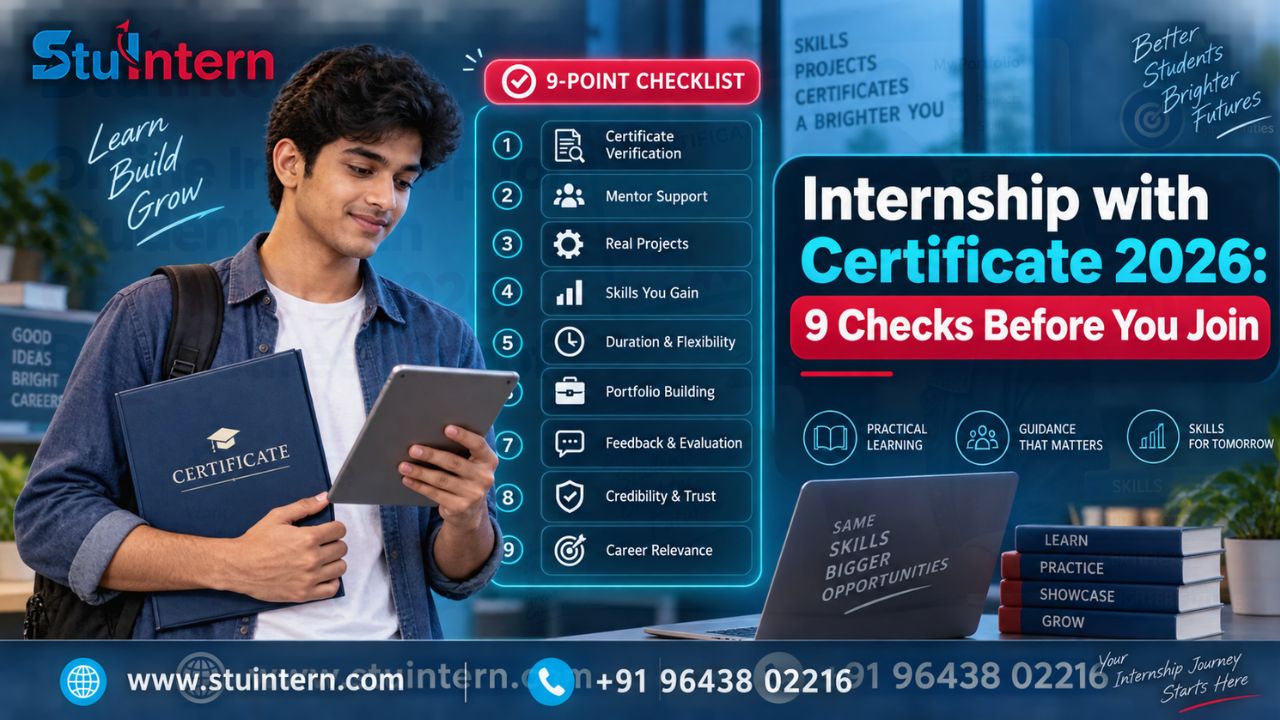
An internship with a certificate can strengthen a student profile, but only when the certificate represents genuine participation, assessed work and practical learning. Many students compare opportunities by looking at the certificate first and the experience later. This can lead to weak projects, unclear terms or a document that is difficult to verify.
The better approach is to evaluate the learning structure, assignments, mentor access, project ownership and certificate process before applying. This guide provides a nine-point verification checklist for choosing an internship that produces credible evidence—not merely another line on a résumé. It is designed for college students and freshers comparing an online internship with a certificate in 2026.
Quick Answer
Choose an internship with a certificate only after checking the provider, curriculum, projects, mentor support, workload, written terms and verification method. A useful certificate should identify the learner, program, completion period and issuer. Its value becomes stronger when it is supported by original work, feedback and portfolio evidence that the student can explain independently.
Table of Contents
- What Is an Internship with Certificate?
- Who Should Choose It?
- Eligibility and Requirements
- Skills and Tools
- Projects and Practical Experience
- Duration and Format
- Certificate and Portfolio
- Certificate Types
- Application Process
- Nine Checks Before Joining
- Common Mistakes
- Career Use
- Why StuIntern?
- FAQs
Quick Highlights
Feature What Students Should Check
Internship Mode Online, hybrid or on-site format
Eligibility Course, semester, age and prerequisite skills
Duration Start date, end date and weekly time commitment
Skills Covered Specific tools and measurable learning outcomes
Live Projects Problem statement, deliverables, feedback and ownership
Certificate Issuer, completion criteria, unique ID and verification method
Mentorship Live guidance, response time and review process
Application Selection steps, fees, policies and written confirmation
What Is an Internship with Certificate?
An internship with certificate is a structured experience in which a student completes defined learning activities, practical tasks or project work and receives a certificate after meeting the stated requirements. It may be delivered online, on-site or in a hybrid format.
A certificate should confirm completion; it should not be treated as a substitute for experience. Students should be able to explain:
- What problem they worked on
- Which tools or methods they used
- What they personally created
- How their work was reviewed
- What improved after feedback
- Which result can be included in a portfolio
An online internship with a certificate can be convenient for students who need remote access and a flexible schedule. Its usefulness still depends on the quality of the tasks, projects and evaluation—not on the word “online” or “certified” alone.
Who Should Choose This Internship?
Certificate-based internships can suit:
- College students looking for practical exposure
- Freshers building their first professional portfolio
- Students who cannot relocate for an internship
- Learners exploring a field before committing to a career path
- Candidates who need structured projects and mentor feedback
- Students preparing for placement or entry-level interviews
The selected domain should support a clear goal. For example, a BTech or BCA student may explore AI, data science or full-stack development. A BBA, MBA or commerce student may consider digital marketing, analytics or HR-related projects.
Do not select a program simply because its title sounds popular. The right choice should match your current level, available time and intended career direction.
Eligibility and Basic Requirements
Eligibility differs by provider and domain. Many beginner programs accept students without previous job experience, while technical internships may expect basic programming, mathematics or subject knowledge.
Common requirements include:
- A laptop or desktop computer
- Reliable internet access
- A professional email address
- Basic communication and file-management skills
- Time for sessions, assignments and project work
- Willingness to accept feedback and revise submissions
- Fundamental subject knowledge where specified
Before applying, confirm whether the program is beginner-friendly. Also check software requirements, minimum attendance, assessment rules and whether missed sessions are recorded or repeated.
Skills and Tools Students Can Learn
The right skills depend on the internship field and the level of the program.
Artificial Intelligence and Machine Learning
Students may practise Python, NumPy, Pandas, machine-learning methods, deep learning, natural language processing and model evaluation. Review the current AI and ML internship program for its published curriculum, duration and certificate conditions.
Data Science and Analytics
A data-focused internship may use Python, SQL, Power BI, Tableau, data cleaning, visualisation, statistical analysis and predictive modelling. Students can examine the Data Science internship program before enquiring.
Digital Marketing
Digital marketing learners may work with SEO, content planning, WordPress, social media, paid advertising and campaign reporting. The Digital Marketing internship program provides program-specific information.
Full-Stack Development
Development internships can involve HTML, CSS, JavaScript, React, Node.js, databases, APIs, version control and deployment. Explore the MERN Full-Stack internship to compare the latest requirements.
A long tool list does not guarantee practical learning. Check whether students actually use the tools in assessed assignments and whether the project output can be demonstrated after completion.
Live Projects and Practical Experience
Projects are the bridge between learning and employability. A student who watches sessions but produces no original work may struggle to answer project-based interview questions.
A meaningful project should include:
- A specific problem statement
- Clear objectives and deliverables
- Appropriate tools, data or resources
- Milestones and submission deadlines
- Mentor review at important stages
- Feedback and an opportunity to improve
- A final output the student can explain
For example, a data science student might clean a dataset, build a dashboard and explain three findings. A digital marketing student might audit a website and prepare a measurable SEO plan. A development student might create and deploy a functional web application.
Ask whether the project is individual or team-based. If it is a team project, document your personal contribution. Never copy a ready-made project merely to obtain a certificate; it provides little interview value and can create credibility problems.
Internship Duration and Learning Format
There is no single ideal duration for every internship. The appropriate length depends on the field, project complexity, learning level and weekly workload.
Before joining, confirm:
- Total number of weeks
- Expected hours per week
- Live and recorded session availability
- Attendance requirements
- Assignment and project deadlines
- Mentor-feedback schedule
- Resubmission or extension policy
- Certificate-completion conditions
StuIntern publishes different formats across its internship programs. Use the virtual internship overview and the relevant program page to confirm the latest duration, schedule, price and cohort information before paying or applying.
Certificate Verification and Portfolio Benefits
A certificate is more credible when another person can verify that it was issued by the stated organisation. Before enrolment, check whether the certificate includes:
- Student’s correct name
- Internship field or program title
- Completion or participation period
- Issuing organisation’s name
- Certificate number or unique ID
- Authorised signature or digital authentication
- A verification page, QR code or contact method
StuIntern provides an official certificate verification page. Students should enter or confirm the required certificate details using the provider’s published verification process.
The certificate should be supported by a portfolio containing suitable evidence, such as:
- Project summary and objective
- Screenshots or demonstration video
- GitHub repository or live link
- Dashboard, audit or campaign report
- Tools and methods used
- Your individual contribution
- Challenges, decisions and results
Do not publish confidential material, private datasets or work that you do not have permission to share.
Looking for a practical internship with a verifiable certificate? Compare StuIntern programs by eligibility, curriculum, project requirements and certification terms before submitting an enquiry.
Participation, Completion and Assessment Certificates
Not every certificate communicates the same level of achievement. Before adding a credential to a résumé or LinkedIn profile, understand what it confirms.
Certificate Type What It Usually Confirms Evidence Students Should Keep
Participation The learner attended or registered for activities Attendance record and session details
Completion Required modules or tasks were completed Submitted assignments and completion criteria
Project Completion A defined project was submitted Project link, report, screenshots and contribution notes
Assessed Completion Work was evaluated against stated criteria Score, mentor feedback, rubric or assessment record
Students should describe the credential accurately. Do not present a participation certificate as proof of employment or claim professional experience that the program did not provide.
Step-by-Step Application Process
Step 1: Define your career goal
Choose the role, field or skill you want to explore. This prevents you from collecting unrelated certificates.
Step 2: Check your current level
Decide whether you need a beginner, intermediate or advanced program. Compare prerequisites with your existing knowledge.
Step 3: Study the curriculum
Look for modules, tools, assignments, projects and measurable learning outcomes. Avoid relying on broad claims such as “complete industry exposure.”
Step 4: Verify the provider
Check the official website, company information, contact details, terms, refund policy and certificate system. Students can also review opportunities through the AICTE Internship Portal and National Career Service.
Step 5: Ask program-specific questions
Confirm the format, duration, fees, mentor access, deadlines, project ownership and certificate criteria in writing.
Step 6: Submit accurate information
Use the correct spelling of your name and provide current contact and academic details. The same information may appear on your certificate.
Step 7: Save all records
Keep the application confirmation, payment receipt, curriculum, terms and important communication for reference.
Nine Checks Before Choosing an Internship Program
1. Provider Identity
Confirm the organisation’s official name, website, address, email and phone number. The payment recipient and certificate issuer should be clear.
2. Defined Learning Outcomes
The program should state what you will be able to do after completion—not only list general topics.
3. Structured Curriculum
Modules should progress logically from fundamentals to practical application. Check whether the syllabus matches your level.
4. Original Project Work
You should create, analyse, test or improve something. Ask what the deliverables are and whether project ownership is explained.
5. Mentor Access
Confirm how students contact mentors, how frequently guidance is available and whether submitted work receives a human review.
6. Assessment and Feedback
An automatic completion mark is not the same as evaluation. Look for assignments, review criteria and opportunities to correct mistakes.
7. Transparent Certificate Rules
Students should know the attendance, assignment, project and assessment requirements before joining.
8. Written Fees and Policies
Confirm the total fee, taxes, refund conditions, payment schedule, extension rules and any extra certificate charges.
9. Verifiable Career Evidence
Ask what you will be able to show after completion: code, report, case study, dashboard, campaign, presentation or another portfolio-ready output.
If a provider guarantees a job, fixed salary or placement without explaining the selection conditions, investigate the claim carefully. Skill development can improve readiness, but no genuine internship can guarantee an employer’s hiring decision.
Common Mistakes Students Should Avoid
Choosing only for the certificate
A certificate cannot compensate for missing skills, weak projects or an inability to explain your work.
Confusing training with employment
A fee-based learning program, unpaid internship and paid employer internship are different models. Confirm which one is being offered.
Ignoring completion criteria
Do not assume that payment alone guarantees certification. Read attendance, assignment and project requirements.
Joining an unrelated field
Choose a field connected to your academic background, interests or intended career path.
Copying project submissions
Copied work prevents learning and becomes difficult to defend in an interview.
Failing to document progress
Save project versions, feedback, results and lessons throughout the program instead of reconstructing them at the end.
Expecting guaranteed employment
An internship can support skill development and interview preparation, but final hiring depends on the employer and candidate performance.
Career Opportunities After Completion
The certificate becomes useful when students convert their experience into clear career evidence. After completing the internship:
- Add the certificate to LinkedIn with the correct issuer and credential ID.
- Create a dedicated project section in your résumé.
- Publish permitted work on GitHub or a portfolio website.
- Prepare a 60-second explanation of each project.
- Describe your role, tools, decisions and measurable output.
- Practise answering questions about mistakes and improvements.
- Apply for relevant internships and entry-level roles.
- Continue improving the project after receiving feedback.
Instead of writing “Completed an online internship,” use a specific statement describing what you built, analysed or improved. Accuracy is more persuasive than an exaggerated claim.
Why Explore StuIntern?
StuIntern lists remote internship options across technology, data, marketing and other career areas. Its current program pages describe learning formats that may include mentor-led sessions, practical projects and certificate-related information. Published details can differ between programs and may change over time.
Before applying, review the selected program’s:
- Eligibility and prerequisite knowledge
- Curriculum and tools
- Current duration and schedule
- Assignment and project structure
- Mentor-support process
- Current fees and payment terms
- Certificate-completion requirements
- Refund and other published policies
Ready to compare programs? Explore StuIntern’s virtual internship opportunities and submit an enquiry to confirm the current eligibility, curriculum, project expectations, duration, fees and certificate process.
Frequently Asked Questions
1. Is an internship with a certificate useful for students?
Yes, when the certificate represents genuine participation, assessed work and practical learning. Its value increases when the student can show original projects, explain personal contributions and verify the credential through the issuer. A certificate alone does not prove skill, so it should support—not replace—portfolio evidence.
2. How can I verify an online internship certificate?
Check the certificate for the learner’s name, program, dates, issuer and unique ID. Use the organisation’s official verification page or QR code where available. If online verification is unavailable, contact the issuer through the email or phone number published on its official website.
3. Can freshers join an online internship with certificate?
Many beginner programs accept freshers without previous employment experience. Technical programs may still require basic subject or programming knowledge. Read the eligibility criteria and syllabus carefully, then ask the provider whether the assignments and projects are suitable for your current level.
4. Are certificate internships free or paid?
Both models exist. Some employers offer free or stipend-based internships, while structured learning programs may charge for training, mentorship, projects and support. Confirm whether the opportunity is employment, unpaid work experience or fee-based learning, and obtain the complete terms before enrolling.
5. How long does an online internship usually take?
Duration varies by field, workload and project complexity. Programs may run for a few weeks or several months. Compare weekly hours, live sessions, assignment deadlines, project depth and mentor access rather than choosing only the shortest program. Always confirm the current schedule on the official program page.
6. What should an internship certificate contain?
A useful certificate should include the student’s correct name, internship domain, completion period, issuer’s identity and a certificate number or verification method. It should also be clear whether the document confirms participation, training or successful completion of required assignments and projects.
7. Do live projects make a certificate more valuable?
Projects provide evidence behind the certificate. Their value depends on whether the student completed meaningful tasks, received feedback and can explain the process independently. An original report, dashboard, campaign, model or application is usually more persuasive than an undocumented completion certificate.
8. Does an internship certificate guarantee a job?
No. A certificate may support a résumé and show structured learning, but employers evaluate skills, project understanding, communication and performance during selection. Avoid providers that promise guaranteed employment without clear written conditions and verifiable evidence.
Conclusion and Apply Now
The right internship with a certificate should produce three outcomes: relevant skills, completed work and a credential that can be verified. Before joining, examine the provider, curriculum, projects, mentor access, assessment process, written terms and certificate rules.
An online internship with a certificate becomes more credible when you can demonstrate what you created and explain every important decision. Select a program that fits your level and career goal rather than collecting certificates without practical evidence.
📞 Call/WhatsApp: +91 96438 02216
Explore StuIntern internship programs and enquire about current eligibility, duration, projects, fees, mentorship and certificate requirements before applying.