

Completed multiple online courses but still struggling to explain what you can actually do in an interview?
That is where many students and freshers get stuck. They may have completed certifications, watched technical tutorials, or studied concepts in college, but their resumes often lack practical projects, industry exposure and demonstrable skills.
In 2026, building a career is increasingly about showing what you can apply—not simply what you have studied.
This is why structured internship programs can help students turn academic knowledge into practical experience.
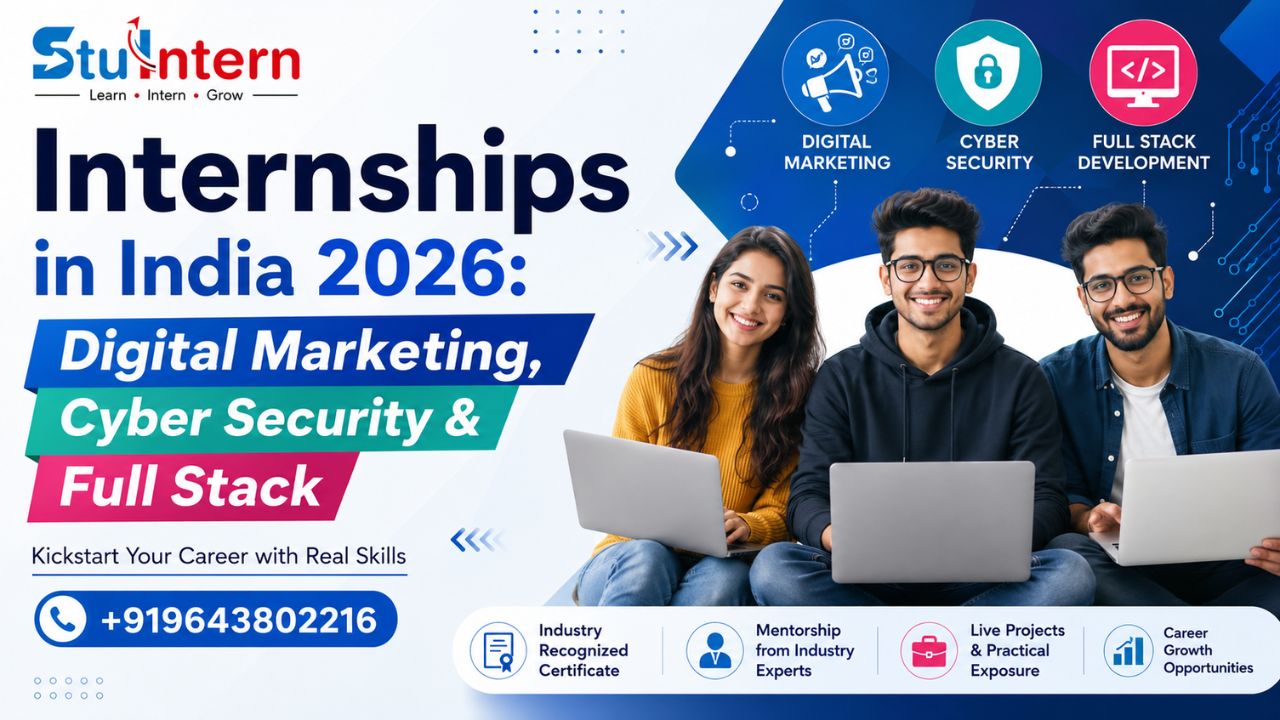
If you are exploring technology and digital careers, three areas deserve particular attention: Digital Marketing Internship in India, Cyber Security Internship in India, and Full Stack Development Internship opportunities.
This guide explains how students can compare these career paths, what skills matter in 2026, how projects compare with certificates, and what to look for before choosing an internship program.
Quick Answer: Which Internship Should You Choose in 2026?
The right internship depends on your career goal.
- Choose Digital Marketing if you are interested in SEO, advertising, content, social media and analytics.
- Choose Cyber Security if you want to work in ethical hacking, threat detection, security testing and information security.
- Choose Full Stack Development if you want to build websites, web applications and software products using frontend and backend technologies.
The most useful programs combine structured learning with practical assignments, live projects, mentorship and career preparation.
StuIntern currently lists 10K+ active students, 500+ companies and a 95% success rate on its platform.
Biggest Challenges Students Face When Starting Their Careers
Getting a degree is only one part of becoming employable. Students often face several practical challenges when they begin searching for internships and entry-level jobs.
1. Academic Knowledge Does Not Always Equal Practical Skills
College courses can teach concepts, but students may not get enough opportunities to apply those concepts to real-world problems.
For example, knowing what SEO means is different from actually performing keyword research, optimising a page and analysing search performance.
Similarly, understanding programming concepts is different from building and deploying a working application.
2. Lack of Portfolio Projects
Recruiters need evidence of what a candidate can do.
A resume containing only:
- Degree
- College
- Course certificates
- Academic marks
may not communicate practical ability effectively.
Projects can provide that missing evidence.
3. Difficulty Choosing the Right Career Path
Students may be interested in several fields at once.
Should they learn marketing?
Programming?
Cybersecurity?
Data?
AI?
Instead of trying everything simultaneously, students should identify the career direction that matches their interests and strengths.
4. Limited Industry Exposure
Students who have never worked on practical assignments may find interviews difficult because they have limited examples to discuss.
An internship can give them situations where they can explain:
What problem did you solve?
What tools did you use?
What was your role?
What did you learn?
5. Too Much Focus on Certificates
Certificates can demonstrate course completion, but they should not become the entire career strategy.
A stronger profile combines:
Skills + Projects + Internship Experience + Portfolio + Interview Preparation
What Should a Good Student Career Platform Offer?
A student career platform should go beyond simply providing a certificate.
Before enrolling in an internship or training program, check whether it provides:
Practical Projects
Students should have opportunities to apply concepts through assignments, case studies or projects.
Mentor Support
Access to mentors can help students understand concepts, solve problems and receive feedback.
Industry-Relevant Tools
The tools taught should reflect the technologies and platforms students are likely to encounter in their target careers.
Career Preparation
Resume building, mock interviews and interview preparation can help students transition from learning to job applications.
Flexible Learning
Students should be able to learn without unnecessarily disrupting their college schedules.
Verifiable Certification
If a certificate is provided, students should understand what it represents and whether it can be verified.
StuIntern currently highlights 100% online mentor-led learning, verified internship certificates with unique IDs, live projects and case studies, industry-recognised tools, mock interviews, AI resume builders, flexible batches, 24/7 support and placement assistance.
Why Is Practical Learning Important for Students?
Practical learning changes the way students understand a subject.
Instead of only memorising concepts, students learn how those concepts are applied to actual tasks.
For example:
Digital Marketing
A student can move from learning SEO theory to:
- Keyword research
- On-page optimization
- Content planning
- Google Ads
- Meta Ads
- Analytics
- Campaign analysis
StuIntern’s Digital Marketing internship currently focuses on SEO, advertising and content tools, including Google Ads, Meta Ads, Canva and ChatGPT.
Cyber Security
Students can explore areas such as:
- Ethical hacking
- Penetration testing
- Threat analysis
- Security testing
- Security infrastructure
StuIntern describes its Cyber Security Internship as hands-on training covering ethical hacking, penetration testing, threat analysis and security infrastructure development.
Full Stack Development
Students can learn how different parts of a web application work together:
- Frontend
- Backend
- APIs
- Databases
- Application development
- Deployment
StuIntern currently lists its Full Stack Development Internship around building complete applications using technologies including React, Node.js, Express and MongoDB.
How Should Students Compare Different Learning Programs?
Do not select a program simply because its title sounds impressive.
Compare the actual learning experience.
| Factor | What to Check |
| Curriculum | Does it cover relevant skills? |
| Projects | Are students required to build practical work? |
| Mentorship | Can students receive guidance? |
| Tools | Are industry-relevant tools included? |
| Duration | Is there enough time to practise? |
| Certification | Is the certificate verifiable? |
| Career Support | Are resume and interview services available? |
| Flexibility | Can students manage it with college? |
| Portfolio | Will students finish with demonstrable work? |
| Support | Is help available when students get stuck? |
The goal should be to choose a program that creates career evidence, not simply another line on a resume.
Which Skills Should College Students Learn in 2026?
Students should focus on a combination of technical, digital and professional skills.
Digital Marketing Skills
For students interested in marketing:
- SEO
- Content marketing
- Paid advertising
- Social media marketing
- Keyword research
- Analytics
- AI-assisted content workflows
- Campaign optimization
Cyber Security Skills
For students interested in security:
- Networking fundamentals
- Ethical hacking
- Threat analysis
- Penetration testing
- Security monitoring
- Vulnerability assessment
- Security best practices
Full Stack Development Skills
For aspiring developers:
- HTML and CSS
- JavaScript
- React
- Node.js
- Express
- MongoDB
- APIs
- Git/GitHub
- Application deployment
Career Skills
Technical knowledge alone is not enough.
Students should also develop:
- Communication
- Problem-solving
- Presentation
- Teamwork
- Resume writing
- Interview skills
- Portfolio development
- Professional communication
How to Choose the Right Program Based on Your Career Goal
| Career Goal | Recommended Internship | Skills to Prioritize | Ideal Project Type |
| SEO Specialist | Digital Marketing Internship in India | SEO, content, analytics | SEO campaign |
| Performance Marketer | Digital Marketing Internship in India | Google Ads, Meta Ads, analytics | Advertising campaign |
| Content/Marketing Executive | Digital Marketing Internship in India | Content, SEO, social media | Content strategy |
| Ethical Hacker | Cyber Security Internship in India | Security testing, ethical hacking | Security assessment |
| Cyber Security Analyst | Cyber Security Internship in India | Threat analysis, monitoring | Threat-analysis project |
| Web Developer | Full Stack Development Internship | React, Node.js, databases | Web application |
| Full Stack Developer | Full Stack Development Internship | Frontend + backend + APIs | Full-stack application |
| Software Development Fresher | Full Stack Development Internship | Programming, Git, APIs, databases | Deployable application |
Digital Marketing Internship in India: Who Should Choose It?
A Digital Marketing Internship in India can be a suitable starting point for students who enjoy a combination of creativity, communication, technology and business.
It may suit:
- BBA and MBA students
- B.Com students
- Mass communication students
- Marketing students
- Entrepreneurs
- Students interested in SEO
- Students interested in advertising
- Freshers looking to enter digital marketing.
A strong internship should allow students to move beyond theory and work with real marketing workflows.
The key areas to look for include:
SEO → Content → Advertising → Analytics → Campaign Optimization
Cyber Security Internship in India: Who Should Choose It?
A Cyber Security Internship in India is designed for students who are interested in protecting systems, identifying vulnerabilities and understanding how cyber threats operate.
It can be relevant for:
- B.Tech/BE students
- BCA students
- MCA students
- Computer science students
- IT students
- Networking students
- Technology graduates
- Students interested in ethical hacking
A practical cybersecurity program should combine foundational knowledge with hands-on exercises.
Important areas can include:
- Ethical hacking
- Penetration testing
- Threat analysis
- Vulnerability assessment
- Security infrastructure
- Security awareness
Students should also verify the program’s syllabus, duration, project structure and mentorship before enrolling.
Full Stack Development Internship: What Can You Learn?
A Full Stack Development Internship can help aspiring developers understand how complete web applications are designed and built.
Rather than focusing only on frontend coding, full-stack learning connects multiple components.
Frontend
Students learn how users interact with an application.
Common technologies include:
HTML + CSS + JavaScript + React
Backend
Backend development handles application logic, APIs and server-side functionality.
Common technologies include:
Node.js + Express
Database
Students learn how application data can be stored and managed.
For example:
MongoDB
Final Project
The most important part is bringing these components together into a working application.
This can give students something concrete to demonstrate during interviews.
Online vs Offline Learning: Which Is Better for Students?
There is no universal winner.
The better option depends on the student’s learning style, schedule and location.
| Factor | Online Learning | Offline Learning |
| Flexibility | High | Usually lower |
| Location | Learn from anywhere | Requires physical attendance |
| College Compatibility | Easier to combine | May require fixed schedules |
| Mentorship | Depends on program | Usually face-to-face |
| Learning Resources | Digital resources | Physical/classroom resources |
| Accessibility | High | Location dependent |
| Networking | Online communities | In-person interaction |
| Cost | Often more flexible | Can include travel/infrastructure costs |
For students balancing college and skill development, a structured online program can be convenient.
StuIntern positions its internship programs as online and mentor-led, allowing students to build skills and work on projects remotely.
Projects vs Certificates: What Actually Helps Your Career More?
| Factor | Projects | Certificates |
| Demonstrates practical ability | High | Limited |
| Shows problem-solving | High | Low |
| Useful during interviews | High | Moderate |
| Portfolio value | High | Low |
| Proves course completion | Sometimes | High |
| Shows technical application | High | Depends on program |
| Resume value | Strong when relevant | Supporting evidence |
The best approach is not projects OR certificates.
It is:
Projects + Relevant Certificate + Internship Experience
A certificate can show that you completed a program.
A project can show what you actually built or accomplished.
Common Mistakes Students Make When Choosing a Career Program
1. Choosing Only by Certificate
A certificate without practical experience may not give students enough material to discuss in interviews.
2. Selecting a Program Because It Is Cheap
Price should not be the only consideration.
Compare curriculum, mentorship, projects, support and outcomes.
3. Learning Too Many Skills at Once
Trying to learn digital marketing, coding, cybersecurity, data science and AI simultaneously can create shallow knowledge.
Start with one career direction.
4. Ignoring Projects
Students sometimes complete lessons without creating anything.
That makes it harder to demonstrate their abilities.
5. Not Checking the Curriculum
Always review the syllabus before joining.
Make sure the program covers the skills you actually want to develop.
6. Ignoring Interview Preparation
Technical skills can help you reach an interview, but communication and interview preparation help you perform during it.
7. Treating Internship Experience as a Formality
An internship should not simply be about obtaining documentation.
The objective should be to gain experience that you can explain on your resume and in interviews.
Why Choose StuIntern?
StuIntern positions itself as an internship and career platform focused on helping students move from academic learning toward practical, career-oriented skills. Its current platform includes internships, jobs, academic projects, mentor-led training and career support.
Key differentiators highlighted by StuIntern include:
Mentor-Led Learning
Students can learn through structured mentor-led programs instead of relying entirely on self-study.
Live Projects & Case Studies
The platform emphasises practical projects and case studies to help students build demonstrable experience.
Verified Internship Certificate
StuIntern states that its internship certificates include unique IDs for verification.
Industry-Recognized Tools
Programs are built around tools relevant to specific career paths, such as Google Ads and Meta Ads for digital marketing and React, Node.js, Express and MongoDB for full-stack development.
Career Preparation
The platform also highlights mock interviews, AI resume builders, placement assistance and interview preparation.
Flexible Learning
Its internship model is designed around online learning, making it easier for students to combine skill development with college schedules.
Who Can Benefit From StuIntern?
StuIntern can be relevant to specific student groups, including:
College Students
Students who want to gain practical experience alongside their degree.
Final-Year Students
Students preparing for placements who need projects, internship experience and interview preparation.
Freshers
Graduates looking to strengthen a resume before applying for entry-level jobs.
Career Switchers
Learners who want structured exposure to a new career area.
Students Without Previous Internship Experience
Learners who have academic knowledge but limited practical exposure.
Students Building a Technical Portfolio
Aspiring developers and technology students who want project-based experience.
Marketing Aspirants
Students interested in SEO, advertising, content and digital marketing.
Cyber Security Aspirants
Students who want practical exposure to security-related concepts and workflows.
StuIntern currently lists internship programs across areas including Digital Marketing, Full Stack Development, AI, Data Science & Analytics and HR & People Analytics.
How to Prepare for Future Career Opportunities
An internship should be treated as the beginning of your career preparation—not the end.
Students can follow a simple process:
Step 1: Select One Career Direction
Choose the field you want to explore seriously.
Step 2: Learn the Fundamentals
Build a strong understanding of the core concepts.
Step 3: Work on Practical Projects
Turn your knowledge into something demonstrable.
Step 4: Build Your Portfolio
Document your projects, responsibilities and outcomes.
Step 5: Improve Your Resume
Highlight skills and projects relevant to the job you want.
Step 6: Practise Interviews
Prepare technical, behavioural and project-based questions.
Step 7: Start Applying
Use your internship experience and portfolio to apply for relevant opportunities.
Frequently Asked Questions
What is the best internship for students in India in 2026?
There is no single best internship for every student. The right choice depends on your career goal. Digital Marketing suits students interested in marketing and advertising, Cyber Security suits students interested in information security, and Full Stack Development suits students interested in software and web development.
Is a Digital Marketing Internship in India useful for freshers?
Yes. A practical Digital Marketing Internship in India can help freshers develop skills in areas such as SEO, content, advertising and analytics while building project experience.
What does a Cyber Security Internship in India teach?
Depending on the program, students can learn ethical hacking, penetration testing, threat analysis, vulnerability assessment and security fundamentals.
What is included in a Full Stack Development Internship?
A Full Stack Development Internship can cover frontend development, backend development, databases, APIs and application development. Programs may use technologies such as React, Node.js, Express and MongoDB.
Are projects more important than certificates?
Projects and certificates serve different purposes. Projects demonstrate practical ability, while certificates demonstrate completion of a learning program. A strong student profile can include both.
Can college students do internships online?
Yes. Online internships allow students to gain practical experience remotely and can be easier to manage alongside college schedules.
How long should an internship be?
The appropriate duration depends on the learning objectives and program. Students should choose a duration that gives them enough time to learn, practise and complete meaningful projects rather than selecting a program solely based on duration.
What should I check before joining an internship?
Check the curriculum, mentor support, project structure, tools covered, certificate verification, duration, learning format, career support and the credibility of the organisation.
Does StuIntern provide career support?
StuIntern currently highlights placement assistance, interview preparation, mock interviews and AI resume-building support as part of its career-focused offering.
Conclusion
The job market in 2026 is not simply about having a degree.
Students need to demonstrate that they can apply knowledge, solve problems, use relevant tools and communicate what they have accomplished.
Whether your goal is a Digital Marketing Internship in India, a Cyber Security Internship in India, or a Full Stack Development Internship, focus on programs that provide more than lessons and certificates.
Look for:
Practical Learning + Mentorship + Projects + Industry Tools + Career Preparation
The right internship can help you turn classroom knowledge into a portfolio of work that you can discuss with recruiters and use as a foundation for your next career step.
Start Building Job-Ready Skills With StuIntern
If you are a student or fresher planning your career in 2026, explore internship programs that match your target field and start building practical experience today.
Choose your career path. Build real projects. Strengthen your resume. Prepare for your next opportunity with StuIntern.
Website: www.stuintern.com
Call/WhatsApp: +91 96438 02216