

Introduction
Choosing the right Management Research Topic is a deal for PhD students. It sets the stage for the research project, including the problem, literature review, objectives, methodology, data collection, analysis and final thesis.
The topic should be interesting. That is not all. It needs to be relevant something that can be researched focused and supported by existing studies.
For PhD students the process is like this:
Management Research Area, an Initial Idea followed by a Literature Review, which leads to a Research Problem then a Research Gap and finally a novel idea.
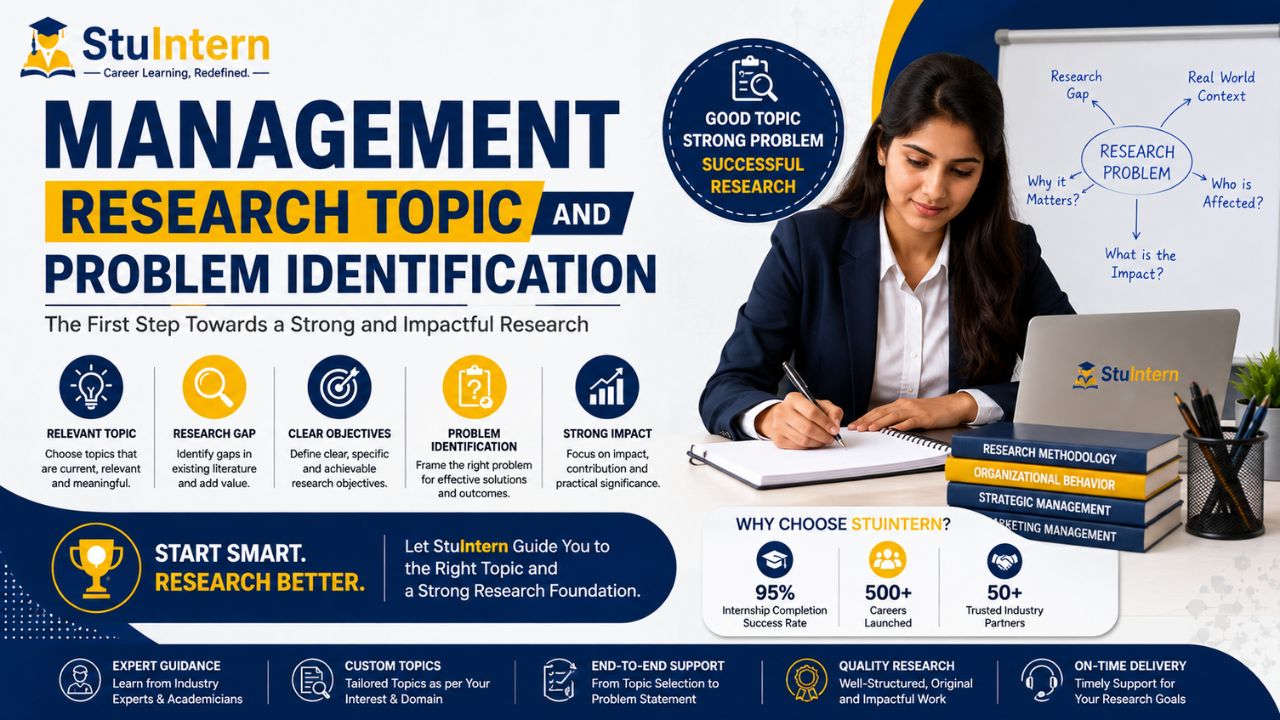
StuIntern provides guidance to help students turn their Management research ideas into topics.
What Makes a Good PhD Management Research Topic?
A good topic should have some characteristics.
It should be about Management, clearly defined something that can be researched and supported by studies.
It should also be feasible connected to a problem and capable of producing useful findings.
The topic should be appropriate for the students field of study. Potentially valuable to theory or practice.
A topic that is too broad can be hard to research while a topic that is too narrow may not be good enough for a PhD project.
Start with a Broad Management Research Area
Before choosing a topic students can look at a broader research area.
Some potential areas include Human Resource Management, like employee engagement, retention and leadership.
Then there is Marketing Management, which includes marketing, customer experience and brand loyalty.
Strategic Management is another area with topics like advantage, innovation and business performance.
Finance and Operations Management are also options with topics like governance, financial performance and supply chain resilience.
Entrepreneurship is another area with topics like startup performance, innovation and small business growth.
The research area is the starting point and it needs to be turned into a specific research problem.
From Research Area to Research Topic
Here is an example of how to narrow down a topic:
Start with an area like Employee Engagement.
Then focus on an area like Employee Engagement in Hybrid Workplaces.
Next identify a problem like organizations experiencing differences in engagement among employees working in hybrid arrangements.
Then identify variables like leadership support work flexibility and employee engagement.
Finally come up with a research topic, like the influence of leadership support and work flexibility on employee engagement in workplaces.
This process creates a researchable topic.
What Is a Research Problem?
A research problem is an issue or question that a study aims to investigate.
It answers the question of what needs to be understood or explained.
A good research problem should not be too general like "employee turnover's a problem".
It should be more specific like why employee retention differs among organizations with workplace policies.
The problem should be supported by evidence and existing research.
How to Identify a Strong Research Problem
Here are the steps to identify a research problem:
First choose a research area that matches your interests and specialization.
Then review existing literature, like journal articles and books.
Next identify repeated issues and limitations in the literature.
Compare studies and identify what remains unclear.
Define the research context, including the population, industry and geography.
Finally formulate the research problem turning the identified issue into a question.
Understanding the Research Gap
A research gap is an area where existing knowledge's incomplete or insufficient.
There are types of gaps, like contextual geographical population, methodological, empirical and theoretical gaps.
For example a relationship may have been studied in one context. Not another.
A topic may have been investigated in one country. Not another.
Existing research may focus on one group, like managers while ignoring another group, like employees.
The research gap provides justification for investigating a research problem.
Research Gap vs Research Problem
These two concepts are. Not the same.
A research problem is the issue that a study seeks to investigate.
A research gap is the limitation. Missing knowledge in existing research that supports the need for the study.
For example a research problem might be employee engagement in workplaces.
The research gap might be the understanding of how leadership support and work flexibility interact to influence employee engagement.
What Is Research Novelty?
A PhD study should make a contribution to knowledge.
Research novelty refers to what's new and meaningful about the study.
Novelty can come from relationships between variables a new research context or a new population.
It can also come from applying theory in a setting integrating theories or using new empirical evidence.
Novelty should be demonstrated through a review of existing research.
How to Develop Research Variables
Once the research problem is established students can identify variables.
For research variables might include independent variables, dependent variables, mediating variables and moderating variables.
Independent variables are factors that influence another variable like leadership support or work flexibility.
Dependent variables are the outcomes being investigated, like employee engagement or retention.
Mediating variables explain how or why a relationship occurs, like commitment.
Moderating variables change the strength or direction of a relationship like work environment.
Variables should be selected based on theory and previous research.
Developing Research Objectives
Research objectives describe what the study aims to achieve.
For example the objective might be to examine the influence of leadership support on employee engagement.
Another objective might be to examine the relationship, between work flexibility and employee engagement.
Research objectives should be clear and specific. They should guide the rest of the research project.
- To look into the role of commitment in management.
- To figure out what the findings mean for managing organizations.
Good objectives should be:
Easy to understand
Clear
Something that can be researched
Related to the problem being studied
Consistent with the way the research is done
Coming Up With Research Questions
Research questions turn objectives into questions that the study will answer.
For example:
How does support from leaders affect employee engagement?
What is the connection between work flexibility and employee engagement?
Does organizational commitment play a part in the relationship between leadership support and employee retention?
What management practices can help improve employee engagement?
Each question should be answerable using the research design that was chosen.
Hypotheses in Management Research
Research that uses numbers may use hypotheses.
For example:
H1: Leadership support has an effect on employee engagement.
H2: Work flexibility has an effect on employee engagement.
H3: Organizational commitment plays a part in the relationship between leadership support and employee retention.
Hypotheses should be based on theory. What has been found in the past rather than just being made up.
Creating a Conceptual Framework
The conceptual framework shows how the variables are expected to relate to each other.
For example:
Leadership Support
↓
Organizational Commitment
↓
Employee Engagement
↓
Employee Retention
The framework provides a representation of the research model.
It can also help guide:
Research objectives
Research questions
Hypotheses
Questionnaire design
Data collection
Statistical analysis
Creating a Framework
A theoretical framework connects the research to established theories.
Depending on the research topic Management scholars may consider theories such as:
Social Exchange Theory
Resource-Based View
Theory of Planned Behaviour
Institutional Theory
Dynamic Capabilities Theory
Stakeholder Theory
Technology Acceptance Model
The selected theory should be relevant to the research problem.
The theoretical framework should explain why certain relationships or mechanisms are expected.
Examples of Management Research Topics
The following are examples of research directions.
Human Resource Management
Employee Engagement and Retention in Hybrid Workplaces
variables:
Leadership Support
Work Flexibility
Employee Engagement
Organizational Commitment
Retention Intention
Marketing
Digital Customer Engagement and Brand Loyalty
Possible variables:
Social Media Engagement
Customer Experience
Brand Trust
Customer Satisfaction
Brand Loyalty
Strategic Management
Organizational Agility and Competitive Advantage
Possible variables:
Organizational Agility
Innovation Capability
Digital Capability
Competitive Advantage
Entrepreneurship
Entrepreneurial Orientation and Startup Performance
Possible variables:
Entrepreneurial Orientation
Innovation Capability
Market Orientation
Business Performance
Operations
Supply Chain Resilience and Operational Performance
Possible variables:
Supply Chain Flexibility
Digital Visibility
Risk Management
Supply Chain Resilience
Operational Performance
These are examples for topic development and should be refined through literature review and analysis of the context.
How to Avoid a Research Topic That Is Broad
Consider:
Too Broad:
"Digital Transformation in Business"
This covers a huge area of research.
A focused direction might be:
"The Influence of Digital Capability on Organizational Agility in Manufacturing SMEs."
The second version specifies:
phenomenon
Independent variable
Dependent variable
Organizational context
Further refinement may be necessary depending on the literature and research objectives.
How to Evaluate a PhD Topic
Before finalizing a topic ask:
Is it relevant?
Does it belong to Management or your specialization?
Is there enough literature?
Can you find credible academic research?
Is there a gap in the research?
Can you explain what is not well understood?
Is there potential for ideas?
Can the research make a contribution?
Is data available?
Can the required participants or secondary data be obtained?
Is the methodology feasible?
Can the research questions be answered using a research design?
Is the scope manageable?
Can the study be completed within the time and resources?
Mistakes in Choosing a Management Topic
Choosing a Topic Because It Is Popular
A popular subject is not automatically a good PhD topic.
The research still needs a problem and gap.
Selecting Many Variables
A conceptual framework with too many variables can become difficult to justify and analyze.
Copying an Existing Study
Repeating a study can be valuable in some research contexts. Simply reproducing an existing study without a clear contribution may not establish sufficient novelty.
Ignoring Data Availability
A interesting topic may become impractical if relevant data cannot be accessed.
Failing to Define the Context
A topic should establish boundaries around the population, industry, geography or organizational setting.
Treating the Research Gap as a Single Sentence
A research gap should emerge from critical analysis of relevant literature.
From Topic to PhD Research Proposal
Once the topic has been finalized it can be developed into a research proposal.
A typical proposal may include:
- Research Title
- Background
- Research Problem
- Research Gap
- Research Aim
- Research Objectives
- Research Questions
- Literature Review
- Theoretical Framework
- Conceptual Framework
- Hypotheses, where
- Research Methodology
- Expected Contribution
- Scope
- References
The universitys proposal requirements should always be followed.
How StuIntern Supports Management Research Topic Development
StuIntern provides academic research guidance for scholars developing PhD Management research.
Support may include:
Management research topic identification
Research area selection
Research problem development
Literature review planning
Research gap identification
Research novelty development
identification
Research objectives
Research questions
Hypothesis development
Theoretical framework
Conceptual framework
Research proposal structure
Methodology planning
Questionnaire guidance
Data analysis planning
Thesis research roadmap
The aim is to help scholars understand and structure their research decisions while keeping the scholar responsible for the originality, academic judgment, research data, analysis and final thesis.
A Practical Framework for Topic Development
A useful framework is:
- Research Area
Employee Engagement
↓
- Context
Hybrid Workplaces
↓
- Research Problem
Differences in employee engagement under work arrangements.
↓
- Literature Review
Examine existing employee engagement and hybrid-work studies.
↓
- Research Gap
Identify what existing studies have not adequately explained.
↓
- Variables
Leadership Support + Work. Organizational Commitment + Employee Engagement
↓
- Objectives
Define what the study will examine.
↓
- Research Questions
Convert objectives, into questions.
↓
- Conceptual Framework
Establish expected relationships.
↓
- Methodology
Select the research design and data collection approach.
This process helps turn an idea into a researchable doctoral project.
Frequently Asked Questions
How do I choose a PhD Management research topic?
To start you need to look at an area of Management then read what other people have written about it recently find a specific problem that nobody has solved yet and make your topic more specific around the right variables and context.
What is the difference between what you want to study and the actual problem you are trying to solve?
The thing you want to study is the subject while the problem you are trying to solve is the specific issue that you want to figure out.
How do you find a gap in the research that nobody has filled yet?
You need to read what other people have written look for things that do not make sense things that people have not studied before populations that nobody has looked at methods that're not good and questions that nobody has answered.
Does every PhD project need to have things that nobody has studied before?
No. You can come up with something by looking at it from a different perspective using a different theory studying a different group of people using a different method looking at how things are related or finding new evidence.
How things should you study in a Management PhD project?
There is no right or wrong number. You should decide what to study based on the problem you are trying to solve the theory you are using what you want to find out and how you are going to do it.
Should you decide on your topic before you read what other people have written?
You can start with an idea but reading what other people have written will help you make your topic better find the problem you want to solve and figure out what you want to study.
Conclusion
Choosing a topic for your Management PhD project is not about finding something interesting. You need to have an idea of what you want to study a problem that you can defend a gap in the research that nobody has filled yet things that you want to study and something that can contribute to what we already know.
The steps you need to take can be summarized like this:
Management Area → Research Idea → What Other People Have Written → Problem You Want To Solve → Gap In The Research → Something New → Things You Want To Study → What You Want To Find Out → Questions You Want To Answer → Framework → Method
If you take your time to develop your topic at the beginning the rest of your PhD project will be easier to focus on and make sense.
StuIntern helps people who are studying Management develop their ideas into topics and proposals with guidance, on problems, gaps, something things you want to study what you want to find out questions, frameworks and methods.
Take the Next Step with StuIntern
Website: www.stuintern.com
Call / WhatsApp:+91 96438 02216
Have a Management PhD research idea but need help refining it? Connect with StuIntern for structured guidance in developing your research topic, problem statement, research gap, objectives, questions, framework, and research proposal.