

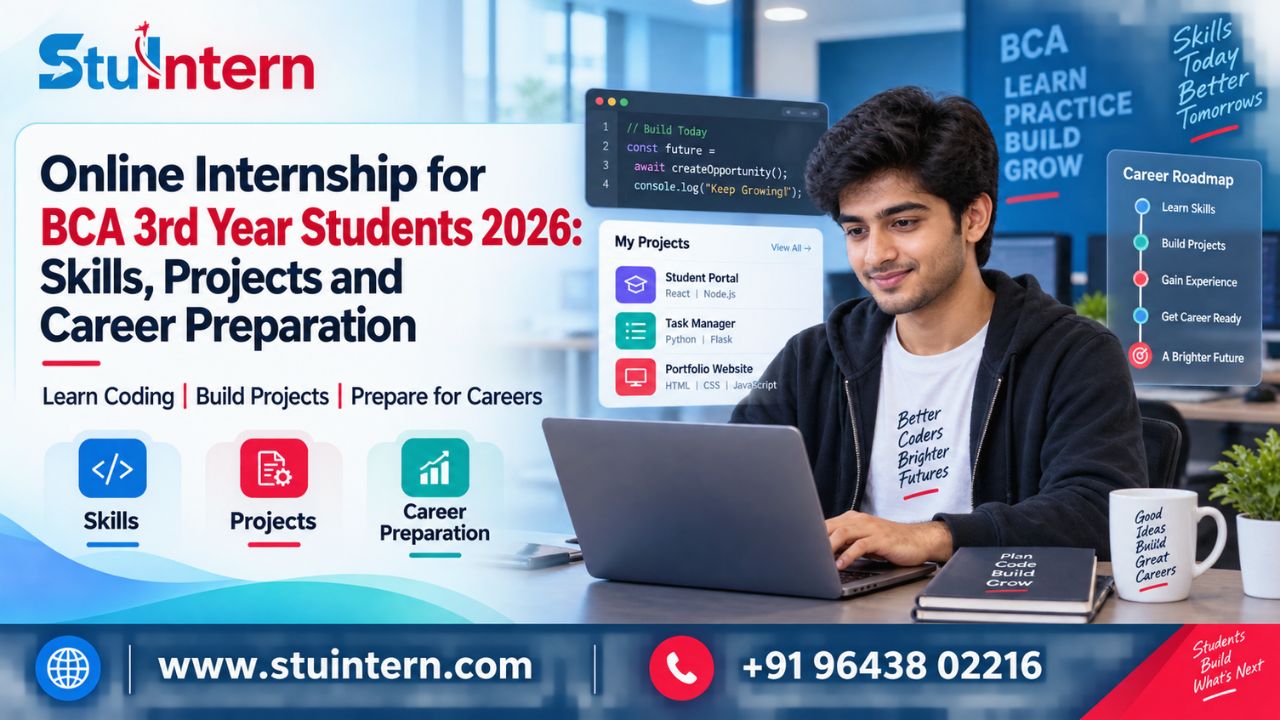
Third year is the right time for a focused online internship because students still have time to strengthen their portfolio before final-year placements. By this stage, most BCA learners have studied programming fundamentals, databases and web concepts, but many still lack a project they can confidently explain in an interview. A suitable online internship opportunity can bridge that gap through guided practice, mentor feedback and a clearly documented project.
However, not every virtual internship is equally useful. Some focus mainly on videos, while others expect skills that a student has not yet developed. BCA students need to compare the domain, prerequisites, project depth, schedule and completion terms before applying. This guide explains how to choose an internship for BCA 3rd-year students, prepare for it and convert the experience into portfolio evidence.
Quick Answer
An online internship for a BCA third-year student should match the student’s skill level and career goal. Look for structured learning, mentor support, practical assignments, an original project and clear completion terms. Suitable areas include full-stack development, data science, AI/ML, cybersecurity, databases and digital marketing technology.
Table of Contents
- What Is an Online Internship Opportunity?
- Why Third-Year BCA Students Should Consider It
- Eligibility and Basic Requirements
- Skills and Tools to Build
- Project Ideas and Practical Experience
- Duration and Learning Format
- Certificate and Portfolio Evidence
- Application Process
- Selection Checklist
- Common Mistakes
- Career Preparation
- Why StuIntern
- FAQs
Quick Highlights
Feature: What a BCA Student Should Check
Program Mode Fully online, hybrid or self-paced
Eligibility BCA year, prerequisites and beginner/intermediate level
Duration Weeks, weekly hours and project deadlines
Skills Covered Programming language, tools and measurable outcomes
Live Projects Individual or team project, deliverables and feedback
Certificate Issuer, completion rules and verification facility
Mentorship Live sessions, doubt support and project reviews
Application Profile, résumé, selection steps and written terms
What Is an Online Intern Opportunity?
An online intern opportunity is a remote, structured work or learning experience completed through digital platforms. Depending on the provider, students may attend live sessions, complete assignments, collaborate online, submit project work and receive feedback from mentors.
The term can describe different models, so read the offer carefully. An employer internship may involve work responsibilities, while a training-based internship may combine instruction with projects. A certificate confirms the stated completion or participation; it does not automatically prove professional employment.
Before joining, a student should be able to identify the expected output, assessment process, schedule and support available. These details matter more than attractive phrases such as “industry ready” or “guaranteed career.”
Why Third-Year BCA Students Should Consider an Online Internship
Third-year students have enough academic foundation to begin applying technical knowledge, but they still have time to improve before graduation. A well-chosen internship can help them:
- Test a career direction before final-year placement preparation
- Turn classroom concepts into a working project
- Practise professional communication and documentation
- Identify skill gaps in coding, databases or deployment
- Build résumé and portfolio evidence
- Prepare clearer answers for project-based interviews
- Continue learning while managing college schedules
Virtual internships can also help students who cannot relocate. The flexibility is useful, but it should not become an excuse for skipping deadlines or mentor sessions. The strongest programs combine remote convenience with fixed milestones, mentor review and a final project that can be demonstrated.
Eligibility and Basic Requirements
Most programs set their own eligibility rules. Many beginner-friendly options accept BCA students without previous employment experience, while intermediate technical programs may expect basic programming and database knowledge.
Common requirements include:
- Current enrolment in BCA or a related degree
- A laptop or desktop computer
- Reliable internet connection
- Professional email and phone number
- Basic English communication and file-management skills
- Familiarity with the listed prerequisites
- Regular time for assignments and project work
Check whether the program requires HTML and CSS, JavaScript, Python, SQL, Git or another tool before applying. If you are unsure, ask the provider which level is appropriate rather than selecting an advanced program by title alone.
Skills and Tools to Build
Full-Stack Development
Students interested in web development can strengthen HTML, CSS, JavaScript, React, Node.js, Express, databases, APIs, Git and deployment. Review the MERN Stack Development Internship for current curriculum and project information.
Data Science and Analytics
Data-focused learners may practise Python, Pandas, NumPy, SQL, visualisation, Power BI, Tableau and introductory machine learning. See the Data Science Internship before applying.
Artificial Intelligence and Machine Learning
An AI/ML pathway can include Python, model-building concepts, data preparation, deep learning, NLP and evaluation. The AI/ML Internship lists program-specific prerequisites and outcomes.
Cybersecurity and Databases
Students may explore security fundamentals, authentication, database design, SQL queries, access control and responsible testing. Choose only a program whose level matches your existing knowledge.
Digital Marketing Technology
Students combining BCA with marketing may learn SEO, WordPress, analytics, campaign measurement and basic automation. The Digital Marketing Internship can be reviewed for its current scope.
Do not judge a program by the number of tools in its syllabus. Ask which tools will be used in assessed tasks and the final project.
Project Ideas and Practical Experience
Projects give a BCA student something concrete to discuss. A suitable project should have a problem, user or dataset, clear deliverables and a review process. It should also produce a portfolio asset that demonstrates decisions, implementation and results—not merely a participation screenshot.
Possible project directions include:
- A responsive student-resource website with login and search
- A task-management application using a database and API
- A dashboard that cleans data and presents useful trends
- A machine-learning model with documented evaluation
- A website audit and technical SEO improvement report
- A basic inventory, attendance or appointment system
For every project, document your role, tools, decisions, challenges and final result. If the work is team-based, record exactly what you contributed. Never submit copied code or a project you cannot explain.
Duration and Learning Format
The ideal duration depends on project complexity and your weekly availability. Before applying, confirm:
- Start and end dates
- Weekly time requirement
- Live versus recorded sessions
- Assignment deadlines
- Number of projects
- Mentor review schedule
- Resubmission or extension policy
- Certificate requirements
StuIntern’s virtual internship overview lists different remote opportunities. Program formats, fees, cohort dates and duration can change, so verify those details on the selected program page before enrolment.
Certificate and Portfolio Evidence
An online internship certificate can support a BCA student’s résumé when it accurately represents completed requirements. Check for the student’s name, program field, dates, issuer and a unique identification or verification method.
StuIntern provides a certificate verification facility. Keep the verification link or credential ID with your records.
Your portfolio should include:
- Project objective and your contribution
- Screenshots, demo or permitted live link
- GitHub repository where appropriate
- Tools and technical methods used
- Testing, results and limitations
- A short explanation of what you would improve next
This evidence helps recruiters understand what you actually did. Do not publish confidential data or private client material. If the project is team-based, clearly label your own contribution; accurate documentation is stronger than exaggerated claims.
Planning your BCA internship? Compare StuIntern’s virtual programs by syllabus, project depth, mentor support and completion requirements before applying.
Step-by-Step Application Process
Step 1: Choose a target role
Decide whether you want to explore web development, data, AI/ML, cybersecurity, databases or another area.
Step 2: Audit your skills
List the tools you already know and compare them with the program prerequisites.
Step 3: Compare the syllabus
Look for assignments, projects, mentor sessions, assessments, and expected outputs.
Step 4: Verify the provider and terms
Check the official website, contact details, fee, refund policy, schedule and certificate process.
Step 5: Prepare a simple résumé
Include academic projects, programming languages, GitHub link and relevant coursework. Do not add tools you have not used.
Step 6: Apply with accurate details
Use your correct name, email, phone number and BCA year because these details may appear in program records.
Step 7: Save confirmation
Keep the application acknowledgement, payment receipt, terms and official communication.
How to Choose the Right Virtual Internship
Use this checklist before joining:
- The project matches your target role.
- The difficulty level matches your current skills.
- Learning outcomes are specific and measurable.
- Mentor support and feedback are clearly explained.
- The certificate criteria are available before enrolment.
- Fees, refund rules and schedule are written clearly.
- You know whether the internship is employment or training.
- The final work can be documented in a portfolio.
If a provider promises a guaranteed job or salary without transparent selection conditions, treat the claim cautiously. An internship can improve preparation, but hiring remains an employer’s decision.
Common Mistakes to Avoid
- Choosing a program only for its certificate
- Applying to an advanced track without checking prerequisites
- Joining an unrelated domain for a résumé line
- Ignoring weekly workload during college exams
- Copying a project from GitHub or another student
- Failing to save mentor feedback and project versions
- Calling a fee-based training program a paid job
- Adding unverified skills to your résumé
Career Preparation After the Internship
After completion, update your LinkedIn profile with the correct issuer and credential details. Add one or two strong projects to your résumé and prepare a short explanation of the problem, your role, tools, result and limitations.
Practise coding, SQL or domain questions relevant to your target role. Apply for entry-level opportunities only where your skills match the requirements. Continue improving the project rather than treating the certificate as the final step.
Why Choose StuIntern?
StuIntern offers virtual internship opportunities across technology, data, marketing and related areas. Students can compare program pages, review eligibility and enquire about current curriculum, duration, project structure, mentorship, fees and certificate conditions.
The most suitable program for a BCA third-year student depends on prior knowledge and career direction. Explore StuIntern virtual internships and ask program-specific questions before applying. Confirm the current syllabus, duration, fees, project deliverables, mentor access and certificate process on the selected program page.
Frequently Asked Questions
1. Can BCA third-year students apply for an online internship?
Yes. Many online programs accept students in their third year, although eligibility differs by domain and provider. Check whether the selected program is beginner, intermediate or advanced, and confirm prerequisites such as JavaScript, Python, SQL or Git before applying.
2. Which internship is best for a BCA third-year student?
The best option depends on your target role and current skills. Full-stack development suits students interested in web applications; data science or AI/ML suits students who enjoy Python, mathematics and analysis. Choose a program with a clear project and mentor support.
3. Are virtual internships useful for BCA students?
They can be useful when they include structured tasks, feedback and original project work. Remote delivery is convenient, but the student must still meet deadlines, communicate professionally and document the work. A certificate without demonstrable skills provides limited career value.
4. What should I learn before applying for a technical internship?
Start with the prerequisites listed by the provider. Depending on the domain, revise programming fundamentals, HTML/CSS, JavaScript, Python, SQL, Git or basic data structures. A small personal project can help you identify gaps before the internship begins.
5. How long do virtual internships usually last?
Duration varies by provider, learning level and project scope. Some are short and task-based, while others run for several weeks or months. Compare weekly workload, live sessions, assignments and project depth rather than choosing only by the number of days.
6. Is an online internship certificate enough for placement?
No. A certificate may show structured participation, but placement decisions also depend on technical skills, projects, communication and interview performance. Use the internship to build evidence you can explain, then continue practising for the specific role you want.
7. How should I show a virtual internship on my résumé?
Mention the provider, domain, dates, tools and one or two specific project outcomes. Add a GitHub, demo or report link when permitted. Describe your personal contribution accurately and avoid claiming employment, client work or results that you cannot prove.
8. Can I do an internship while attending BCA classes?
Often, yes, if the schedule and weekly workload are manageable. Confirm live-session timings, deadlines and attendance rules before enrolling. Plan study time around exams and do not choose a program whose commitments you cannot consistently complete.
Conclusion and Apply Now
For BCA third-year students, the right online internship opportunity should connect academic knowledge with a practical project and a clear career direction. Compare the domain, prerequisites, mentor support, duration, project work, certificate process and written terms before applying.
Virtual internships are most valuable when you finish with work you can demonstrate—not just a certificate you can list. Explore StuIntern’s current programs and enquire about eligibility, curriculum, projects, fees and certificate requirements before joining.
📞 Call/WhatsApp: +91 96438 02216