

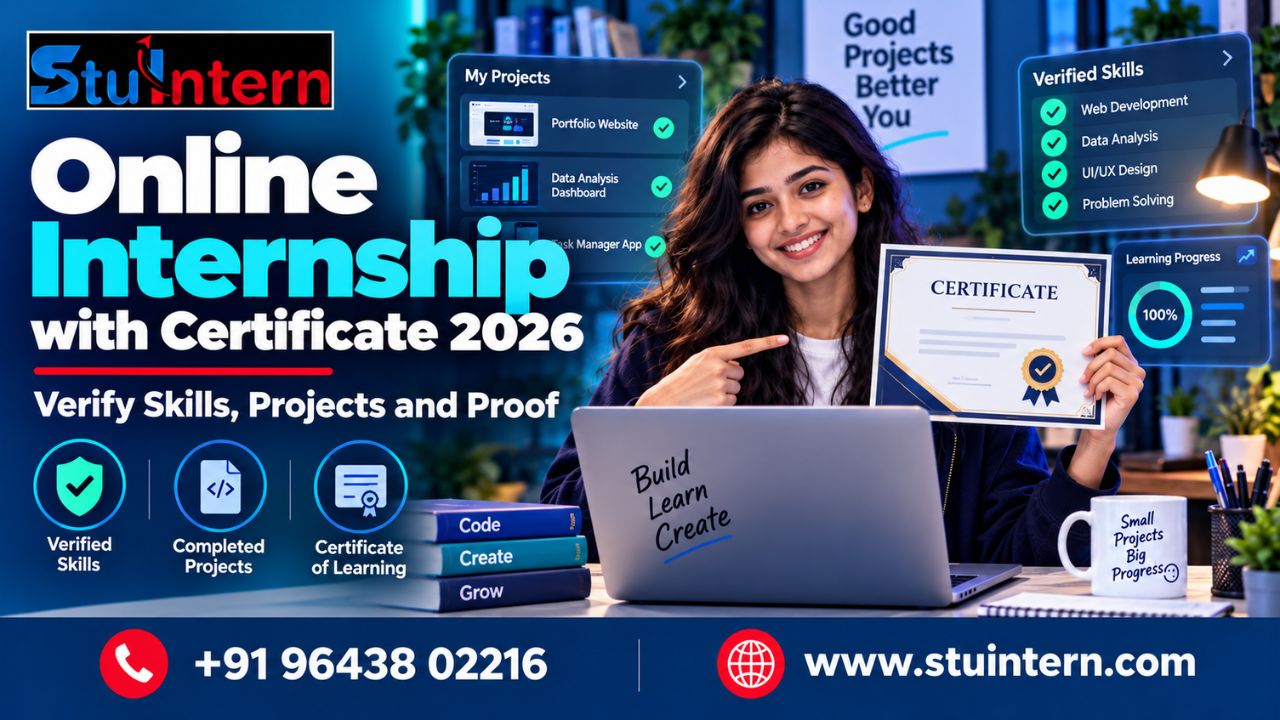
An online internship with a certificate should give students more than a downloadable document. It should connect guided learning with assignments, feedback and work that can be explained in a résumé or interview. Yet many students choose a program only because it is online, short or certificate-based. They later discover that the syllabus is vague, the project is copied, or the certificate cannot be verified.
This guide explains what a useful certificate should prove, how a work-from-home format should operate and which questions to ask about projects, mentors, fees and completion rules.
Quick Answer
Choose an online internship with a certificate only after checking the provider, syllabus, project requirements, mentor support and verification process. The certificate should confirm completed work through identifiable details or an official verification facility. Its career value becomes stronger when you can also present a project, explain your contribution and demonstrate the tools you used.
Table of Contents
- Quick Highlights
- What Is It?
- Who Should Choose It?
- Eligibility
- Skills and Tools
- Live Projects
- Duration and Format
- Certificate and Portfolio
- Application Process
- Selection Checklist
- Mistakes
- Career Opportunities
- Why StuIntern?
- FAQs
- Conclusion
Quick Highlights
Item: What Students Should Verify
Internship/Program Mode Online delivery, session format and communication channel
Eligibility Academic level, prerequisites and device requirements
Duration Start/end dates, weekly workload and submission deadlines
Skills Covered Specific tools connected to measurable tasks
Live Projects Defined problem, deliverables, feedback and permitted portfolio use
Certificate Completion conditions, issuer and verification method
Mentorship Live guidance, doubt support and review frequency
Application Process Current fee, selection steps, policies and written confirmation
What Is an Online Internship with Certificate?
An online internship with certificate is a remote program combining career-related learning and practical tasks. After meeting stated requirements, the provider issues evidence of participation or completion.
It is different from simply watching a course. A credible internship should identify:
- what you will learn;
- what you will produce;
- how your work will be reviewed; and
- what you must complete to earn the certificate.
Your strongest proof remains the work you completed and can explain independently.
Who Should Choose This Internship?
A virtual internship for students may suit:
- college students who need practical exposure beyond classroom theory;
- freshers preparing their first portfolio;
- learners balancing internships with classes or examinations;
- career changers testing a new field before making a larger commitment.
Choose a track connected to your intended role. Avoid joining an unrelated program only to collect a certificate.
Eligibility and Basic Requirements
Many beginner programs do not require previous employment, but students still need:
- a laptop or desktop capable of running the required tools;
- stable internet and basic digital communication skills;
- scheduled weekly time for practice and deadlines;
- willingness to receive and apply feedback.
Technical tracks may require foundational knowledge. Check prerequisites rather than assuming every program starts at zero.
Skills and Tools Students Will Learn
Skills should lead to an assessable output. StuIntern currently presents tracks such as:
- Digital marketing: SEO, content, WordPress, Google Ads, Meta Ads and campaign measurement. See the Digital Marketing Internship.
- Data science: Python, SQL, Pandas, Power BI, visualisation and machine-learning concepts. Review the Data Science Internship.
- Full-stack development: MongoDB, Express.js, React, Node.js, APIs and deployment. Explore the MERN Stack Internship.
- Artificial intelligence: Python, TensorFlow, NLP applications and AI-focused project work.
- HR analytics: Excel, Power BI, HR metrics and workforce dashboards.
Ask which listed tools you will personally use.
Live Projects and Practical Experience
A useful project turns learning into evidence: a website audit, data dashboard or deployed application.
Document every project with this five-part framework:
- Problem: What needed to be solved?
- Role: What did you personally handle?
- Process: Which steps and tools did you use?
- Output: What did you create or improve?
- Reflection: What changed after feedback?
Ask what may be shown publicly and never publish confidential data.
Internship Duration and Learning Format
A work-from-home internship for students still needs structure. Confirm the session format, support process and submission deadlines.
StuIntern currently lists approximately 12 weeks for digital marketing, 12–18 weeks for several AI and data-focused tracks, and 5–6 months for its MERN program. Schedules can change, so verify the selected program page before enrolling.
Plan weekly time for learning, practice, projects and revisions.
Certificate and Portfolio Benefits
Before trusting a certificate claim, verify:
- issuing organisation and official contact details;
- student name, field and completion date;
- certificate identification or verification method;
- assignments, assessment or attendance required;
- whether incomplete participants receive the same document.
StuIntern provides an official certificate verification page. Students should confirm which certificate applies to their chosen track and how its unique details can be checked.
Pair the certificate with a project link, report or short case study.
Step-by-Step Application Process
- Define your goal. Choose a role or skill you want to explore.
- Compare relevant tracks. Start with the StuIntern internship directory.
- Read the complete syllabus. Note prerequisites, tools, projects and outcomes.
- Check the provider. Verify the website, company details, policies and certificate process.
- Confirm the terms. Ask about current fees, schedule, mentorship, deadlines, refund rules and completion requirements.
- Submit correct details. Your name and course information may appear on the certificate.
- Save written records. Keep the application acknowledgement, receipt and current program outline.
Students may also review the AICTE Internship Portal and National Career Service. Verify every listing directly.
How to Choose the Right Internship Program
CheckStrong SignalWarning Sign
Learning outcome Specific, demonstrable result Vague “complete exposure” claim
Project Defined task and review Ready-made project to copy
Mentorship Stated guidance process Mentor mentioned without access details
Certificate Clear earning and verification rules Certificate promised for payment alone
Fee Written price and inclusions Unclear or changing amount
Career support Portfolio or interview preparation Guaranteed job or salary
Terms Accessible policies Pressure to pay before questions
Judge the deliverables and feedback—not duration alone.
Common Mistakes Students Should Avoid
- Choosing only for the certificate.
- Joining several tracks without completing one project properly.
- Ignoring device, software or prerequisite requirements.
- Copying a project that cannot be explained in an interview.
- Confusing fee-based training, unpaid internships and stipend-based employment.
- Adding tools to a résumé without being able to demonstrate them.
- Assuming a certificate guarantees placement.
- Paying before checking written terms and refund conditions.
Career Opportunities After Completion
An internship cannot create an automatic job offer, but a relevant project can strengthen applications for trainee roles in marketing, data, development, AI or HR analytics.
Turn project work into a truthful résumé bullet. Replace “learned Power BI” with “cleaned a practice dataset and built a dashboard.” Prepare a short explanation of your contribution and one challenge solved.
Why Choose StuIntern?
StuIntern presents flexible tracks with mentor-led learning, project work and a certificate verification facility.
Confirm the latest eligibility, curriculum, duration, fee, project and certificate conditions on the official program page.
Frequently Asked Questions
1. Is an online internship with certificate valuable?
It can be valuable when the certificate represents completed tasks, and the student can demonstrate the related project. Its credibility improves when the provider is identifiable, the completion rules are clear, and the certificate can be verified. A certificate without practical evidence usually carries less weight than documented work.
2. How can I verify an online internship certificate?
Check for the issuing organisation, student details, field, completion date and a unique identification number. Use the provider’s official verification page where available. If verification is unclear, contact the organisation through details published on its official website rather than relying only on a social-media message.
3. Can college students complete an internship from home?
Yes. A work-from-home internship for students can be completed through online sessions, communication tools, digital assignments and remote project submissions. Students still need reliable internet, a suitable device, time for deadlines and a clear support process. Verify whether any in-person meeting or fixed attendance is required.
4. How long does a virtual internship for students take?
Duration depends on the subject, project depth and weekly workload. StuIntern currently lists several tracks at approximately 12–18 weeks, while its MERN program lists 5–6 months. Check the active program page because schedules may change, and compare the expected deliverables rather than duration alone.
5. Do online internships include live projects?
Some do, but “live project” can mean different things. Ask for the problem statement, expected deliverables, feedback process, data source and portfolio permissions. StuIntern describes project-based learning across its internship offerings; the exact project should be confirmed for the selected track before applying.
6. Are online internships free, paid or stipend-based?
All three models exist. Some programs charge for structured training and mentorship, some employer internships are unpaid, and others offer a stipend. Confirm whether the offer is employment, training or a fee-based learning program. Review the current price, stipend conditions and written terms before accepting or paying.
7. Does an internship certificate guarantee a job?
No. A certificate can support your profile, but hiring depends on relevant skills, project quality, communication, applications and employer requirements. Be cautious of unconditional placement or salary guarantees. Use the internship to build evidence and interview readiness rather than treating it as an automatic job route.
Conclusion and Apply Now
A credible online internship with a certificate should leave you with verifiable completion details, practical skills and a project you can explain. Compare the syllabus, mentorship, duration, fee and certificate process before joining. For a virtual or work-from-home internship, also verify the communication method, deadlines and technical requirements.
Explore StuIntern’s available internship programs, open the most relevant track and submit an enquiry after reviewing its latest terms. For assistance, contact StuIntern through its official website or call +91 81308 34430. No program should be treated as a guaranteed job or salary outcome.