

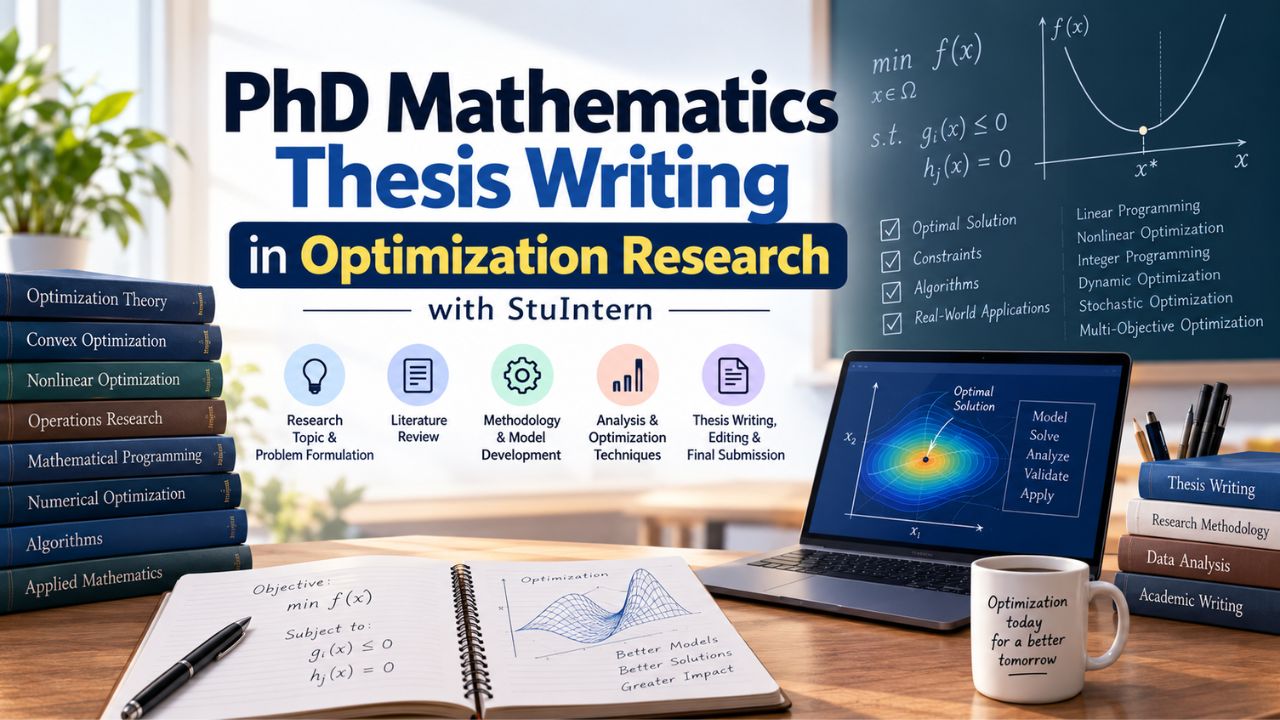
INTRODUCTION
Optimization is a part of advanced mathematical research. It focuses on finding the possible solution given certain goals, limits and mathematical rules. A doctoral project in Optimization Research can cover math, computational methods, algorithms, operations research or applications in engineering, economics, management, computer science and more.
Writing a PhD Mathematics Thesis in optimization goes beyond just showing a formula or a computational result. The thesis must define a research problem review current approaches build a proper mathematical model, use or improve suitable algorithms analyze results and explain the contribution of the work.
StuIntern offers help with Optimization Thesis Support, Research Guidance, thesis chapter development and Thesis Review for researchers working on complex mathematical optimization projects.
Understanding Optimization Research in a PhD Mathematics Thesis
Optimization research studies ways to find solutions that either maximize or minimize a goal while meeting certain conditions. This research might focus on optimization, discrete optimization, nonlinear optimization, constrained optimization, multi-objective optimization, stochastic optimization or other specialized topics. At the level the study should clearly present the mathematical problem and show why existing methods may not fully solve the chosen challenge.
From Research Area to Optimization Thesis Topic
A good thesis topic starts with a research problem rather than a general interest in optimization. For instance a researcher might explore an optimization problem related to resource allocation, scheduling, transportation, network design, parameter estimation, energy systems or another defined application. The topic needs to be narrow enough to allow mathematical investigation but broad enough to offer a meaningful research contribution.
Identifying the Research Gap
The literature review must look at existing optimization models, solution techniques, algorithms, assumptions and limitations. The goal is to understand what has already been done and where gaps still exist. A identified research gap helps shape the research objectives and keeps the thesis from turning into a general summary of known optimization methods.
Formulating a Mathematical Optimization Problem
formulation is one of the most important parts of any optimization thesis. A defined optimization problem includes decision variables, objective function, constraints, parameters and relevant assumptions.
Defining Decision Variables
Decision variables are the quantities the optimization process aims to determine. These need to be explained and connected to the real-world problem. Their domains and restrictions should also be stated when needed. For example a variable could represent production amount, allocation level, route choice, scheduling decision or another quantifiable value. Clear definitions make the following mathematical framework easier to follow.
Developing Objective Functions
functions set what the model wants to maximize or minimize. Depending on the research this could mean reducing cost minimizing error, increasing efficiency, improving performance or handling competing goals. The thesis must justify why the chosen objective function fits the problem being studied.
Establishing Constraints
Constraints describe the conditions a feasible solution must meet. These may include capacity limits, available resources, mathematical relationships, physical rules, policy requirements or other restrictions. The relationship between the function and the constraints should be clearly explained so readers understand the structure of the optimization models.
Types of Optimization Models in Doctoral Research
problems require different types of optimization frameworks. Choosing the model depends on the mathematical nature of the problem and the research goals.
Linear Optimization
Linear optimization deals with functions and constraints that can be written using linear equations. These models are common in resource allocation, production planning, transportation, scheduling and other decision-making tasks. A thesis involving linear optimization should clearly explain the formulation. Give reasons for choosing the solution method.
Nonlinear Optimization
In optimization the objective function or some constraints involve nonlinear terms. These problems often bring mathematical and computational challenges. Researchers may need to consider convexity, feasibility, local versus optima and algorithm behavior. A good thesis will examine these factors thoroughly.
Integer and Discrete Optimization
Some optimization problems require variables to take integer or discrete values. These models apply when decisions involve selecting facilities assigning resources choosing routes or making yes/no choices. The thesis should explain why the discrete setup matches the research context and how the chosen algorithm handles its complexity.
Operations Research and Mathematical Optimization
Operations Research uses mathematics and analysis to support decisions in systems. Optimization is a part of this field. Doctoral research may combine modeling, algorithms, computational testing and decision analysis.
Connecting Optimization with Real-World Problems
Applied optimization research usually begins with an issue that needs to be translated into math. The researcher must decide which aspects of the system become variables, objectives or constraints. This modeling step requires care. An oversimplified model may miss features while an overly complicated one can be hard to solve or analyze.
Mathematical Assumptions
All optimization models rely on assumptions. These must be clearly stated in the thesis. Their effects should be discussed. Researchers should also ask if changing an assumption would affect the existence of a solution the quality of the result or how the model is interpreted.
Developing Algorithms for Optimization Research
Many optimization studies involve designing or using algorithms to find approximate or efficient solutions. The algorithm choice should match the problems structure and the research aims.
Algorithm Selection
The thesis should explain why a particular algorithm suits the optimization problem. The discussion may include complexity, convergence speed, solution accuracy, scalability, feasibility or other relevant traits. When several methods exist researchers should compare them based on methodological criteria instead of just showing raw output without context.
Algorithm Development and Improvement
Some doctoral projects involve improving an existing algorithm or creating a computational approach. In cases the thesis should describe the base method the proposed changes, the mathematical or computational reasoning behind them and the conditions under which the improved method is expected to work better. This can be a part of the research contribution if supported by solid theory or computational evidence.
Numerical Analysis in Optimization Research
Numerical analysis helps researchers test how optimization algorithms behave under computational circumstances. Experiments may include benchmark problems, simulated data, parameter adjustments, convergence tracking, computation time objective values or comparisons between algorithms.
Evaluating Optimization Results
Results from optimization should be interpreted in light of the research goals. Researchers might check whether the algorithm found a solution how fast it worked and how the final outcome compares to benchmarks or alternative methods. The thesis should explain what the numbers mean, not present tables of data.
Convergence and Computational Behaviour
When researchers should discuss convergence patterns and computational traits. This may involve looking at iteration counts stopping rules, solution precision, computation time or other measures tied to the algorithm used. Such analysis strengthens the link between algorithms, numerical analysis and the overall research impact.
Building a Clear Research Methodology
A strong optimization thesis presents a research methodology. This may include reviewing literature formulating the math model doing analysis developing algorithms running computational experiments comparing results and interpreting findings.
Linking Methodology with Research Objectives
Each step, in the methodology should address a research question or help reach a research goal. A logical flow can be shown as:
Research Problem → Literature Review → Research Gap → Optimization Model → Algorithm → Numerical Analysis → Results → Research Contribution
This sequence keeps the research focused and coherent throughout.
Maintaining Academic and Mathematical Clarity
Optimization research often involves math notation and computational language. The thesis must maintain symbols clearly define variables explain algorithms in detail and describe procedures transparently. Good academic writing lets readers not see the final answer but also understand how and why it was reached.
How StuIntern Supports PhD Mathematics Thesis Writing in Optimization
Developing an optimization thesis can be a task. It often demands help across areas—like planning the research building the math models choosing the right methods, running computations and writing the academic content clearly. StuIntern is here to support researchers with:
PhD Mathematics Thesis structure
Optimization research topic development
Literature review organization
Mathematical Optimization guidance
Optimization Models development
Objective Functions and constraint formulation
Algorithm documentation
Numerical Analysis
Results organization and interpretation
Thesis chapter development
Thesis Review
Research Guidance
Final editing and submission preparation
All support is given in a way that stays true to the researcher’s own work, university standards and the responsibilities of doctoral research.
Why Structured Optimization Thesis Writing Matters
An optimization thesis should not just be a collection of formulas, algorithms and tables. It needs to tell a story—a complete mathematical argument. The research problem must make sense. Show why it matters. The literature review should highlight what’s already known and where gaps exist. The mathematical model has to represent the real-world issue. The algorithm must offer a sound method to solve it.. The numerical analysis should back up the claims made by showing evidence.
Finally the thesis must explain how this work adds something to what is already known. A structured approach keeps all these parts linked from start to finish—making the journey clear for readers.
Structuring a PhD Mathematics Thesis in Optimization Research
A strong PhD mathematics thesis in optimization follows a flow. This helps the reader follow the research: from the problem to the solution and finally to its contribution. While exact chapter order may change based on university rules or topic most optimization theses include these sections:
Introduction
Literature Review
Methodology
Mathematical Formulation
Algorithm Development
Numerical Experiments
Results
Discussion
Conclusion
Introduction and Research Objectives
The introduction sets the stage. It explains the optimization problem. Gives reasons why it deserves a doctoral-level study. It covers background information the problem statement, research gap, objectives, questions, scope and a preview of the methodology used. The objectives need to be specific enough to guide everything model design, algorithm choices and computational tests.
Literature Review and Research Gap
This section looks at work in mathematical optimization, operations research, algorithms, modeling techniques and related fields. It's not enough to list papers. The researcher must critique them—pointing out weaknesses, unresolved issues, computational limits or areas needing improvement. The identified gap becomes the foundation for the research being proposed.
Advanced Mathematical Optimization Models
The mathematical model is the core of the project. It turns the research question into a framework that can be solved and analyzed.
Objective Functions and Decision Variables
The objective function defines what the optimization aims to achieve. This could mean minimizing cost maximizing efficiency reducing risk improving accuracy or balancing goals. Decision variables represent the choices that affect the outcome. The thesis must explain how each variable connects to the problem—not just give equations without meaning.
Constraints and Feasibility
Constraints are the rules that valid solutions must follow. They can come from capacity limits, resource availability, physical laws, operational needs or other boundaries. Each major constraint should be explained clearly. The thesis should describe how the constraints shape the solutions and affect the overall problem.
Multi-Objective Optimization
Some problems require balancing conflicting goals. In cases the research might use multi-objective optimization. The thesis should explain how these objectives are built how they interact and how the chosen method handles trade-offs between them.
Optimization Algorithms and Solution Strategies
Once the model is ready the next step is. Creating a method to solve it. The algorithm may be exact, approximate, iterative, heuristic or based on another principle depending on the problem’s nature.
Approximate Approaches
Exact methods aim to find the best possible solution under the model’s assumptions. Approximate methods focus on getting good-quality results within time and resources. The choice depends on how complex the problem's what the research aims to achieve. The thesis should justify why the selected strategy fits the research goal.
Algorithm Development
When the thesis proposes an improved algorithm it needs to clearly describe:
The problem being solved
What's wrong with methods
The new approach
Why it works ( computational reasoning)
How to implement it
How to test it
Results from testing
This makes it easy for others to understand the innovation and compare it to existing techniques.
Algorithmic Efficiency
For research, speed and performance matter. Researchers might look at computation time number of iterations, memory usage, convergence speed, solution quality or scalability. These measures should match the research focus—not just be included because they’re common.
Numerical Analysis for Optimization Algorithms
Numerical analysis helps check how well optimization methods perform under conditions. It supports claims about effectiveness and reliability.
Designing Numerical Experiments
Experiments should be planned carefully. The researcher decides which test problems to use, what parameters to set, stopping criteria, datasets or benchmark functions and how to measure success. The details must be written clearly so others can reproduce the work.
Comparing Optimization Algorithms
If multiple algorithms are tested comparisons must be fair. All run under the conditions. For example compare values feasibility, time taken iterations, convergence or any other relevant factor. Explain why each measure matters.
Interpreting Computational Results
Tables and graphs should not stand alone. Each result needs explanation. Don’t just say "value A is better than value B." Instead explain what that difference means—whether it shows convergence, better stability or greater robustness. Turning numbers into insights is essential for research findings.
Sensitivity and Robustness Analysis in Optimization Research
Optimization solutions can depend on input values, model assumptions or constraints. Sensitivity and robustness analyses help see how changes affect outcomes.
Parameter Sensitivity
Researchers can tweak parameters and watch how the optimal solution changes. They track shifts in value, decision variables, feasibility or other outputs. The reason for each test should connect directly to the research question. This analysis deepens understanding of how stable and reliable the model is.
Robustness of Optimization Results
Sometimes the data or inputs aren't fixed—they vary due to uncertainty. In cases researchers can test whether the method still produces good results when conditions change slightly. This is especially important in real-world applications where assumptions may not always hold. The thesis should describe the robustness method used. Explain how the findings fit the model’s assumptions.
Research Results and Discussion
This part presents the findings from the mathematical and computational work.
Presenting Optimization Results
Results may include:
Best objective values found
Values of decision variables
Whether solutions were
How fast the algorithm converged
Performance measures like time or iterations
Comparison results
Sensitivity findings
Outcomes from numerical experiments
These should be organized around the research questions—not just listed in order of calculation.
Connecting Results with Previous Research
The discussion should compare results to studies. Did the new model match known behavior? Did it improve on methods? Does it fix a limitation? Are there differences? These comparisons build credibility. Show where this research fits in the broader field. Every claim must be backed by data from the thesis.
Establishing the Contribution of Optimization Research
A doctoral thesis must clearly state what knowledge it brings. In optimization research contributions can take forms:
A new mathematical model
A theoretical result or property
A new algorithm or improvement to an existing one
A computational framework
A better solution method
Applying a known technique to a new problem
Or another supported advancement
Linking Objectives with Contributions
The thesis should tie each objective to its final finding and ultimate contribution. Using a chain helps clarify the process:
Objective → Mathematical Model → Method/Algorithm → Numerical Analysis → Finding → Contribution
This shows how the original idea evolved into an addition to mathematical knowledge. It ensures that every piece of the research connects back, to the picture.
Explaining the Research Novelty
The thesis must not rely on claims about originality. Instead the researcher should clearly describe what earlier studies have already shown. Then they should identify what gap or limitation still existed in the work. Next explain what was specifically investigated in this research. Finally state what new result or method emerged from the study. This approach makes the contribution more precise and easier to defend
Thesis Chapter. Academic Editing
After the mathematical research is complete the thesis should go through a review of both structure and language. The review process can assess whether the chapters follow a sequence. It should also check if the mathematical content is presented consistently throughout the document.
Mathematical Notation Review
All symbols, variables, functions, operators, equations and abbreviations must stay the same across the thesis. Every important symbol should be defined before it first appears. Also researchers need to make sure that the same notation is not accidentally used for meanings in different parts of the thesis.
Equation and Figure Review
Equations should be numbered in a way where needed. Figures, graphs and tables must have captions. They should also be. Discussed in the surrounding text. For graphs it's important that all variables parameters and results are clearly labeled and easy to understand.
Academic Presentation
The thesis should keep a tone but avoid using unnecessarily complex language. Technical terms must be used correctly. Transitions between derivations, computational outcomes and discussion sections should be smooth and clear. Thesis editing helps improve readability and consistency without changing the mathematical work.
Preparing an Optimization Thesis for Academic Presentation
A doctoral thesis may need to be shortened for seminars progress reports, conferences or the final defence. The presentation should focus on the research problem the setup, the method used the main findings and the overall contribution.
Presenting Optimization Models
of showing every equation from the thesis researchers should pick only the most essential ones. These key equations should be explained clearly. A strong presentation shows how the research problem connects to the function, constraints and the chosen solution method.
Presenting Algorithmic Results
For research involving algorithms the presentation should summarize the steps of the algorithm. It should highlight the important numerical results. Charts, tables and diagrams can help show comparisons between methods when they support the argument.
How StuIntern Supports Optimization Thesis Development
StuIntern offers guidance for researchers working on PhD mathematics theses focused on optimization. Support includes:
Optimization research topic guidance
Literature review organization
Research gap identification
Mathematical Optimization support
Optimization Models development
Objective Functions and constraints
Algorithm documentation
Numerical Analysis
Results interpretation
Thesis chapter development
Thesis Review
Thesis Editing
Academic presentation preparation
Submission preparation support
The exact type of help needed depends on the research topic, university rules, methodology and the stage of the study.
Why Optimization Research Requires a Structured Thesis Approach
Optimization research brings together modeling, analytical thinking, algorithms, computation and result evaluation. Without a structure even technically correct research can become hard to follow. A organized thesis ensures that the research problem naturally leads to the mathematical model. That model then leads to the algorithm. The algorithm produces results that can be tested against the goals of the research. This logical flow supports an explanation of the doctoral contribution.
Final Thesis Review for PhD Mathematics Research
The final thesis review is a step before submitting a PhD thesis in mathematics. At this point the researcher should examine the thesis from mathematical, structural, methodological and presentation angles. In optimization research the thesis must not contain correct math but also show a clear connection between the research problem the optimization model, the solution method, the results and the research contribution.
A detailed final review should start with the research objectives and questions. Each objective must be addressed in the thesis. The researcher should confirm that the proposed optimization model actually solves the problem being studied. Mathematical notation needs to stay consistent across all chapters. Variables, parameters, constraints, objective functions, assumptions and algorithms should all be clearly defined.
The literature review must also be checked for relevance. Recent studies should connect properly with foundational mathematical work. The researcher should clearly state what limitations were found in approaches and how their own research fills a specific gap.
The methodology chapter must give detail to allow someone else to reproduce the work. If computational experiments were used the thesis must explain the datasets, parameter choices, algorithms, stopping criteria, evaluation metrics and experimental conditions.
The results chapter requires attention. Tables, figures, mathematical results, numerical tests and comparisons must match what was done in the methodology. The researcher should double-check calculations, equation references, table numbers, figure numbers and interpretations of computational data before submission.
Optimizing the Research Contribution in a PhD Mathematics Thesis
A PhD mathematics thesis must make its research contribution visible and understandable. In optimization research the contribution could be an optimization model, a better formulation, an improved algorithm, a theoretical proof, a more efficient computational method or the application of known methods to an underexplored problem.
The researcher should not treat every calculation as a contribution. A real contribution adds something to existing knowledge. Examples include:
A mathematical optimization formulation
A modified objective function or constraint setup
A new or improved optimization algorithm
A theoretical result or mathematical proof
Better convergence properties
Increased computational efficiency
Comparative evaluation of optimization techniques
A new use of an existing optimization framework
An integrated model for solving a complex problem
New computational or numerical findings
Each contribution should directly link back to the research objectives. If the thesis introduces an algorithm the researcher should explain why it was created and what weakness in methods it fixes.
Comparative analysis is especially important in optimization. Results may be compared to established methods using measures like solution quality, time taken, convergence behavior, robustness, scalability or other relevant indicators.
The researcher should also separate research contribution, research findings and future scope. The contribution explains what new knowledge or tools the research provides. Findings describe what was discovered through analysis or testing. Future scope points to open questions that could be explored next.
Preparing the PhD Mathematics Thesis for Submission
Thesis submission preparation begins after the academic content has been reviewed and finalized. The researcher should carefully read the PhD regulations at their university. Formatting, declaration forms, certificates, plagiarism policies, abstract length, number of copies, electronic submission rules and required documents vary widely between institutions.
The final thesis should be checked for:
Title and preliminary pages: The title page, declaration, certificate, acknowledgements, abstract, table of contents, list of figures, list of tables and abbreviations must follow guidelines.
Chapter structure: Each chapter should relate logically to the research objectives. Support the main argument.
Mathematical formatting: Equations, symbols, variables, matrices, expressions theorem structures and proofs must be formatted uniformly.
References: Every source cited in the text must appear in the reference list. All citations should follow the style.
Figures and tables: All visuals must have titles, numbering, captions and sources when needed. They should be referenced in the text.
Appendices: Long derivations, extra computational results, datasets, algorithms or supplementary material can go into appendices if appropriate.
Originality documentation: The researcher must complete any similarity checks. Any potential issues with citing or attributing others’ work must be resolved.
The final document should receive a language and formatting proofread. Small errors—such as equation numbers, broken cross-references missing headings, wrong page numbers, citation problems or inconsistent notation—can stand out during evaluation.
Thesis Defence Presentation for PhD Mathematics
The thesis defence presentation gives the researcher a chance to explain their research problem, methodology, findings and contribution to the examiners or committee.
A mathematics defence presentation should not repeat every page of the thesis. Instead it should guide the audience through the research journey clearly.
A useful structure for the presentation includes:
Research Background: Explain the applied problem and why it matters.
Research Gap: Identify the issue or limitation in prior research.
Objectives: State the goals the thesis aims to achieve.
Mathematical Formulation: Describe the optimization model, including variables, objective function, constraints and assumptions.
Methodology: Present the algorithm, method, computational framework or experimental design.
Results: Highlight the significant mathematical and computational outcomes.
Comparative Analysis: Show how the proposed method compares with existing approaches.
Research Contribution: Clearly state what knowledge or method the thesis brings.
Limitations: Acknowledge any shortcomings in the research.
Future Research: Suggest directions for further investigation.
The researcher should also prepare answers to questions, about assumptions, mathematical soundness, parameter choices, algorithm complexity, convergence, computational speed data used comparison techniques, limitations and practical uses.
Frequently Asked Questions About PhD Mathematics Thesis Writing
1. What should be checked during the review of a PhD Mathematics thesis?
The final review should check accuracy, research objectives, literature review, methodology, equations, results, references, formatting, figures tables originality requirements and consistency across all chapters.
2. How can an Optimization thesis demonstrate research contribution?
An Optimization thesis can show research contribution by introducing a mathematical model, a new algorithm, a theoretical result, an improved computational method, a novel application, comparative findings or any other clearly justified addition to existing research.
3. Should all mathematical derivations be included in the thesis?
Not always. The main thesis should include derivations that are essential for understanding and validating the research. Longer or repetitive calculations can go into appendices if allowed by the institution’s guidelines.
4. How should computational optimization results be presented?
Results should be shown with tables, graphs, numerical measures and clear comparisons. The researcher must explain what the results mean, not just list numbers.
5. What should a PhD Mathematics thesis defence presentation include?
A defence presentation should cover the research background the problem being studied the research gap, objectives, mathematical method, results, research contribution, limitations and future directions. The exact content may vary depending on the university and doctoral program.
6. Can a thesis support service guarantee PhD approval or publication?
No reputable academic support service should promise thesis approval, examiner decisions, degree completion or publication in a journal. Final outcomes depend on research quality, institutional rules, examiner evaluations and the researcher’s own effort.
CONCLUSION
A PhD Mathematics thesis in Optimization is not about equations or computational results. The thesis must clearly connect the research problem the gap in the literature the formulation, the method, the analysis, the findings and the research contribution.
The final stage of the thesis is especially important because it brings together all the work. A thorough final review can catch errors missing references, unclear explanations, formatting issues and gaps between the research objectives and the results. These checks make the thesis clearer and easier for examiners to assess.
For Optimization research the contribution must be clearly stated. Whether the contribution is a model, a new algorithm, a theoretical insight, a computational improvement or a new application the researcher must explain how it advances existing knowledge and back it up with solid mathematical or empirical evidence.
Submission preparation must follow the requirements of the university or institution. Formatting, declarations, similarity checks, references, documentation and electronic submission steps should be carefully reviewed. Assumptions should not be made.
The thesis defence is another moment in the doctoral journey. The researcher must be able to explain the research using mathematical language and answer questions, about assumptions, methods, results, limitations and contribution. A focused and well-organized presentation helps communicate Optimization research more effectively.
StuIntern can help researchers with PhD Mathematics thesis writing structuring Optimization research, mathematical academic writing organizing literature thesis review, research presentation and submission preparation. The researcher’s own ideas, reasoning, authentic analysis, data, computational work and genuine findings must remain at the heart of the process.
Academic support should help the researcher present. Develop their work responsibly. It should not replace the researcher’s responsibility or promise acceptance, approval or publication.
Final CTA – StuIntern
If you are working on a PhD Mathematics thesis, Optimization research project, mathematical model, algorithm, computational study, or thesis defence, StuIntern can help with structured academic support across the research and thesis-development process.
Call / WhatsApp: +91 96438 02216
Website: www.stuintern.com