

Introduction
Publishing a research paper in a reputed journal is an important part of academic research. PhD scholars, researchers, professors, and postgraduate students often look for suitable journals where they can present their research findings to a wider academic audience. However, preparing a research paper for an international journal requires proper structure, clear methodology, accurate references, strong research findings, and careful formatting.
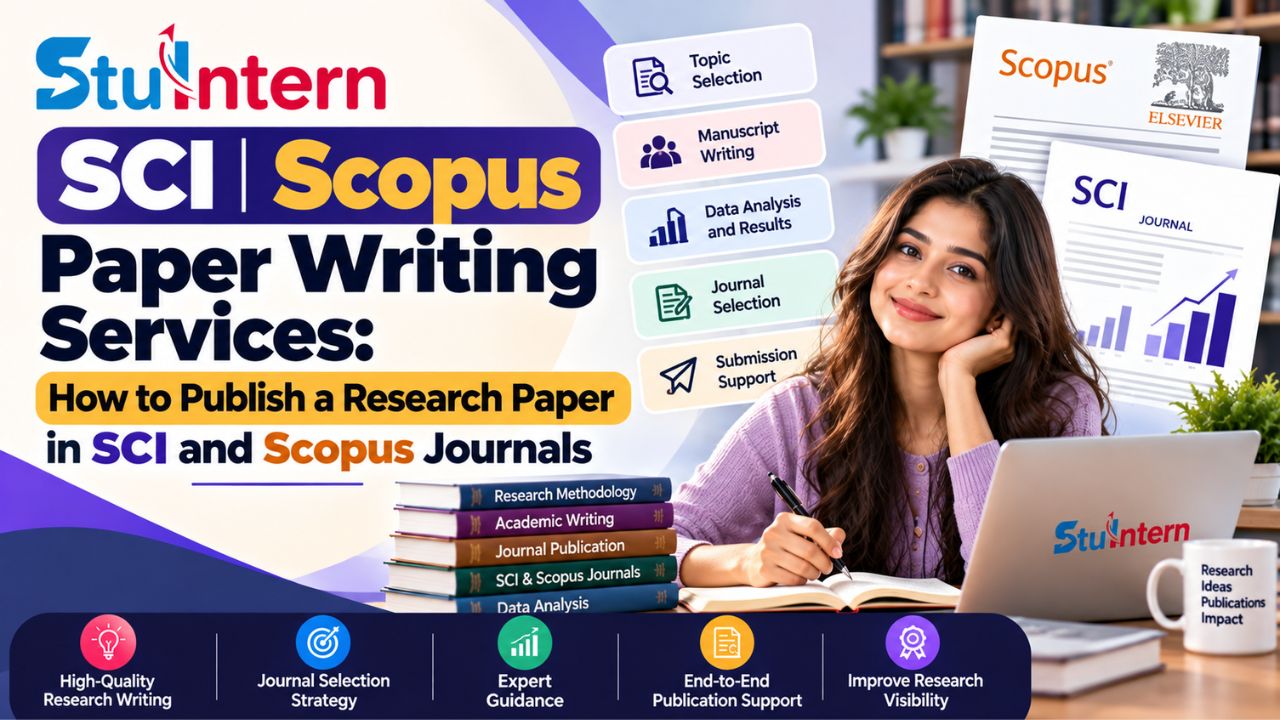
This is where SCI Scopus Paper Writing Services can provide structured academic guidance. Researchers may need support with manuscript preparation, research paper structure, citation management, journal requirements, formatting, and submission preparation.
StuIntern provides SCI/Scopus paper support across areas such as science, engineering, pharmacy, management, commerce, accounting, and medical sciences. Its current service page also lists subject-specific areas ranging from Physics and Chemistry to Computer Science, Engineering, Pharmacy, Management, and Medicine.
What Are SCI and Scopus Journals?
SCI and Scopus are widely used research indexing systems and databases in academic publishing. Researchers often consider indexed journals when they want their work to be discoverable within established scholarly literature.
Before submitting a paper, researchers should carefully verify the current indexing status of a journal and check the journal's official website for its latest submission guidelines.
A research paper prepared for an indexed journal generally needs:
- A clear and relevant research topic
- Original research or a meaningful scholarly contribution
- Strong research objectives
- Appropriate methodology
- Reliable data or evidence
- Logical analysis
- Proper references
- Clear academic writing
- Journal-specific formatting
Understanding these requirements before writing can save time and reduce avoidable formatting and structural problems.
Why SCI Scopus Paper Writing Requires Careful Preparation
Writing an academic paper is different from writing a general article or blog. A research paper needs to communicate a research problem, explain the methodology, present findings, and connect the results with previous academic literature.
Researchers may face difficulties with:
- Selecting a suitable research topic
- Identifying a research gap
- Organizing the manuscript
- Writing the literature review
- Explaining the methodology
- Presenting statistical results
- Creating tables and figures
- Managing references
- Following journal guidelines
- Responding to reviewer comments
For this reason, SCI Scopus Paper Writing Services can be useful when researchers need structured guidance during the manuscript-development process.
How to Prepare a Research Paper for SCI and Scopus Journals
A research paper should follow a logical structure. Although journal requirements vary, many research papers include the following sections.
1. Research Title
The title should clearly communicate the subject of the research. It should be specific without being unnecessarily long.
A good title helps readers understand the research topic before they read the abstract.
2. Abstract
The abstract provides a short summary of the research paper.
It commonly includes:
- Research background
- Research objective
- Methodology
- Major findings
- Conclusion
The exact word count and structure depend on the target journal.
3. Keywords
Keywords help describe the main subjects covered in the research paper.
Researchers should select terms that accurately represent the study and follow the journal's instructions.
4. Introduction
The introduction explains the research background and establishes why the study was conducted.
A strong introduction normally discusses:
- Background
- Research problem
- Existing knowledge
- Research gap
- Research objective
- Importance of the study
5. Literature Review
The literature review connects the current study with previous research.
Researchers should not simply list earlier papers. Instead, they should compare findings, identify limitations, explain important theories, and establish how the current research contributes to the subject.
6. Research Methodology
The methodology explains how the research was conducted.
It may include:
- Research design
- Study population
- Sample size
- Sampling method
- Data collection
- Research instruments
- Variables
- Statistical methods
- Ethical considerations
A clear methodology allows readers to understand how the research findings were generated.
7. Results
The results section presents the findings of the study.
Researchers may use:
- Tables
- Graphs
- Charts
- Statistical tests
- Models
- Figures
Results should be presented clearly and should correspond to the research objectives.
8. Discussion
The discussion explains what the findings mean and how they relate to previous research.
Researchers can compare their findings with earlier studies and discuss possible reasons for similarities or differences.
9. Conclusion
The conclusion summarizes the major findings and explains the overall contribution of the research.
Researchers should avoid introducing completely new information in the conclusion.
10. References
All sources used in the research paper should be cited according to the target journal's requirements.
Correct referencing is important for academic integrity and helps readers locate the original research.
How to Publish a Research Paper in SCI and Scopus Journals
Publishing a paper involves more than simply writing the manuscript. Researchers should follow a systematic process.
Step 1: Select a Research Topic
Start with a topic that is relevant to your field and connected to an identifiable research problem.
Step 2: Identify the Research Gap
Review previous studies to understand what has already been researched and what areas require additional investigation.
Step 3: Conduct the Research
Collect relevant data and apply an appropriate research methodology.
Step 4: Analyze the Results
Use suitable analytical or statistical methods based on your research design.
Step 5: Write the Manuscript
Prepare the research paper according to the structure and requirements of your target journal.
Step 6: Select an Appropriate Journal
Check the journal's scope and current indexing information. Also review its author guidelines, article types, publication requirements, and submission process.
Step 7: Format the Paper
Adapt the manuscript to the journal's formatting requirements, including references, figures, tables, headings, word limits, and supplementary materials.
Step 8: Submit the Manuscript
Submit the paper through the journal's official submission system and provide all required documents.
Step 9: Respond to Reviewers
If the manuscript goes through peer review, researchers may receive comments or revision requests. Responses should address each point clearly and provide appropriate changes.
Step 10: Complete the Publication Process
After revisions and editorial decisions, follow the journal's instructions for the remaining publication stages.
Importance of Scopus Publication Support
Researchers who are unfamiliar with journal submission procedures may need guidance during the publication process.
Scopus publication support may include assistance with:
- Journal selection guidance
- Manuscript formatting
- Citation management
- Reference checking
- Manuscript structure
- Research paper editing
- Submission preparation
- Reviewer response preparation
The exact support available depends on the service provider and the researcher's requirements.
SCI Research Paper Writing Services for Different Subjects
Research requirements vary significantly between academic disciplines.
StuIntern's SCI/Scopus service currently covers multiple broad areas, including Science, Arts & Humanities, Engineering, Pharmacy, Management, Commerce & Accounting, and Medical Sciences.
Science
Research areas include:
- Physics
- Chemistry
- Mathematics
- Biology
- Biotechnology
- Microbiology
- Biochemistry
- Environmental Science
- Geology
- Nanotechnology
- Agricultural Science
Engineering
Researchers can work in areas such as:
- Computer Science & Engineering
- Electronics & Communication Engineering
- Electrical Engineering
- Mechanical Engineering
- Civil Engineering
- Chemical Engineering
- Information Technology
Pharmacy
Research areas include:
- Pharmaceutical Science
- Pharmaceutics
- Pharmacology
- Pharmaceutical Chemistry
- Pharmacognosy
- Clinical Pharmacy
Management and Commerce
Research can cover:
- Human Resource Management
- Marketing Management
- Finance Management
- Operations Management
- Business Analytics
- International Business
- Entrepreneurship
- Accounting
- Corporate Finance
- Banking and Financial Services
Medical Sciences
The listed areas include:
- Medicine
- Internal Medicine
- General Surgery
- Pediatrics
- Cardiology
- Neurology
- Orthopedics
- Dermatology
- Radiology
- Pathology
- Public Health
- Nursing
This subject coverage allows researchers to look for support that is relevant to their specific academic field.
What Makes a Research Paper Publication-Ready?
A publication-ready manuscript should be carefully checked before submission.
Important areas include:
Research Quality
The research should have a clearly defined problem, suitable methodology, and meaningful findings.
Academic Structure
The paper should follow a logical structure and maintain consistency between the objectives, methodology, results, discussion, and conclusion.
References
References should be accurate and follow the journal's required citation style.
Language Quality
The manuscript should be clear, readable, and appropriate for academic communication.
Journal Compliance
The manuscript should follow the selected journal's author guidelines.
Originality and Research Integrity
Researchers should use sources responsibly, cite previous work properly, and maintain appropriate research and publication ethics.
How StuIntern Supports SCI and Scopus Research Papers
StuIntern's current academic services include Publication Ready Paper Writing and Global Standards Scopus/SCI Papers. The website describes support for research-paper writing, formatting, citation alignment, and publication-related preparation.
Its SCI/Scopus page presents support across several academic disciplines and describes its service around PhD-level research and journal publication preparation.
Researchers can use such support for specific stages of their research process, depending on their academic requirements and institutional guidelines.
Common Mistakes to Avoid Before Journal Submission
Many manuscript problems can be reduced by checking the paper carefully before submission.
Avoid:
- Choosing a journal without checking its scope
- Ignoring author guidelines
- Using inconsistent references
- Writing an unclear research objective
- Presenting unsupported conclusions
- Using poor-quality or outdated sources where current evidence is required
- Ignoring reviewer instructions
- Submitting the same manuscript to multiple journals simultaneously
- Failing to check the journal's current indexing status
- Overusing keywords in the manuscript
Researchers should always follow the ethical and submission policies of the target journal.
Frequently Asked Questions
What are SCI Scopus Paper Writing Services?
SCI Scopus Paper Writing Services provide academic support for preparing research manuscripts intended for SCI/Scopus-indexed journals. Support may include manuscript structure, formatting, references, editing, and publication preparation.
How do I publish a research paper in a Scopus journal?
First, complete your research, prepare the manuscript, identify a suitable journal, check its current indexing and author guidelines, format your paper, and submit it through the journal's official submission system.
What is the difference between SCI and Scopus?
SCI and Scopus are different scholarly indexing systems with their own coverage, criteria, and database structures. Researchers should verify the current status of a specific journal directly through the relevant official database or journal information.
Can PhD scholars use SCI Scopus paper writing support?
Yes. PhD scholars may seek support for manuscript organization, research paper editing, formatting, literature review, methodology presentation, and publication preparation.
What subjects are covered by StuIntern?
StuIntern's SCI/Scopus service lists subjects across Science, Engineering, Pharmacy, Management, Commerce & Accounting, Arts & Humanities, and Medical Sciences.
How can I choose a suitable Scopus journal?
Check the journal's subject scope, article types, current indexing status, author guidelines, publication policies, and submission requirements before making a decision.
Final Thoughts
Publishing research in an SCI or Scopus-indexed journal requires careful preparation. From identifying a research gap and conducting the study to preparing the manuscript, selecting a suitable journal, formatting references, and responding to reviewers, every stage needs attention.
For researchers looking for SCI Scopus Paper Writing Services, structured academic support can help them understand the manuscript preparation and publication process.
StuIntern provides SCI/Scopus paper support across multiple research disciplines and offers publication-oriented academic services for researchers and scholars.
If you are preparing a research paper and need guidance with manuscript structure, formatting, research presentation, or publication preparation, you can explore the StuIntern SCI/Scopus research service.
Website: Stuintern.com
Phone: +91 81308 34430