

1. Introduction
Completed multiple courses, but your resume still feels empty? That is a common problem for college students. You may have passed examinations, completed assignments and collected certificates, yet an interviewer can still ask one difficult question: “What have you actually worked on?”
This is where the gap between academic knowledge and practical skills becomes visible.
A student studying Agricultural Science may understand crop production, soil science, agricultural economics or biotechnology but may have limited experience applying that knowledge to practical projects. Similarly, a student interested in AI/ML may know Python, statistics or machine learning concepts but struggle to explain how those skills were used to solve a real-world problem.
Virtual Internships can help bridge this gap by allowing students to learn remotely, practise professional skills, work on projects and build evidence of their capabilities.
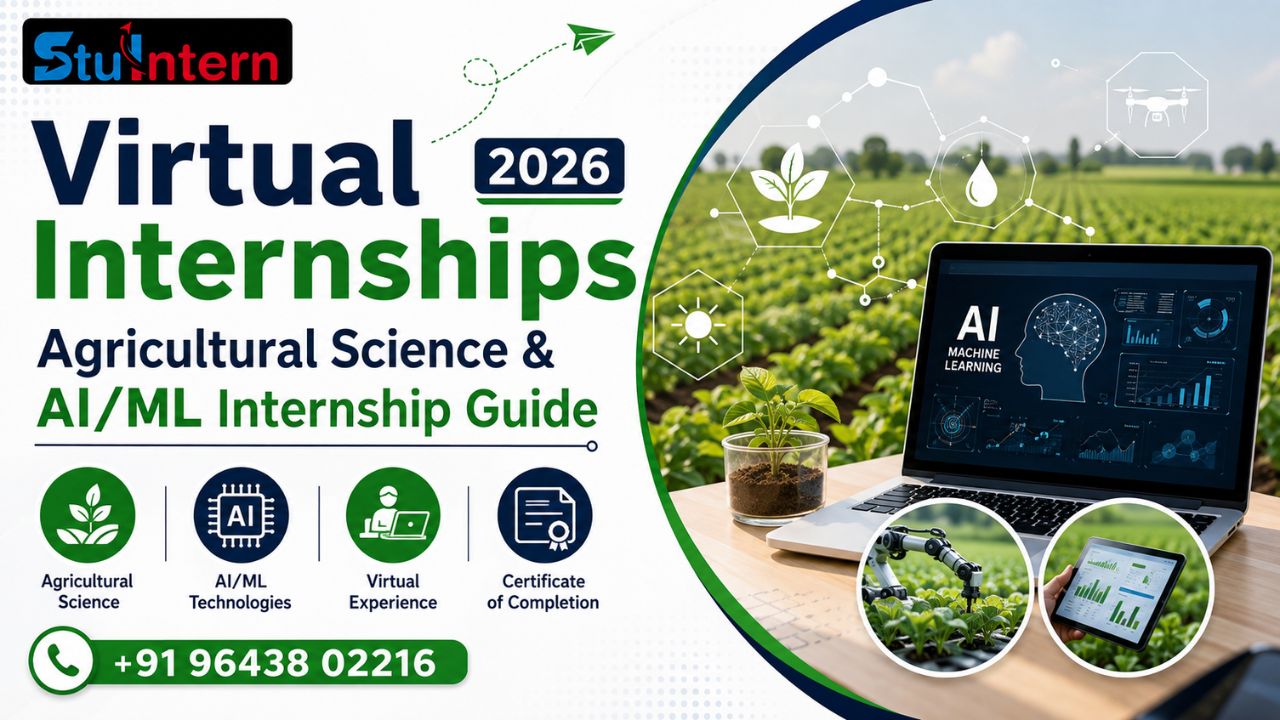
In 2026, students can explore different paths, including an Agricultural Science internship, technology-focused programs and an AI/ML Internship. The right choice depends on your academic background, career goals and the type of practical experience you want to develop.
This guide explains how to compare internship programs, which skills students should prioritise in 2026, why practical projects matter and how to choose a career-focused internship platform.
Quick Answer: What Are Virtual Internships?
Virtual Internships are remote internship programs that allow students to develop practical and professional skills without needing to work at a physical office. The most valuable programs typically combine structured learning, mentor support, practical projects and meaningful proof of completion.
Students should look beyond a certificate and consider what they will actually learn, practise, build and contribute during the internship.
2. Biggest Challenges Students Face When Starting Their Careers
Moving from college to professional work is rarely straightforward. Students commonly face several challenges.
Lack of Practical Experience
Academic assignments often demonstrate whether a student understands a subject. Employers, however, also want to know whether that knowledge can be applied in practical situations.
A relevant project can demonstrate this much better than a list of completed subjects.
Too Many Certificates, Too Little Evidence
A resume containing ten certificates may look impressive at first glance, but certificates alone do not necessarily demonstrate practical ability.
A stronger student profile can include:
- Relevant skills
- Completed projects
- Project outcomes
- Tools and technologies used
- Internship experience
- Mentor feedback
- Portfolio or work samples
Uncertainty About Career Direction
Students may also be unsure whether to continue in their degree field or explore another career path.
For example, an Agricultural Science student may become interested in:
- Agri-tech
- Agricultural data analysis
- Precision agriculture
- Remote sensing
- GIS
- Food technology
- Agricultural research
- Farm management technology
Likewise, students from mathematics, engineering, computer science or statistics backgrounds may explore AI, machine learning and data science.
Limited Professional Exposure
Many students do not know how professional teams communicate, document their work, meet deadlines or present project results.
A structured internship can provide exposure to these professional expectations while helping students develop practical skills alongside their academic studies.
3. What Should a Good Student Career Platform Offer?
Choosing an internship platform should not be based only on price or certificate design.
A useful platform should ideally provide:
1. Practical Learning
Students should have opportunities to apply concepts rather than only watch lectures.
2. Mentor Guidance
Mentorship is especially valuable when students are working on unfamiliar tools or projects.
3. Live or Industry-Based Projects
Projects give students something concrete to discuss during interviews.
4. Flexible Learning
Virtual programs can be useful for students who need to balance college, examinations and other responsibilities.
5. Certification
A verified certificate can document participation and completion, but it should support—not replace—the practical work.
6. Career Support
Resume guidance, mock interviews and career counselling can help students understand how to present their skills professionally.
4. Why Is Practical Learning Important for Students?
Practical learning turns knowledge into demonstrable ability.
Suppose two students apply for the same entry-level position. Both have completed the same academic course.
Student A says:
“I studied machine learning.”
Student B says:
“I studied machine learning and completed a classification project using a real dataset, evaluated the model and documented the results.”
The second answer provides an interviewer with something concrete to discuss.
The same principle applies to Agricultural Science.
Instead of simply writing “Agricultural Science student” on a resume, students can strengthen their profile through practical work involving areas such as:
- Crop data analysis
- Soil-related research
- Agricultural surveys
- Farm-management studies
- Agricultural economics
- GIS and mapping
- Agri-business analysis
- Sustainability projects
Practical learning does not guarantee employment, but it can make a student’s skills easier to evaluate.
5. How Should Students Compare Different Learning Programs?
Before enrolling, compare programs using practical questions rather than promotional claims.
| Factor | Questions to Ask |
| Curriculum | Does it match my career goal? |
| Projects | Will I complete practical projects? |
| Mentorship | Can I ask questions and receive feedback? |
| Mode | Is it fully online, offline or hybrid? |
| Duration | Can I realistically complete it with college? |
| Certificate | Is completion properly documented? |
| Portfolio | Will I have work I can show recruiters? |
| Career Support | Are resume and interview services available? |
| Tools | Will I practise tools used in the target field? |
| Support | Is help available when I get stuck? |
Do not choose an internship simply because it has the word “certificate” in its title.
6. Which Skills Should College Students Learn in 2026?
The best skills depend on the student’s intended career.
For Agricultural Science Students
Students can consider building skills around:
- Agricultural data analysis
- GIS and spatial analysis
- Remote sensing fundamentals
- Excel and data visualisation
- Research methodology
- Agricultural economics
- Digital agriculture
- Sustainability and resource management
- Scientific communication
- Basic programming and data handling
Students interested in technology-driven agriculture can also explore how data science and AI are being applied to agriculture.
For AI/ML Students
An AI/ML Internship can be particularly relevant for students who want to develop technology skills.
Useful areas include:
- Python
- Statistics
- Data preprocessing
- Machine learning
- Model evaluation
- Deep learning fundamentals
- Natural language processing
- Data visualisation
- Git and project documentation
- Responsible use of AI
The goal should not be to learn every tool available. It is better to understand a smaller set of skills and demonstrate them through projects.
7. How to Choose the Right Program Based on Your Career Goal
Choosing the right internship or learning program becomes easier when you first identify your career goal. A student interested in Agricultural Science may need a different learning path from someone preparing for an AI/ML Internship or a career in data analytics.
| Career Goal | Recommended Learning Focus | Useful Project Direction |
|---|---|---|
| Agricultural Science | Agriculture research, data, GIS and digital agriculture | Crop, soil or farm-data project |
| Agri-Tech | Agriculture + technology | Agricultural monitoring or analytics |
| Agricultural Research | Research methods, statistics and data analysis | Research-based analysis project |
| Data Analyst | Excel, SQL, Python and data visualisation | Business or data dashboard |
| AI/ML Engineer | Python, machine learning and deep learning | Predictive or classification project |
| Data Science | Statistics, Python, machine learning and visualisation | Real-dataset analytics project |
| Software Development | Programming, databases and development tools | Web or software application |
| Digital Marketing | SEO, analytics, content and advertising | Campaign or website growth project |
When comparing programs, consider your current education, existing skills, career objective and the type of practical experience you want to gain.
For example, an Agricultural Science student may benefit from a program that combines agriculture with data, GIS or digital technologies. A student targeting an AI/ML Internship should look for practical exposure to Python, machine learning, datasets and project development.
The right program should create a clear connection:
Education → Skills → Practical Project → Internship Experience → Career Goal
8. Online vs Offline Learning: Which Is Better for Students?
There is no single answer because the better learning format depends on your schedule, learning style and career requirements.
Online Learning
Advantages:
- Flexible learning schedule
- No daily commute
- Accessible from different locations
- Easier to manage alongside college
- Suitable for students looking for Virtual Internships
- Can include remote mentorship and project-based learning
Limitations:
- Requires self-discipline
- Less face-to-face interaction
- Students need to manage their own time
- Learning quality can vary between programs
Offline Learning
Advantages:
- Direct classroom interaction
- Face-to-face communication with trainers and mentors
- Structured physical learning environment
- Useful for students who prefer traditional classroom learning
- Easier to participate in certain hands-on activities
Limitations:
- Fixed location and schedule
- Travel requirements
- Less flexibility for students managing college commitments
- May not be convenient for students living far from training centres
Which Option Should Students Choose?
Students who need flexibility can consider a well-structured Virtual Internship or online learning program. Online learning can be particularly convenient when students need to balance their degree, assignments and internship experience.
However, the delivery format should not be the only deciding factor.
Before choosing an online or offline program, check whether it provides:
- Practical projects
- Mentor support
- Relevant learning material
- Career guidance
- Certification
- Clear learning outcomes
- Opportunities to apply the skills you learn
Ultimately, the quality of the learning experience matters more than whether the program is online or offline. A structured online program with practical projects and mentorship can be more valuable than an offline program that offers only classroom lectures.
9. Projects vs Certificates: What Actually Helps Your Career More?
When building a resume, students often wonder whether they should focus more on certificates or practical projects. Both can be useful, but they serve different purposes.
A certificate can show that you completed a course or internship. A project can demonstrate how you applied what you learned to a practical problem.
| Factor | Projects | Certificates |
|---|---|---|
| Demonstrates practical ability | Strong | Limited |
| Shows problem-solving | Strong | Limited |
| Helps interview discussions | Strong | Moderate |
| Supports portfolio building | Strong | Low |
| Proves course completion | Moderate | Strong |
| Shows specific learning | Strong | Strong |
| Adds value to a resume | Very useful | Useful as supporting evidence |
The Best Combination: Projects + Certificates
Students should not treat projects and certificates as competitors. The strongest approach is to use both as part of a broader career-development strategy.
A practical progression is:
Learn → Practise → Complete a Project → Receive Certification → Build a Portfolio → Prepare for Interviews
For example, a student completing an AI/ML Internship can use a machine learning project to demonstrate practical skills while using the internship certificate as evidence of program completion.
Similarly, an Agricultural Science student can strengthen their profile through a project involving crop data, soil analysis, agricultural research or digital agriculture.
Projects show what you can do. Certificates show what you completed.
For this reason, students should prioritise programs that offer meaningful project work rather than choosing an internship solely because it provides a certificate.
10. Common Mistakes Students Make When Choosing a Career Program
Choosing the right internship or learning program requires more than comparing course fees. Several common mistakes can prevent students from getting the practical value they expect.
Choosing Only Based on Price
The cheapest program is not necessarily the best option. Students should compare the curriculum, project opportunities, mentor support, certification and career assistance before making a decision.
Chasing Certificates
Collecting multiple certificates without developing practical skills can leave the same gap on your resume.
A better strategy is to select programs where the certificate is supported by projects, assignments and practical learning.
Ignoring Projects
Always check what students will actually work on during the program.
Ask:
- What projects are included?
- Are projects related to the target career?
- Can the completed work be included in a portfolio?
- Will mentors provide feedback?
Selecting a Program Without Checking the Syllabus
A program may sound attractive but still fail to match your career objective.
Before enrolling, compare the syllabus with the skills employers commonly expect in your target field.
Trying to Learn Everything at Once
Students sometimes choose programs covering too many technologies or subjects. This can result in surface-level knowledge.
It is generally better to develop a strong foundation in relevant skills and then expand gradually.
Ignoring Mentorship
When learning technical, research or data-focused subjects, having someone available to answer questions and review project work can make the learning process more effective.
Expecting an Internship to Guarantee a Job
An internship can help students develop skills and experience, but it cannot replace consistent effort.
Students still need to:
- Build relevant skills
- Complete quality projects
- Improve communication
- Prepare their resumes
- Practise interviews
- Apply for suitable opportunities
An internship should be viewed as a career-building opportunity, not an automatic job guarantee.
11. Why Choose StuIntern?
Choosing an internship platform should ultimately depend on whether its learning experience matches your career goals.
StuIntern focuses on combining skills, projects, internships and career preparation, rather than positioning certification as the only outcome.
Based on the platform's current offerings, key features include:
- Mentor-led learning
- Virtual and flexible internship options
- Live and industry-oriented projects
- Internship certificates
- Internship and training combinations
- Project-focused learning for portfolio development
- Resume and mock interview support
- Career guidance and placement assistance
- Online and offline learning options for selected programs
- Mentor and learner support
AI/ML Internship Opportunities
Students interested in an AI/ML Internship can explore programs covering areas such as Python, machine learning, deep learning and NLP, along with practical projects and mentor-led learning.
This can be useful for students who want to move beyond theoretical knowledge and build practical evidence of their technical skills.
What About Agricultural Science Students?
Agricultural Science students should choose programs based on their specific academic and career interests.
Potential areas of interest can include:
- Agricultural data
- Digital agriculture
- GIS
- Agricultural research
- Crop and soil analysis
- Agri-tech
- Data-driven farming
Students should verify the current availability and exact syllabus of an agriculture-specific internship before enrolling. Not every program on a student career platform is designed specifically for Agricultural Science.
The most important consideration is simple:
Choose an internship that matches your academic background, practical skill requirements and long-term career direction.
12. Who Can Benefit From StuIntern?
StuIntern can be relevant for specific student groups, including:
Undergraduate Students
Students who want practical experience alongside their degree can use internships to supplement classroom learning.
Postgraduate Students
Students pursuing advanced degrees can explore specialised projects and career-oriented skills.
Agricultural Science Students
Students from Agricultural Science can explore opportunities at the intersection of agriculture, research, data and technology, while checking that the selected program aligns with their specific agricultural career goal.
Computer Science & Engineering Students
Students interested in software, data, AI or machine learning can use project-based internships to strengthen technical portfolios.
Data and Statistics Students
Students can explore data analytics, machine learning and related project work.
Freshers
Students without previous professional experience can use structured projects and internships to create evidence of practical skills.
Career Switchers
Students who want to move from one academic area into technology or another career path can use structured learning to build foundational skills.
13. How Virtual Internships Can Prepare Students for Future Career Opportunities
The workplace is changing quickly, and students need more than academic credentials.
Virtual Internships can help students practise skills that are increasingly important across industries:
- Remote collaboration
- Digital communication
- Project documentation
- Independent problem-solving
- Time management
- Data handling
- Professional presentations
- Online meetings
- Digital tools
- Portfolio development
For an Agricultural Science student, this could mean combining domain knowledge with digital agriculture, data or research skills.
For a technology student, an AI/ML Internship could provide a pathway from theoretical machine learning concepts toward practical project experience.
The strongest career profile is often not based on one qualification. It is built progressively through education + skills + projects + experience + communication.
14. Frequently Asked Questions
What are Virtual Internships?
Virtual Internships are remote internship experiences that allow students to learn, complete assigned work and develop professional skills without being physically present at a workplace.
Are Virtual Internships useful for college students?
Yes. They can help students gain practical experience while continuing their academic studies, particularly when the program offers structured projects and mentorship.
What is an Agricultural Science internship?
An Agricultural Science internship provides practical exposure related to agriculture, research, farming systems, agricultural technology, data, agribusiness or related areas.
Students should check the exact syllabus and project work before selecting an agriculture-focused internship.
What is an AI/ML Internship?
An AI/ML Internship is a practical learning experience focused on areas such as Python, machine learning, data preparation, model development, deep learning and related technologies.
Is an online internship better than an offline internship?
Not necessarily. The better option depends on the student’s learning preferences, schedule and career goal. Online internships can offer flexibility, while offline programs may provide more direct classroom interaction.
Are certificates enough to get a job?
No. A certificate can document completion, but employers may also evaluate skills, projects, communication, problem-solving and relevant experience.
Should Agricultural Science students learn AI and data skills?
Students interested in agri-tech, agricultural analytics, research or digital agriculture may benefit from learning relevant data and technology skills. The appropriate skill set depends on their intended career path.
How long should a virtual internship be?
There is no single ideal duration. Students should consider whether the program provides enough time for learning, mentorship and meaningful project completion rather than selecting solely by duration.
What should students check before joining an internship?
Check the syllabus, project work, mentor support, learning mode, duration, certificate details, career support, reviews and whether the program matches your career objective.
15. E-E-A-T: What Students Should Verify Before Enrolling
A trustworthy internship decision should be based on evidence rather than marketing language.
Before joining any program, students should check:
- Who provides the internship or certificate?
- Is the curriculum clearly published?
- Are projects explained before enrollment?
- Is mentor support available?
- Are program outcomes clearly stated?
- Are reviews from identifiable learners available?
- Does the platform provide clear contact information?
- Are fees and refund terms transparent?
- Does the program genuinely match the student’s career goal?
Students should also avoid claims such as “guaranteed job” unless the provider clearly explains the conditions behind that claim.
Career development is a process. A good internship should help students become more capable and better prepared—not promise an outcome that no program can completely control.
16. Prepare for Future Career Opportunities
Your degree gives you academic knowledge. Your practical work shows how you use it.
That is why students should start building their career profile before graduation rather than waiting until the final semester.
Whether your goal is Agricultural Science, agri-tech, data analytics, software development or an AI/ML Internship, focus on creating a clear progression:
Academic Knowledge → Practical Skills → Projects → Internship Experience → Portfolio → Interview Preparation
This approach can make your resume more meaningful and give you better stories to discuss during interviews.
Conclusion
The transition from college to a professional career can be difficult when students know but little practical evidence of their abilities.
Virtual Internships offer one way to bridge that gap by combining remote learning, practical assignments, mentorship and project experience.
Agricultural Science students can explore opportunities connected to agriculture, research, data and emerging technologies, while students interested in technology can consider an AI/ML Internship to develop practical skills in machine learning and related areas.
The key is to choose carefully. Do not select a program only because it offers a certificate. Look for the combination of relevant skills, meaningful projects, mentorship, career support and credible certification.
In 2026, students who start building practical experience early can enter the job market with more than a degree—they can show what they know and what they can actually do.
CTA
Ready to build practical skills for your career?
Explore StuIntern’s internship and training options, compare programs based on your career goal, and choose a pathway that helps you learn, practise and build your portfolio.
Start with the right skills. Work on practical projects. Prepare for your future career.
Explore Virtual Internships with StuIntern today.
Website: www.stuintern.com
Call/WhatsApp: +91 96438 02216