

Introduction
Writing a PhD research synopsis is not only about adding different sections to a document. Every section should connect with the next one.
One of the most common problems researchers face is a lack of connection between the research problem, research objectives, research questions, and methodology. When these parts do not match, the research plan can become confusing and difficult to evaluate.
For example, a researcher may identify one research problem but create objectives that focus on a different issue. The research questions may then focus on something else, while the methodology does not provide a suitable way to answer those questions.
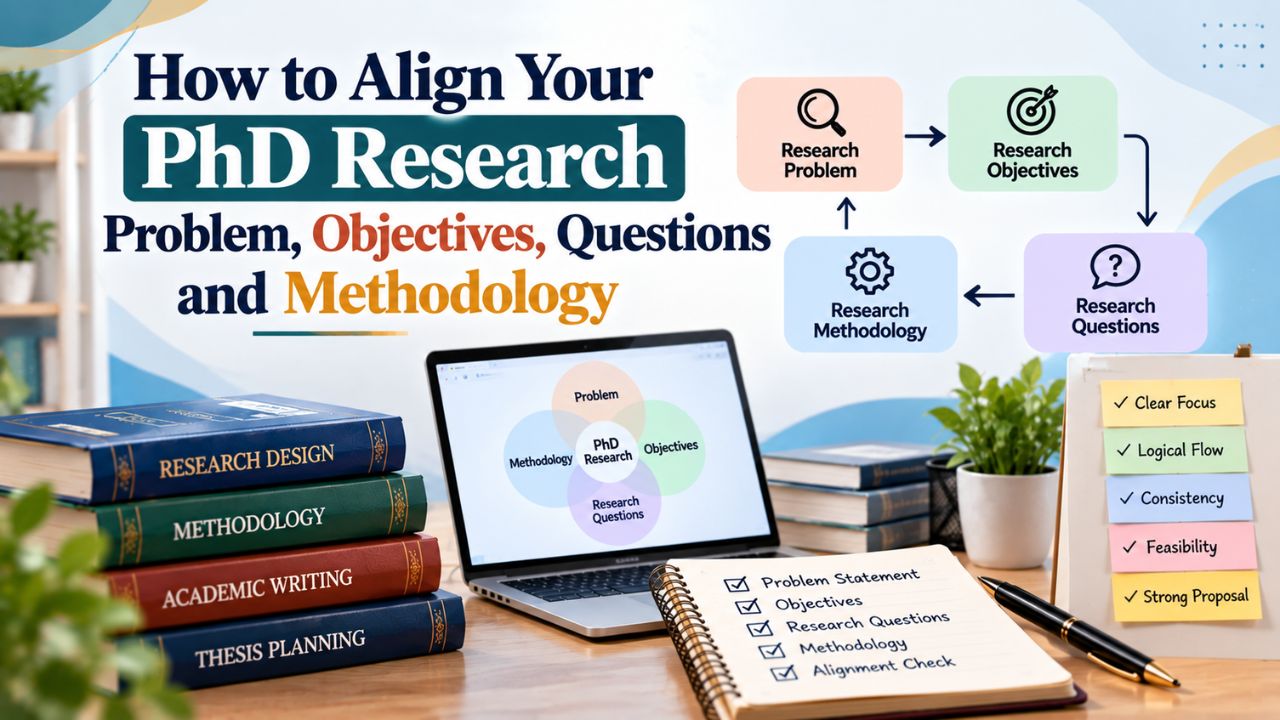
A strong research synopsis should have a logical flow:
Research Problem → Research Gap → Research Objectives → Research Questions → Methodology → Expected Contribution
Understanding this connection can make your research proposal clearer and more focused.
What Is Research Alignment?
Research alignment means that the major parts of your research support the same research direction.
Your research problem should explain the issue you want to investigate.
Your research gap should explain what is missing or unclear in existing research.
Your objectives should explain what you want to achieve.
Your research questions should turn those objectives into questions that can be investigated.
Your methodology should explain how you will answer those questions.
When all these parts work together, your research becomes easier to understand.
Why Is Research Alignment Important?
A PhD study can involve many ideas, theories, variables, and sources. Without proper alignment, the research can become too broad.
Good alignment helps you:
- Keep your research focused
- Develop clear objectives
- Create relevant research questions
- Select a suitable methodology
- Avoid unnecessary data collection
- Explain your research direction clearly
- Build a stronger research synopsis
It also makes it easier for supervisors and academic committees to understand what you are planning to study.
Start With a Clear Research Problem
The first step is to clearly define your research problem.
A research problem identifies the issue that requires investigation. It should not simply describe a general topic.
For example:
General topic:
Artificial Intelligence in Education
Research problem:
Many higher education institutions are adopting AI-based learning tools, but there is limited understanding of how these tools influence student engagement and learning outcomes in specific educational contexts.
The second example gives a clearer direction for further research.
A good research problem should answer:
- What is the issue?
- Who or what is affected?
- Where does the issue exist?
- What is not yet clearly understood?
- Why does the issue require research?
Connect the Research Problem With the Research Gap
After identifying the problem, review existing literature to understand what researchers already know.
The research gap should explain what remains missing, unclear, inconsistent, or underexplored.
For example, previous studies may have examined AI-based learning tools among undergraduate students in developed countries. However, limited evidence may exist about their impact on postgraduate students in a particular region.
This possible gap can help you develop a more focused research problem.
Remember that a research gap should be supported by relevant literature. Simply not finding a paper with your exact topic does not prove that a research gap exists.
How to Create Research Objectives
Once the research problem and gap are clear, develop your research objectives.
Objectives explain what your study intends to achieve.
Good objectives should be:
- Clear
- Specific
- Realistic
- Researchable
- Connected to the research problem
Useful action words include:
- Identify
- Examine
- Analyze
- Evaluate
- Assess
- Compare
- Investigate
- Determine
For example:
Research Problem:
There is limited understanding of how AI-based learning tools influence student engagement.
Objective 1:
To examine the use of AI-based learning tools among higher education students.
Objective 2:
To analyze the relationship between AI-based learning tools and student engagement.
Objective 3:
To evaluate factors influencing student engagement when using AI-supported learning tools.
Notice how each objective is connected to the research problem.
How to Develop Research Questions
Research questions should be directly connected to your objectives.
If an objective asks you to examine something, the related research question should ask about the same area.
For example:
Objective:
To examine the use of AI-based learning tools among higher education students.
Research Question:
How are AI-based learning tools used by higher education students?
Another example:
Objective:
To analyze the relationship between AI-based learning tools and student engagement.
Research Question:
What is the relationship between AI-based learning tools and student engagement?
This creates a clear connection between the two sections.
Objectives and Questions Should Not Introduce New Topics
One common mistake is adding a research question that is not covered by the objectives.
For example, suppose your objectives focus on AI and student engagement, but one research question suddenly asks about university funding.
This creates a problem because the research direction has changed.
Every important research question should have a clear connection with your objectives.
Connect the Methodology With the Research Questions
The next important step is choosing the right research methodology.
Your methodology should provide a practical way to answer your research questions.
For example, if you want to measure the relationship between two variables, a quantitative approach may be appropriate depending on the research design.
If you want to understand participants' experiences and opinions in detail, a qualitative approach may be more suitable.
The choice depends on your research problem, objectives, questions, data, and discipline.
Do not choose a methodology simply because another researcher used it.
Quantitative Research Alignment
Quantitative research often involves measurable variables and numerical data.
A quantitative study may include:
- Surveys
- Structured questionnaires
- Experiments
- Statistical analysis
- Hypothesis testing
For example:
Objective:
To examine the relationship between employee training and job performance.
Research Question:
What is the relationship between employee training and job performance?
Possible Data:
Employee survey responses and performance measures.
Possible Analysis:
Appropriate statistical techniques based on the research design and data.
The exact statistical method should be selected according to the research question, data type, study design, and assumptions.
Qualitative Research Alignment
Qualitative research focuses on understanding experiences, perceptions, meanings, or processes.
Common methods include:
- Interviews
- Focus groups
- Observations
- Case studies
- Document analysis
For example:
Objective:
To explore the experiences of postgraduate students using AI-based learning tools.
Research Question:
How do postgraduate students experience the use of AI-based learning tools?
Possible Method:
Semi-structured interviews with suitable participants.
Again, the methodology should be selected based on the research question.
Mixed-Methods Research Alignment
Some research questions may require both quantitative and qualitative information.
A mixed-methods study combines numerical data with qualitative information.
For example, a researcher may first conduct a survey to understand general patterns and then conduct interviews to understand participants' experiences in greater detail.
The decision to use mixed methods should be based on the research problem and objectives rather than simply trying to make the research appear more advanced.
Create a Research Alignment Table
One of the easiest ways to check your research plan is to create an alignment table.
| Research Element | Main Purpose |
|---|---|
| Research Problem | Explains the issue being investigated |
| Research Gap | Shows what is missing in existing knowledge |
| Research Objective | Explains what the study aims to achieve |
| Research Question | Converts the objective into an answerable question |
| Methodology | Explains how the question will be investigated |
| Expected Contribution | Explains what the study may add |
This simple table can help you identify missing connections before submitting your synopsis.
Example of a Complete Research Flow
Consider a research topic related to online learning.
Research Topic
Impact of Online Learning on Student Engagement in Higher Education
Research Problem
Many universities use online learning platforms, but student engagement can vary across different learning environments. More research may be needed to understand the factors influencing student engagement in a particular context.
Research Gap
Existing studies have examined online learning and student engagement, but findings may vary by educational setting, student population, technology, and learning environment. A specific context may require further investigation.
Research Objective
To examine the factors influencing student engagement in online learning.
Research Question
What factors influence student engagement in online learning?
Methodology
The researcher may select a suitable research design and collect data from an appropriate student population using methods that match the research question.
This example shows how each part can follow logically from the previous one.
Common Research Alignment Mistakes
1. Broad Research Problem
A problem that covers too many issues can make the entire study difficult to manage.
2. Too Many Objectives
Adding a large number of objectives does not necessarily make a PhD study stronger.
Focus on objectives that are important and achievable.
3. Objectives Do Not Match Questions
Every major objective should have an appropriate research question where research questions are part of the study design.
4. Methodology Does Not Answer the Questions
If your research questions require detailed participant experiences, a method that only provides unrelated numerical information may not be suitable.
5. Research Gap Is Not Connected to the Problem
The research gap should help explain why your research problem needs further investigation.
6. Adding Unrelated Variables
Avoid adding variables simply because they appear in other research papers.
Every variable should have a clear reason for being included.
7. Ignoring Research Scope
A research plan should fit the available time, data, participants, resources, and academic requirements.
How to Check Your Research Alignment
Before submitting your synopsis, ask yourself these questions:
Does my research problem clearly explain what I want to investigate?
Is my research gap supported by relevant literature?
Are my objectives directly connected to the problem?
Do my research questions match my objectives?
Can my methodology answer my research questions?
Are my expected outcomes connected to my research objectives?
Is the research scope realistic?
If you can answer these questions clearly, your research plan is likely to have a much stronger logical structure.
How Literature Review Supports Alignment
A good literature review does more than provide references.
It helps you understand:
- What has already been studied
- Which theories are commonly used
- Which methods have been applied
- What findings have been reported
- Where researchers disagree
- What limitations exist
- What questions remain unanswered
This information can help you refine your research problem and identify a meaningful research gap.
As you read, maintain notes about the topic, research method, sample, findings, limitations, and recommendations of important studies.
This makes it easier to compare studies instead of simply summarizing them.
Keep Your Research Scope Realistic
A strong research idea can still become difficult if the scope is too large.
Consider limiting your research according to:
- Population
- Location
- Industry
- Time period
- Variables
- Research context
- Available data
A focused study is often easier to design, conduct, analyze, and explain.
Your PhD research does not need to solve every problem in your field. It needs to address a meaningful and researchable problem.
Follow Your University Guidelines
Every university may have different requirements for a PhD research synopsis.
Requirements can differ regarding:
- Synopsis structure
- Word count
- Formatting
- Referencing style
- Research methodology
- Required sections
- Submission procedure
Always check the current guidelines provided by your university and discuss important requirements with your supervisor.
Get Support With Your Research Synopsis
Developing a clear connection between your research problem, gap, objectives, questions, and methodology can be challenging.
StuIntern provides synopsis and research gap support covering areas such as research-gap identification, synopsis development, research objectives, methodology guidance, and proposal development.
Academic guidance can help researchers organize their ideas and identify areas that need further refinement. Your final research decisions should remain consistent with your university requirements and supervisor's guidance.
Frequently Asked Questions
What is research alignment in a PhD?
Research alignment means that the research problem, research gap, objectives, questions, methodology, and expected contribution are logically connected.
Should research questions come from research objectives?
Yes. Research questions should generally be closely connected to the objectives they are intended to address.
Why should methodology match research questions?
The methodology explains how you will collect and analyze information to answer your research questions. A mismatch can make the research design difficult to justify.
Can research objectives change during a PhD?
Yes. Objectives may be refined as the literature review develops and the research direction becomes clearer. Any major changes should be discussed with your supervisor and reflected consistently throughout the research.
How can I make my PhD synopsis more focused?
Start with a specific research problem, identify a well-supported research gap, create a manageable number of objectives, develop related research questions, and select a methodology that fits the study.
Final Thoughts
A strong PhD research synopsis is not simply a collection of separate sections. It should tell one clear research story.
The research problem explains the issue. The research gap explains what is missing. The objectives explain what you want to achieve. The research questions explain what you want to find out, and the methodology explains how you will investigate it.
When these elements are properly aligned, your research plan becomes clearer and easier to evaluate.
Take time to review each section before submitting your synopsis. A simple alignment check can help you identify unnecessary information, unclear objectives, unrelated questions, and methodology problems at an early stage.
Website: Stuintern.com
Call / WhatsApp: +91 81308 34430