

Introduction
Preparing a PhD synopsis involves more than selecting an interesting research topic and writing a few pages about it. A good synopsis must explain what you want to investigate, why the study is important, and how you plan to complete the research.
One challenge many research scholars face is connecting their research objectives, research questions, and research methodology. These three elements are closely related. If they do not support one another, the entire research proposal may become confusing or difficult to follow.
For example, a researcher may want to study the impact of digital learning on university students. However, if the objectives focus on academic performance while the research questions examine student satisfaction, the proposed methodology may not properly address the study's purpose.
A well-organised PhD research synopsis creates a logical connection between the research problem, objectives, questions, and methods. This guide explains how to develop that connection, with practical examples and useful tips for research scholars.
Why Are Research Objectives, Questions and Methodology Important?
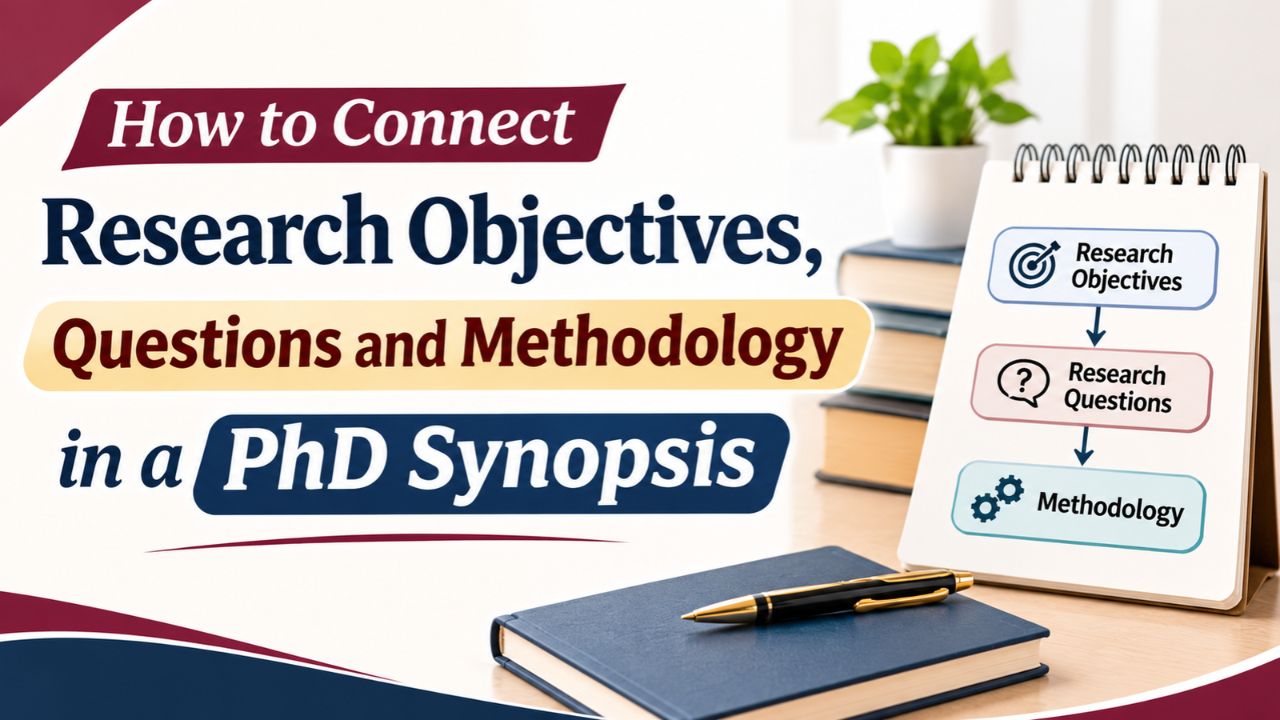
Every research project needs a clear direction. Research objectives explain what the researcher wants to achieve. Research questions identify what the study needs to answer. The methodology describes how the researcher will find those answers.
These elements work together to create a practical research plan.
| Research element | Main purpose | Example |
|---|---|---|
| Research objectives | Explain what the study intends to achieve | To examine the effect of online learning on student performance |
| Research questions | Identify what the study will investigate | How does online learning influence student performance? |
| Research methodology | Explain how the question will be answered | Survey data and academic performance analysis |
When these sections are properly connected, supervisors and research committees can understand the purpose and direction of the proposed study more easily.
1. Start With a Clearly Defined Research Problem
Before writing research objectives, identify the problem that your study intends to investigate.
A research problem should be specific enough to guide the entire project. Avoid choosing a broad subject without explaining the issue that needs further investigation.
For example:
Broad topic: Artificial Intelligence in Education.
Focused research problem: Limited understanding of how AI-based personalised learning tools influence student engagement in postgraduate education.
The focused problem provides a clearer direction for developing objectives and research questions.
To define your research problem:
- Select a subject related to your academic field.
- Read relevant and recent research papers.
- Identify an issue that requires further investigation.
- Consider the population, location, or context of the study.
- Check whether the proposed research is realistic.
- Discuss the problem with your research supervisor.
A clearly defined problem is the foundation of a strong research proposal.
2. Understand the Difference Between Research Objectives and Research Questions
Research objectives and research questions are connected, but they perform different functions.
An objective describes what the study aims to accomplish. A research question expresses the issue that the study intends to answer.
Consider the following example:
Research topic: Impact of Digital Learning on University Students.
| Research objectives | Related research questions |
|---|---|
| To examine the use of digital learning platforms among university students | How frequently do students use digital learning platforms? |
| To analyse the relationship between digital learning and student engagement | What relationship exists between digital learning and student engagement? |
| To identify challenges faced by students during online learning | What challenges do students experience while using online learning platforms? |
| To evaluate student satisfaction with digital learning tools | How satisfied are students with the available digital learning tools? |
Notice how each objective has a related question. This makes it easier to decide what information needs to be collected and analysed.
3. How to Write Clear and Achievable Research Objectives
Research objectives should describe the main activities or outcomes of your study. They should be specific, realistic, and directly connected to the research problem.
Avoid objectives that are too general, such as:
"To study artificial intelligence."
A more focused objective would be:
"To evaluate the effectiveness of AI-based personalised learning tools in improving student engagement in higher education."
Useful action verbs for research objectives include:
- Analyse
- Examine
- Evaluate
- Identify
- Compare
- Investigate
- Assess
- Determine
- Explore
- Measure
Choose verbs that match the type of research you intend to conduct.
Example of Research Objectives for a PhD Study
Suppose your research topic is:
The Impact of Social Media Marketing on Consumer Buying Behaviour.
Possible objectives include:
- To examine the influence of social media advertising on consumer purchasing decisions.
- To identify the social media platforms commonly used by consumers before purchasing products.
- To analyse the relationship between online reviews and consumer buying behaviour.
- To evaluate the role of influencer marketing in shaping purchase intentions.
Each objective should be achievable within the available research period and supported by an appropriate method.
4. Develop Research Questions That Match Your Objectives
Once your objectives are clear, convert them into research questions.
A research question should be understandable, focused, and possible to investigate using academic research methods.
For example:
| Research objective | Research question |
|---|---|
| To examine the influence of social media advertising on purchase decisions | How does social media advertising influence consumer purchase decisions? |
| To identify commonly used social media platforms | Which social media platforms do consumers use most before purchasing products? |
| To analyse the relationship between online reviews and buying behaviour | How do online reviews affect consumer buying behaviour? |
| To evaluate influencer marketing | What role does influencer marketing play in shaping purchase intentions? |
Avoid questions that are too broad or cannot be answered using the proposed research design.
A useful research question should help you decide what information is required, which participants or sources are relevant, and how the findings will be analysed.
5. Choose a Research Methodology That Answers Your Questions
The research methodology explains how you will conduct the study. It should be selected according to the objectives and research questions, not simply because a particular method is popular.
Common research approaches include:
| Research approach | When it may be suitable | Example |
|---|---|---|
| Quantitative research | When numerical data and measurable relationships are important | Surveying students about digital learning |
| Qualitative research | When experiences, opinions, or behaviour need detailed exploration | Interviewing teachers about classroom technology |
| Mixed-method research | When both numerical patterns and detailed experiences are required | Combining student surveys with interviews |
| Experimental research | When the effect of a controlled intervention needs to be examined | Comparing two teaching approaches |
| Case study research | When a particular organisation, group, or situation needs detailed investigation | Studying digital transformation in one university |
The choice depends on your research question, available data, subject area, resources, and university requirements.
What Should the Methodology Section Include?
A typical research methodology section may contain:
Research design: Explain whether the study is descriptive, exploratory, experimental, correlational, or another suitable design.
Population and sample: Identify the group or units being studied and explain how participants or observations will be selected.
Data collection: Describe the use of surveys, interviews, experiments, observations, documents, or existing datasets.
Research instruments: Explain the questionnaires, interview guides, equipment, or software used in the study.
Data analysis: Identify suitable statistical, qualitative, or computational analysis methods.
Ethical considerations: Explain how consent, confidentiality, privacy, and relevant research approvals will be handled.
The exact requirements depend on the subject and university.
6. Connect Each Research Objective With a Suitable Method
One of the best ways to improve a PhD synopsis is to create an objective-methodology mapping table.
This table helps you check whether the planned research methods can actually achieve the stated objectives.
For example, consider a study on digital learning and university students.
| Objective | Data required | Possible method |
|---|---|---|
| Examine digital learning usage | Information about platform usage | Student questionnaire |
| Analyse student engagement | Engagement-related responses or measures | Survey and suitable statistical analysis |
| Identify learning challenges | Student experiences and opinions | Interviews or open-ended questions |
| Evaluate student satisfaction | Satisfaction ratings and feedback | Questionnaire and descriptive analysis |
This type of mapping can reveal missing information before the synopsis is submitted.
For example, if an objective requires understanding personal experiences but the proposed methodology only collects numerical ratings, you may need to reconsider the research design.
7. Make Sure Your Research Gap Supports Your Objectives
The research gap explains what remains insufficiently understood in existing literature. Your research objectives should respond to that gap.
Suppose previous studies have mainly examined online learning platforms in large universities, while limited evidence is available about their use in smaller institutions.
A possible research direction could be:
- Research gap: Limited evidence about the experiences of students using digital learning platforms in smaller higher education institutions.
- Research objective: To examine the experiences and challenges of students using digital learning platforms in selected smaller institutions.
- Research question: What challenges do students experience while using digital learning platforms in these institutions?
- Possible methodology: Interviews, surveys, or a mixed-method design, depending on the research scope.
This connection helps demonstrate why the proposed study is necessary and how it will investigate the identified issue.
Remember to verify the gap through a thorough literature review. A lack of easily available search results does not automatically establish that no previous research exists.
8. Use a Research Alignment Matrix in Your PhD Synopsis
A research alignment matrix is a useful planning tool that brings the important elements of your proposal together.
It allows you to check whether the research problem, gap, objectives, questions, and methodology follow a consistent direction.
Here is a simple example:
| Research component | Example |
|---|---|
| Research topic | Digital Learning and Student Engagement |
| Research problem | Limited understanding of student engagement with digital learning platforms in a selected academic setting |
| Research gap | Insufficient evidence about engagement in the selected context |
| Research objective | To examine factors influencing student engagement |
| Research question | Which factors influence student engagement with digital learning platforms? |
| Methodology | Survey and appropriate data analysis |
| Expected contribution | Better understanding of student engagement in the selected setting |
You can prepare a similar table for each major objective in your research.
This is particularly useful when a PhD study contains multiple objectives, research questions, variables, or research methods.
9. Common Mistakes to Avoid When Preparing a Research Synopsis
Even a relevant research topic can become difficult to evaluate when the proposal lacks proper alignment.
| Common mistake | Why it creates a problem | How to improve it |
|---|---|---|
| Writing too many objectives | Makes the study difficult to manage | Keep objectives focused and realistic |
| Using unrelated research questions | Creates confusion about the study's purpose | Connect each question to an objective |
| Choosing an unsuitable methodology | The collected data may not answer the questions | Select methods based on research needs |
| Ignoring the research gap | The need for the study may remain unclear | Support the gap with literature |
| Using vague objectives | Makes research outcomes difficult to evaluate | Use clear and specific action verbs |
| Selecting an unrealistic sample | May affect feasibility and data collection | Consider access, time, and resources |
| Ignoring university guidelines | The synopsis may not follow required structure | Use the latest institutional format |
Reviewing these issues before submission can make your research proposal more coherent and easier to understand.
10. Final Checklist Before Submitting Your PhD Synopsis
Before submitting your synopsis to your supervisor or university, review the following points:
- Is the research topic focused and understandable?
- Is the research problem clearly explained?
- Does the literature review support the research gap?
- Are the research objectives specific and achievable?
- Does every research question relate to an objective?
- Is the methodology appropriate for answering the questions?
- Are the data collection and analysis methods explained?
- Have ethical considerations been addressed?
- Are references accurate and consistently formatted?
- Does the document follow university guidelines?
If these elements are properly connected, your synopsis will present a clearer research plan.
How StuIntern Supports PhD Synopsis and Research Gap Preparation
Developing a research synopsis can be challenging, especially when you are trying to connect your literature review, research gap, objectives, questions, and methodology.
StuIntern provides PhD synopsis and research gap support for scholars who need academic guidance during the early stages of research planning.
The service page covers areas such as:
- Research topic selection and refinement
- Research synopsis preparation guidance
- Research gap identification
- Literature review support
- Research objectives and problem statement development
- Research methodology guidance
- Academic structure and formatting
- Proposal review and improvement
Researchers can explore the Synopsis and Research Gap Services by StuIntern to understand the available support.
Academic guidance should help scholars understand and improve their own research. The final research decisions, evidence, analysis, and academic submission should remain the responsibility of the researcher and follow the university's academic integrity requirements.
Frequently Asked Questions
1. How are research objectives and research questions connected?
Research objectives explain what a study aims to achieve, while research questions identify what it needs to answer. Each research question should support one or more objectives.
2. Can a PhD research synopsis have multiple objectives?
Yes. A PhD synopsis can contain multiple objectives when they address different aspects of the same research problem. They should be realistic, focused, and connected to the overall purpose of the study.
3. How many research questions should I include in a PhD synopsis?
There is no fixed number for every discipline. Include enough questions to address the research objectives without making the study unnecessarily broad. Follow your university's guidelines.
4. How do I choose the right research methodology?
Start with your research problem, objectives, and questions. Decide what type of evidence is required and select a suitable qualitative, quantitative, mixed-method, experimental, or other research design.
5. What is a research alignment matrix?
A research alignment matrix is a planning table that connects the research problem, gap, objectives, questions, data requirements, and methodology. It helps identify inconsistencies in a research proposal.
6. Can research objectives change after synopsis approval?
They may change if new evidence, supervisor feedback, or practical issues require revisions. However, researchers should discuss significant changes with their supervisor and follow the university's approval process.
7. What happens if research objectives and methodology do not match?
The proposed method may fail to collect the information needed to achieve the objectives. This can weaken the research design and make the study difficult to complete. Review the alignment before submitting the synopsis.
8. Why is the research gap important when writing objectives?
The research gap explains what remains unclear in existing studies. It provides a reason for the research objectives and helps ensure that the proposed study addresses a meaningful academic issue.
9. Where can I get guidance for preparing a PhD synopsis?
You can explore StuIntern's Synopsis and Research Gap Services for information about research planning, literature review, gap identification, methodology guidance, and synopsis preparation support.
Conclusion
A strong PhD synopsis should present a clear connection between the research problem, research gap, objectives, questions, and methodology. These elements should not be written as separate sections without considering how they support one another.
Start by defining a focused research problem, develop achievable objectives, create questions that address those objectives, and select methods that can provide reliable answers.
Using a research alignment matrix and reviewing university guidelines can help you identify inconsistencies before submitting your proposal.
A well-planned synopsis gives your research a clear direction and provides a practical foundation for the next stages of your PhD journey.
If you need guidance with research planning, synopsis development, or research gap identification, explore StuIntern's Synopsis and Research Gap Services and take the next step in organising your academic research.
Website: www.stuintern.com
Call/WhatsApp: +91 96438 02216