

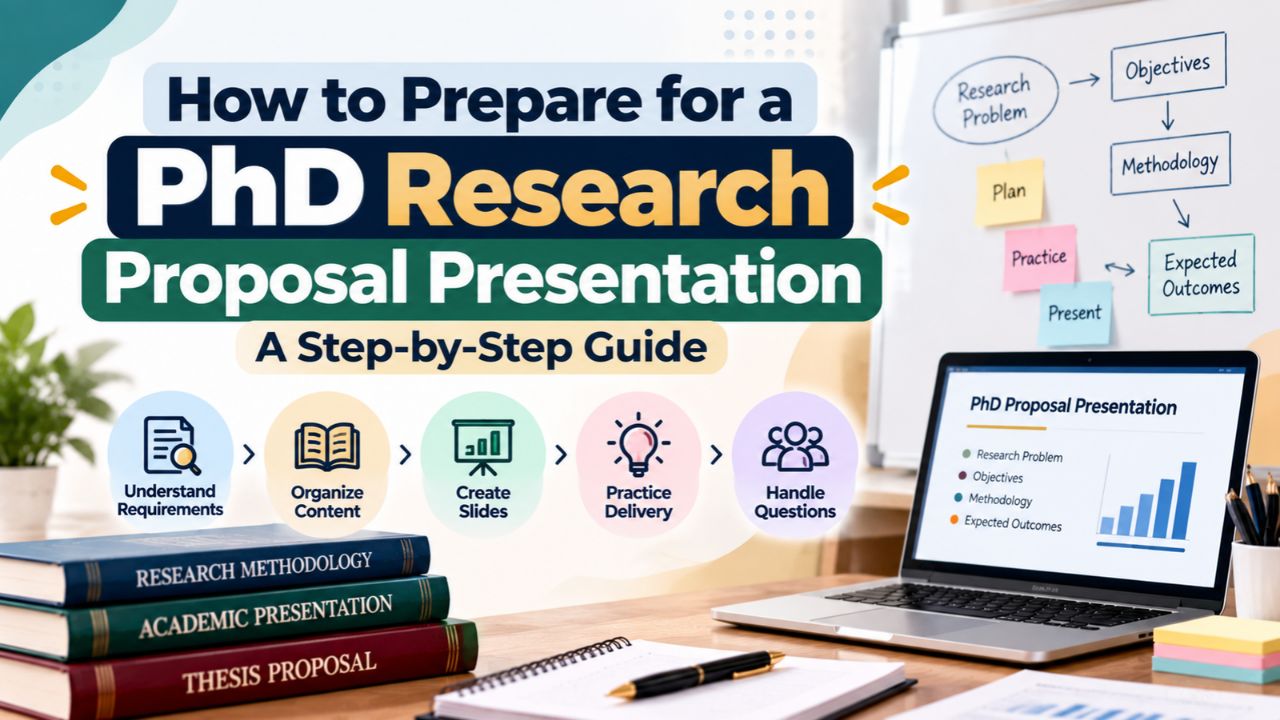
Introduction
Preparing a PhD research proposal is an important part of doctoral studies, but explaining that proposal in front of a supervisor or research committee can be equally challenging. Many scholars understand their research topic but find it difficult to explain their ideas clearly, organise their presentation, or answer questions with confidence.
A PhD research proposal presentation gives you an opportunity to explain what you want to study, why the topic matters, what you have learned from existing research, and how you plan to conduct the study. It also allows your supervisor or committee to assess whether your research plan is focused, practical, and suitable for doctoral-level investigation.
You do not need to use complicated words or fill every slide with information to make a good presentation. What matters most is that you understand your research and can explain it in a logical order.
In this guide, you will learn how to prepare your presentation, organise your slides, explain your research methodology, answer common questions, and avoid mistakes that can make your proposal difficult to understand.
What Is a PhD Research Proposal Presentation?
A PhD research proposal presentation is an oral explanation of your proposed research project. It is usually delivered to a supervisor, departmental committee, research panel, or other academic audience, depending on your university's process.
The presentation summarises the main parts of your research proposal. It should explain the research problem, the reason for conducting the study, the research gap, the objectives, and the proposed methodology.
The purpose is not simply to read your written proposal aloud. Instead, you need to show that you understand the subject, have considered the existing literature, and have a reasonable plan for completing the research.
Universities follow different procedures, so check your department's instructions regarding presentation length, slide limits, required sections, and question-and-answer sessions.
1. Understand Your Research Proposal Before Making Slides
Before preparing your PowerPoint presentation, read your proposal carefully. You should be able to explain its main points without depending entirely on written notes.
Start by answering five basic questions:
- What is my research topic?
- What problem am I trying to investigate?
- Why is this research important?
- What questions will my study answer?
- How will I conduct the research?
If you cannot explain these points clearly, spend more time refining your research plan before designing the slides.
For example, if your research focuses on the use of artificial intelligence in higher education, you should be able to explain which aspect of AI you want to investigate, which group or setting you are studying, and what you hope to understand.
A clear explanation of your research idea will make it easier to prepare the slides and respond to questions from the committee.
2. Organise Your Presentation Slides Properly
A well-organised PhD proposal presentation should guide the audience from the research topic to the proposed research plan. Each slide should have a clear purpose and connect naturally with the next one.
A typical presentation may include the following sections:
| Slide | What to include |
|---|---|
| 1. Title | Research title, your name, department, and university |
| 2. Introduction | Background and context of the study |
| 3. Research problem | The issue your research will investigate |
| 4. Literature review | Important findings from existing studies |
| 5. Research gap | What remains unclear or requires further investigation |
| 6. Aim and objectives | What the study intends to achieve |
| 7. Research questions | The main questions your study will answer |
| 8. Methodology | Research design, sampling, data collection, and analysis |
| 9. Significance | Potential academic or practical contribution |
| 10. Timeline | Main research stages and estimated schedule |
| 11. References | Key sources cited in the presentation |
This is a suggested structure, not a compulsory format. Some research areas may require additional slides for hypotheses, a theoretical framework, experimental design, ethical considerations, or preliminary results.
Follow the structure requested by your university rather than adding slides simply to make the presentation longer.
3. Explain the Research Problem Clearly
The research problem is one of the most important parts of your presentation. It explains the issue that your study intends to investigate and helps the audience understand why the project is necessary.
Avoid spending too much time describing the general background of your subject. Move towards the specific issue you want to study.
For example, instead of saying that digital learning has become popular, explain which aspect of digital learning requires further investigation and why.
A clear research problem should help the audience understand:
- What issue needs investigation?
- Who or what is affected?
- What is not sufficiently understood?
- Why is further research worthwhile?
Support your explanation with relevant literature or reliable evidence. Avoid making broad claims that you cannot support.
When your research problem is clear, the committee can more easily understand the purpose of your objectives and methodology.
4. Present Your Literature Review and Research Gap
Your literature review presentation should show that you have examined relevant research and understand the current state of knowledge in your field.
You do not need to discuss every paper included in your written proposal. Select the most relevant studies and explain their main findings, limitations, and relationship to your research question.
After discussing the literature, explain your research gap. This is the part where you identify what remains unanswered, inconsistent, or insufficiently explored in the available evidence.
For example, previous studies may have investigated a particular digital learning tool among undergraduate students, while evidence concerning postgraduate research scholars remains limited. If your literature review confirms that this issue deserves further study, you can explain how your project will investigate it.
Be careful not to claim that no previous research exists simply because you could not find a paper with exactly the same title. Your research gap should be based on a reasonable review of relevant literature.
A useful presentation structure is:
Existing research → What is known → What remains unclear → Why your study is needed
This helps the audience understand the connection between the literature review and your proposed research.
5. Explain Your Research Objectives and Questions
Your research objectives describe what you intend to achieve, while your research questions explain what you want to find out.
Present them clearly and avoid including too many unrelated objectives on one slide.
For example, a study on digital learning and postgraduate student engagement might have the following illustrative objectives:
- To identify the digital learning platforms used by postgraduate students.
- To examine the relationship between platform use and student engagement.
- To explore challenges students experience when using digital learning tools.
Your research questions should correspond to these objectives.
During the presentation, explain briefly how each objective contributes to the overall research aim. This demonstrates that your project has a clear direction.
Avoid introducing objectives that are not connected to your research problem. If an objective does not support the main purpose of the study, consider whether it needs to be revised.
6. Be Ready to Explain Your Research Methodology
The research methodology presentation is often one of the most important parts of a proposal discussion. The committee may want to understand how you intend to collect evidence, analyse it, and answer your research questions.
You should be able to explain your proposed research design and justify why it is appropriate.
Depending on your project, your methodology may include:
- Research approach: quantitative, qualitative, or mixed methods.
- Research design: the overall structure of the study.
- Population and sample: the people, cases, documents, or data you will study.
- Sampling method: how participants or research materials will be selected.
- Data collection: surveys, interviews, experiments, observations, or other suitable sources.
- Data analysis: how the collected evidence will be examined.
- Ethical considerations: consent, privacy, confidentiality, and necessary approvals.
For example, if your research question concerns the relationship between two measurable variables, a quantitative approach may be suitable. If your purpose is to understand participants' experiences, interviews and qualitative analysis may be more appropriate.
The correct approach depends on the research question, discipline, data requirements, and study design.
Do not choose a methodology simply because it is popular or because you are familiar with a particular software tool. Explain how the method will help you answer your research questions.
7. Design Simple and Readable PowerPoint Slides
Good slide design helps the audience follow your explanation. A presentation with too much text can make even a strong research idea difficult to understand.
Keep these practical tips in mind:
Use clear headings. Each slide should tell the audience what the section is about.
Limit the amount of text. Use short points instead of copying entire paragraphs from your proposal.
Choose readable fonts. Make sure the text can be seen comfortably from a distance.
Use diagrams when useful. A conceptual framework, research process, or timeline may be easier to understand visually.
Keep the design consistent. Use a similar font style, layout, and spacing throughout the presentation.
Cite sources properly. Include citations on slides where you discuss previous research, data, or borrowed figures, and provide a reference slide.
For example, a research process can be shown as:
Research Problem → Literature Review → Research Objectives → Methodology → Data Analysis → Findings
Only include diagrams that genuinely help explain your study. Decorative elements should not take attention away from the research itself.
8. Practise Your Presentation Before the Meeting
Even a well-prepared presentation can become difficult to deliver without practice. Rehearsing helps you manage time, improve your explanation, and identify sections that need clarification.
Practise speaking through the slides rather than reading every sentence word for word.
You can rehearse in front of a friend, colleague, or supervisor and ask them to identify parts that are difficult to understand.
During practice, check the following:
- Can I explain the research problem in simple language?
- Can I justify my research gap?
- Can I explain why I selected this methodology?
- Can I finish within the allotted time?
- Can I answer basic questions without reading from the slides?
It is also useful to practise explaining your research in two or three minutes. If you can summarise the project clearly in a short time, you will usually find it easier to maintain a clear direction during the full presentation.
9. Prepare for Common PhD Proposal Presentation Questions
The question-and-answer session gives the committee an opportunity to understand your research decisions in greater detail. You do not need to know every possible answer in advance, but you should understand the reasoning behind your proposal.
Here are some questions worth practising.
Why did you choose this research topic?
Explain your academic interest and the problem that led you to select the topic. Support your answer with relevant evidence rather than relying only on personal interest.
What is the research gap in your study?
Summarise what existing studies have established, identify what remains unresolved, and explain how your proposed study will investigate the issue.
What is the significance of your research?
Describe the possible academic or practical contribution of your study. Keep your claims realistic and connected to your objectives.
Why did you choose this methodology?
Explain how your research design and data collection methods fit your research questions.
How will you collect the required data?
Describe your intended data sources, sampling strategy, instruments, and access arrangements, as appropriate to your study.
What challenges might you face?
You can discuss potential difficulties involving participant access, data availability, time, cost, or ethical approval. Explain how you may address these challenges.
What makes your research feasible?
Discuss the scope of the project, the resources available, the proposed timeline, and the steps you will take to manage the work.
When answering questions, listen carefully and respond directly. If you do not know an answer, be honest about it and explain how you would investigate the issue. A thoughtful answer is better than making an unsupported claim.
10. Avoid Common Presentation Mistakes
Some mistakes can make a proposal presentation less effective even when the research idea is valuable.
Reading every slide: Reading word for word can make it difficult to engage with the audience. Use the slides as a guide and explain the ideas in your own words.
Using too much technical language: Academic terms are sometimes necessary, but explain specialised concepts when your audience may not be familiar with them.
Making unsupported claims: Statements about research gaps, expected results, or originality should be supported by evidence.
Ignoring the methodology: A good research problem needs a practical plan for investigation. Give the methodology enough attention.
Exceeding the time limit: Too many slides can leave little time to explain the most important points. Practise with a timer and follow your university's instructions.
Becoming defensive during questions: Committee members may challenge your assumptions or suggest improvements. Treat their questions as an opportunity to refine the proposal.
Ignoring feedback: After the presentation, record the suggestions and clarify which changes need to be made. Follow your supervisor's or department's procedures for submitting revisions.
How StuIntern Can Support Your Research Preparation
Preparing a research proposal and explaining it clearly can require considerable planning. Scholars may need to refine their research problem, organise the literature review, clarify their research objectives, or make sure that their methodology matches the questions they intend to answer.
StuIntern offers research-related academic support for students and scholars working on research proposals, synopses, literature reviews, and research methodology.
If you are preparing a PhD proposal and need information about research planning or synopsis support, visit the StuIntern Synopsis and Research Gap service page.
Use any guidance you receive to strengthen your own understanding of the research. Your final presentation should accurately represent your research plan, sources, and intended methods, and should follow your university's academic integrity requirements.
Frequently Asked Questions
1. How do I prepare for a PhD research proposal presentation?
Start by reviewing your proposal and identifying its main points. Prepare slides covering the research problem, literature review, research gap, objectives, questions, methodology, significance, and timeline. Practise explaining the project clearly and prepare for likely questions from your supervisor or committee.
2. How many slides should a PhD proposal presentation have?
There is no universal slide count. It depends on the allotted time, research topic, and university requirements. Use enough slides to explain your research plan clearly without overcrowding the presentation.
3. What questions are asked during a PhD proposal presentation?
Questions may concern your research topic, problem statement, literature review, research gap, objectives, methodology, feasibility, expected contribution, and ethical considerations. You may also be asked to justify your choice of research design or explain how you will obtain the required data.
4. How can I explain my research gap during a presentation?
Summarise the most relevant existing findings, explain what remains unanswered or insufficiently understood, and show how your proposed study will investigate that issue. Support your explanation with credible literature and avoid unsupported claims of originality.
5. What should I do if I cannot answer a question?
Stay calm and listen carefully to the question. If you are unsure, acknowledge the limitation rather than guessing. You can explain what you currently understand and indicate what additional literature, evidence, or methodological guidance would help you answer it.
6. How long should a PhD proposal presentation take?
The duration varies by institution and department. Follow the time limit given by your supervisor or research committee. Practise in advance so that you can explain the most important points without rushing.
Conclusion
A successful PhD research proposal presentation depends on clear thinking, careful preparation, and a logical explanation of your research plan. You need to show that you understand the problem, have examined the relevant literature, identified a meaningful research direction, and selected an appropriate methodology.
Prepare your slides around the main ideas rather than filling them with lengthy paragraphs. Practise explaining each section, check the timing, and prepare for questions about your research decisions.
Most importantly, remember that a proposal presentation is an opportunity to explain and improve your research plan. Listen to feedback, respond honestly, and use the discussion to make your project more focused and practical.
Website: www.stuintern.com
Call/WhatsApp: +91 96438 02216