

Introduction
Preparing a PhD research proposal is an important step in the research journey. A good proposal helps explain your research idea, the problem you want to study, the existing literature, and the method you plan to use.
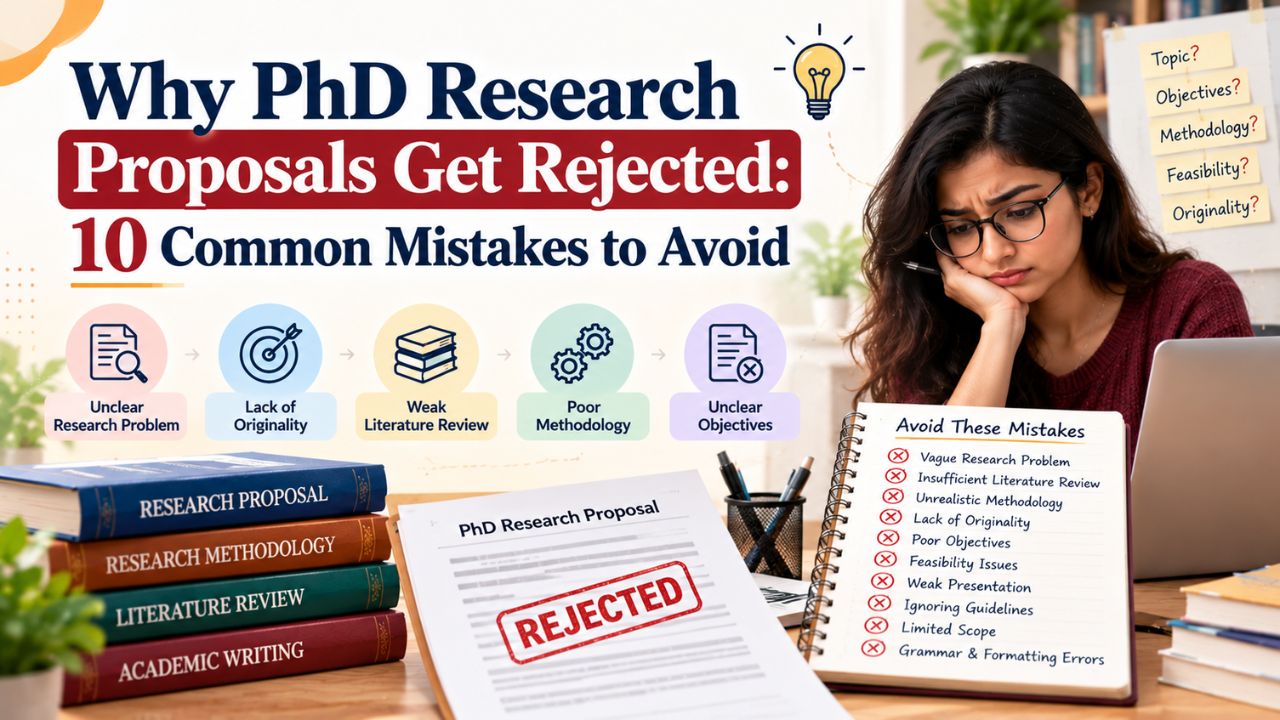
However, many research proposals are returned for revision or rejected because important areas are unclear. Sometimes the research topic is too broad. In other cases, the research gap is weak, the objectives do not match the problem, or the proposed methodology is not suitable.
Understanding these problems before submitting your proposal can save time and help you prepare a stronger research plan.
This guide explains the most common PhD research proposal mistakes, how to avoid them, and what researchers should check before submitting a proposal.
What Is a PhD Research Proposal?
A PhD research proposal is a structured plan for a proposed research study. It explains what you want to investigate, why the research is important, what previous studies have found, and how you plan to conduct the research.
A typical proposal may include:
- Research title
- Introduction
- Background of the study
- Research problem
- Literature review
- Research gap
- Research objectives
- Research questions
- Hypotheses, where applicable
- Research methodology
- Expected outcomes
- Significance of the study
- References
The exact structure can differ between universities, departments, and disciplines. Researchers should therefore follow their university's official guidelines.
Why Do PhD Research Proposals Get Rejected?
There is no single reason why a research proposal may be rejected or returned for revision.
A proposal can have a good topic but still have a weak methodology. Similarly, an interesting research problem may not be convincing if the literature review does not establish a genuine gap.
The following table summarizes common problems:
| Common Problem | Why It Can Create Difficulty | What to Do |
|---|---|---|
| Broad research topic | The study becomes difficult to manage | Narrow the topic |
| Weak problem statement | The purpose of the research is unclear | Define the specific problem |
| Poor literature review | Existing research is not critically understood | Compare relevant studies |
| Unclear research gap | The need for the study is not established | Support the gap with literature |
| Unclear objectives | The research direction becomes confusing | Write focused objectives |
| Mismatched methodology | The method may not answer the research questions | Align method with objectives |
| Outdated sources | The proposal may not reflect recent research | Review current literature |
| Unrealistic scope | The research may be difficult to complete | Reduce unnecessary scope |
| Poor referencing | Academic credibility can be affected | Follow the required citation style |
| Ignoring university guidelines | Required sections or formats may be missing | Check institutional requirements |
1. Choosing a Research Topic That Is Too Broad
One of the most common PhD research proposal mistakes is selecting a topic that covers too many areas.
For example:
Too broad:
“Artificial Intelligence in Healthcare”
This topic covers an extremely large area.
A more focused topic could examine a particular AI application, healthcare setting, population, or research variable.
A focused topic makes it easier to develop:
- A research problem
- Research objectives
- Research questions
- A literature review
- A suitable methodology
Before finalizing your topic, ask whether the study can realistically be completed within your available time, resources, and academic requirements.
2. Writing a Weak Problem Statement
The research problem is the foundation of your proposal.
A weak problem statement may simply describe a general situation without explaining what needs to be investigated.
For example:
“Digital technology is growing rapidly.”
This statement provides background but does not clearly identify a research problem.
A stronger problem statement should explain:
- What is happening?
- What problem exists?
- Who or what is affected?
- What is not sufficiently understood?
- Why does the problem require research?
Your problem statement should lead naturally toward your research objectives and questions.
3. Failing to Identify a Clear Research Gap
A research gap explains what is missing, unclear, limited, or unresolved in existing research.
This is particularly important in PhD-level research because the proposal should demonstrate a meaningful contribution to knowledge.
A research gap may relate to:
- A specific population
- A geographical area
- A research method
- A theoretical approach
- Conflicting findings
- Missing variables
- An emerging technology
- An under-researched context
However, do not claim that “no research exists” simply because you could not find a paper with the same topic.
Review multiple relevant sources and check recent literature before finalizing your gap.
StuIntern's current research synopsis and research-gap guidance also emphasizes connecting the gap with the research problem, objectives, questions, and methodology.
4. Treating the Literature Review as a List of Summaries
Another common mistake is writing the literature review as a collection of individual paper summaries.
For example:
“Researcher A studied X. Researcher B studied Y. Researcher C studied Z.”
This approach does not necessarily demonstrate critical analysis.
Instead, compare studies.
Look at:
- Research findings
- Methods
- Samples
- Locations
- Variables
- Theories
- Limitations
- Recommendations
Ask yourself:
What do these studies tell me about my research problem?
Where do their findings agree or disagree?
What remains unanswered?
This approach can help you move from simple literature collection toward meaningful research gap analysis.
5. Making Research Objectives Too General
Research objectives should tell the reader exactly what your study intends to achieve.
Avoid objectives that are too vague.
For example:
“To study artificial intelligence.”
This objective is too broad.
A more focused objective could be:
“To examine the factors influencing the adoption of artificial intelligence tools among postgraduate students.”
Your objectives should be:
- Clear
- Specific
- Realistic
- Researchable
- Connected to the research problem
Useful research verbs include analyze, examine, identify, evaluate, compare, assess, investigate, and determine.
6. Research Questions Do Not Match the Objectives
Your research questions should be connected directly to your objectives.
For example:
Objective:
To examine the factors influencing online learning adoption among university students.
Research Question:
What factors influence online learning adoption among university students?
If the research questions address completely different issues from the objectives, the proposal can become difficult to follow.
A useful check is to create a simple alignment table:
| Research Problem | Objective | Research Question | Method |
|---|---|---|---|
| Specific issue | What you want to achieve | What you want to investigate | How you will investigate it |
If these four areas do not connect, revise the proposal before submission.
7. Choosing the Wrong Research Methodology
A strong research idea can become difficult to defend if the methodology does not match the research questions.
For example, if your research question requires detailed personal experiences, a purely numerical approach may not provide the type of evidence you need.
Similarly, research involving measurable relationships between variables may require an appropriate quantitative design.
Your research methodology may include:
- Research approach
- Research design
- Population
- Sample
- Sampling technique
- Data sources
- Data collection
- Research instruments
- Data analysis
- Ethical considerations
The methodology should answer a simple question:
How will I obtain the evidence needed to answer my research questions?
8. Using Outdated Literature Without Checking Recent Research
Older research can be valuable, particularly when it provides an important theory, foundational concept, or established framework.
The problem occurs when a proposal relies heavily on old literature while ignoring newer studies.
Research fields change over time.
New technologies, policies, theories, datasets, and research findings may change how a problem is understood.
Therefore, while preparing a PhD research proposal, review recent literature alongside important foundational studies.
Most importantly, do not assume that a research gap from an older paper still exists today. Later researchers may already have addressed it.
9. Making the Research Scope Unrealistic
A PhD is a substantial research project, but that does not mean the study should attempt to solve every problem in a field.
An unrealistic proposal may involve:
- Too many research questions
- Too many variables
- A very large geographical area
- Difficult-to-access participants
- Excessive data requirements
- Multiple unrelated research objectives
A manageable scope is often stronger than an unnecessarily large one.
Before finalizing the proposal, consider:
Can I realistically collect this data?
Can I complete the analysis within my available time?
Do I have access to the required participants or datasets?
Is the methodology practical?
These questions can help you identify feasibility problems early.
10. Ignoring University Guidelines
Even a well-written proposal can require revision if it does not follow institutional requirements.
Universities may specify:
- Word count
- Required sections
- Formatting
- Referencing style
- Research ethics requirements
- Proposal template
- Submission procedure
- Research methodology requirements
Never assume that one PhD research proposal format works for every university.
Always download or obtain the latest official guidelines from your department and compare your proposal against them before submission.
How to Improve a PhD Research Proposal Before Submission
Before submitting your proposal, read it as if you were seeing the research idea for the first time.
Check whether the proposal answers these questions:
What?
What exactly is the research about?
Why?
Why is the research problem important?
What is missing?
What does the existing literature fail to explain?
How?
How will the research be conducted?
What contribution?
What could the study add to academic knowledge or practical understanding?
If you can answer these questions clearly, your proposal will have a more logical structure.
PhD Research Proposal Pre-Submission Checklist
Use this checklist before submitting your proposal:
| Area | Questions to Ask |
|---|---|
| Research Title | Is it focused and clear? |
| Introduction | Does it provide relevant background? |
| Problem Statement | Is the research problem specific? |
| Literature Review | Have relevant studies been compared critically? |
| Research Gap | Is the gap supported by evidence? |
| Objectives | Are they clear and achievable? |
| Research Questions | Do they match the objectives? |
| Methodology | Can the proposed method answer the questions? |
| Scope | Is the project manageable? |
| References | Are citations accurate and consistent? |
| Guidelines | Does the proposal follow university requirements? |
How a Strong Proposal Should Flow
A good proposal should have a logical progression.
A simple way to understand the flow is:
Research Topic
↓
Background
↓
Research Problem
↓
Literature Review
↓
Research Gap
↓
Research Objectives
↓
Research Questions
↓
Methodology
↓
Expected Contribution
If one section feels disconnected from the next, that is a sign that the proposal may need revision.
When Should You Ask for Research Guidance?
You do not have to wait until the proposal is finished before asking for feedback.
It can be useful to discuss your research idea when you are:
- Selecting a research topic
- Developing a problem statement
- Reviewing literature
- Identifying a research gap
- Creating objectives
- Designing research questions
- Selecting methodology
- Preparing the final synopsis or proposal
Early feedback can help you identify problems before investing too much time in a particular research direction.
Research Synopsis and Proposal Support
If you are struggling with PhD research proposal writing, structured academic guidance can help you organize the different parts of your research plan.
StuIntern currently provides research support covering areas such as research synopsis development, research gap identification, research methodology, proposal development, literature review, and academic formatting. The service page also emphasizes connecting the problem, objectives, methodology, scope, significance, and expected contribution.
Researchers can review the Synopsis & Research Gap Support service when they need guidance while developing their research plan.
The final research decisions should remain aligned with your supervisor's feedback and your university's academic requirements.
Frequently Asked Questions
Why do PhD research proposals get rejected?
A proposal may be returned for revision or rejected for several reasons, including an unclear research problem, weak research gap, poor literature review, unrealistic scope, unclear objectives, unsuitable methodology, or failure to follow university guidelines.
How can I make my PhD proposal stronger?
Start with a focused research topic, build a critical literature review, identify a well-supported research gap, create clear objectives, align research questions with the objectives, and select a suitable methodology.
What is the biggest mistake in a PhD proposal?
There is no single biggest mistake for every proposal, but a lack of clear connection between the research problem, gap, objectives, questions, and methodology can significantly weaken the overall research plan.
How important is the research gap in a PhD proposal?
The research gap helps explain why the proposed study is needed. It can provide the justification for the research problem and help establish the potential contribution of the study.
Can I change my research proposal after submission?
This depends on your university and research committee. Research ideas can often be refined after supervisor feedback, literature review, or feasibility assessment, but formal changes may require approval.
How long should a PhD research proposal be?
There is no universal length. Requirements vary by university, department, discipline, and research regulations. Always follow the official guidelines provided by your institution.
Final Thoughts
A strong PhD research proposal is not about using complicated words or making the document unnecessarily long. It is about presenting a clear and logical research plan.
Choose a focused topic. Define the research problem. Study existing literature critically. Identify a genuine research gap. Develop realistic objectives and questions, and select a methodology that can actually answer those questions.
Before submission, check the complete proposal against your university's requirements and ask your supervisor for feedback.
Most importantly, do not rush the research gap or methodology sections. These areas help demonstrate why your research deserves to be conducted and how you intend to carry it out.
Website: Stuintern.com
Call / WhatsApp: +91 81308 34430